eBook - ePub
About this book
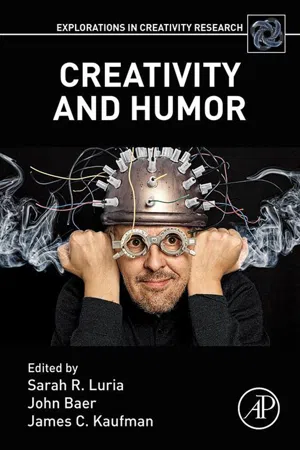
Creativity and Humor provides an overview of the intersection of how humor influences creativity and how creativity can affect humor. The book's chapters speak to the wide reach of creativity and humor with different topics, such as play, culture, work, education, therapy, and social justice covered. As creativity and humor are individual traits and abilities that have each been studied in psychology, this book presents the latest information.
- Explains how, and why, humor enhances creativity
- Explores the thought processes behind producing humor and creativity
- Examines how childhood play is the basis for both creativity and humor
- Discusses cross-cultural differences in humor and creativity
- Reviews creativity and humor in politics, teaching and relationships
Information
Chapter 1
Humor Production and Creativity
Overview and Recommendations
Willibald Ruch and Sonja Heintz, Department of Psychology, University of Zurich, Zürich, Switzerland
Abstract
This chapter focuses on humor production as the humor aspect that is proposed to be closest to creativity. First, approaches to humor production in the literature are reviewed and an overview of relevant elements is presented. Second, measures of humor production are reviewed (in self-reports, other-reports, and performance tests), and recommendations for future developments are given. The Cartoon Punch Line Production Test (CPPT; Köhler & Ruch, 1993) for measuring both the quantity and quality of humor creation is discussed in more detail, along with some yet unpublished research. Finally, the overlap between humor production and creativity is presented both from a theoretical and empirical point of view, and future research directions are suggested.
Keywords
Humor; creativity; humor production; assessment; CPPT; divergent thinking; habit; ability
Acknowledgments
We would like to thank Richard Bruntsch, Liliane Müller, René T. Proyer, Gabriella Sebök, Alicia Shannon, Mira Stüssi, and Lisa Wagner for their help in the studies with the CPPT and the CPPT-K. We would also like to thank Andrés Mendiburo-Seguel for his comments on earlier versions of this chapter.
Humor has been studied in various disciplines for more than 100 years. Humor can be defined as an umbrella term incorporating all kinds of comical phenomena, including different contents of humor (such as word plays, sexual, or aggressive contents), different kinds of humorous materials (like jokes, cartoons, memes, or videos), and different humor domains (i.e., comprehension, appreciation, and production). Delineating the three humor domains in more detail, humor comprehension deals with how humor is understood: Do people understand the punch line(s) of a joke? How and how quick do they understand them? Humor appreciation focuses on the liking and disliking of humorous materials. Finally, humor production entails either newly creating humor (humor creation) or reproducing humor (humor reproduction; by telling rehearsed or well-known jokes or sayings). This chapter focuses on humor production as it is the humor domain theoretically and empirically most closely related to creativity (see Galloway, 1994; McGhee, 1980; O’Quin & Derks, 1997).
Humor Production
Humor production plays a central role in our everyday lives. For example, humor is often shown in social situations and can help to brighten the mood, to reduce tensions, and to create social bonds (Janes & Olson, 2015; Martineau, 1972). Despite its relevance, humor production has been rarely studied, especially in comparison to the sense of humor or humor appreciation. Additionally, most studies used different terminologies and measurements of humor production, impairing comparisons among the findings. Thus, we discuss approaches and the terminology of humor production to delineate how the construct has been conceptualized in the literature, and then present one model of humor production. Where available, results of empirical studies are taken into account. Given the many gaps still existing in the area, however, some exploratory ideas are presented, and open questions and important venues for future research are highlighted throughout the section.
Approaches and Terminology of Humor Production
Humor production has been termed differently throughout the literature, and sometimes the identical term was used, albeit with different (more narrow or wide) meanings. Thus, we first introduce the terminology of humor production employed in this chapter. We use humor production as the overarching term, which comprises humor creation and humor reproduction. Both aspects can be subdivided into quality (i.e., how well humor is created or reproduced) and quantity (i.e., how often humor is created or reproduced), as well as into typical behavior (habit) and maximal behavior (ability). Table 1.1 shows the resulting eight aspects of humor production.
Table 1.1
| Creation | Reproduction | |||
|---|---|---|---|---|
| Behavior | Quality | Quantity | Quality | Quantity |
| Typical (habit) | Typical humor creation quality (how well humor is typically created) | Typical humor creation quantity (how much humor is typically created) | Typical humor reproduction quality (how well humor is typically reproduced) | Typical humor reproduction quantity (how much humor is typically reproduced) |
| Maximal (ability) | Maximal humor creation quality (how well humor can be created) | Maximal humor creation quantity (how much humor can be created) | Maximal humor reproduction quality (how well humor can be reproduced) | Maximal humor reproduction quantity (how much humor can be reproduced) |

It should be noted that some of the eight aspects of humor production depicted in Table 1.1 are not meant to be distinct categories, but rather dimensions (i.e., there is a continuum between the typical and maximal behavior of humor production and from creation to reproduction). Also each of these aspects contains several stages, as outlined in section “Models of Humor Production.” Table 1.2 presents an overview of the terms used in central articles and chapters on humor production, as well as the terminology employed in this chapter.
Table 1.2
| Reference | Term(s) employed | Definition/meaning | Terms along Table 1.1 |
|---|---|---|---|
| Amir and Biederman (2016) | Humor creativity/generation/creation | Cognitive act of creating a joke | Humor creation |
| Babad (1974) | Generative humor | Active generation of humor | Humor production |
| Babad (1974) | Humor production | Invention of funny instances | Humor creation |
| Babad (1974) | Humor reproduction | Tell... |
Table of contents
- Cover image
- Title page
- Table of Contents
- Copyright
- Dedications
- List of Contributors
- Preface
- Acknowledgments
- Chapter 1. Humor Production and Creativity: Overview and Recommendations
- Chapter 2. Playfulness and Creativity: A Selective Review
- Chapter 3. Developing Creativity and Humor: The Role of the Playful Mind
- Chapter 4. Why Humor Enhances Creativity From Theoretical Explanations to an Empirical Humor Training Program: Effective “Ha-Ha” Helps People to “A-Ha”
- Chapter 5. Thinking Fast and Slow and Creatively in the Experience of Humor
- Chapter 6. Body Joking: The Aesthetics and Creativity of Organizational Humor
- Chapter 7. The Role of Humor in Teaching for Creativity
- Chapter 8. Applied Humor in Creative Product Design
- Chapter 9. Creativity and Humor Across Cultures: Where Aha Meets Haha
- Chapter 10. Evolutionary Explanations for Humor and Creativity
- Chapter 11. A Comedy Professor, Design Thinker, and Theatre Producer Walk Into a Bar
- Index
Trusted by 375,005 students
Access to over 1.5 million titles for a fair monthly price.
Study more efficiently using our study tools.
Frequently asked questions
Yes, you can cancel anytime from the Subscription tab in your account settings on the Perlego website. Your subscription will stay active until the end of your current billing period. Learn how to cancel your subscription
No, books cannot be downloaded as external files, such as PDFs, for use outside of Perlego. However, you can download books within the Perlego app for offline reading on mobile or tablet. Learn how to download books offline
Perlego offers two plans: Essential and Complete
- Essential is ideal for learners and professionals who enjoy exploring a wide range of subjects. Access the Essential Library with 800,000+ trusted titles and best-sellers across business, personal growth, and the humanities. Includes unlimited reading time and Standard Read Aloud voice.
- Complete: Perfect for advanced learners and researchers needing full, unrestricted access. Unlock 1.5M+ books across hundreds of subjects, including academic and specialized titles. The Complete Plan also includes advanced features like Premium Read Aloud and Research Assistant.
We are an online textbook subscription service, where you can get access to an entire online library for less than the price of a single book per month. With over 1.5 million books across 990+ topics, we’ve got you covered! Learn about our mission
Look out for the read-aloud symbol on your next book to see if you can listen to it. The read-aloud tool reads text aloud for you, highlighting the text as it is being read. You can pause it, speed it up and slow it down. Learn more about Read Aloud
Yes! You can use the Perlego app on both iOS and Android devices to read anytime, anywhere — even offline. Perfect for commutes or when you’re on the go.
Please note we cannot support devices running on iOS 13 and Android 7 or earlier. Learn more about using the app
Please note we cannot support devices running on iOS 13 and Android 7 or earlier. Learn more about using the app
Yes, you can access Creativity and Humor by in PDF and/or ePUB format, as well as other popular books in Psychology & Applied Psychology. We have over 1.5 million books available in our catalogue for you to explore.