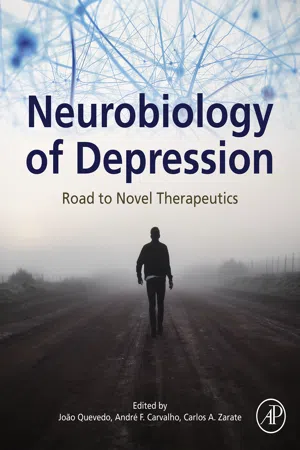
eBook - ePub
Neurobiology of Depression
Road to Novel Therapeutics
- 471 pages
- English
- ePUB (mobile friendly)
- Available on iOS & Android
eBook - ePub
Neurobiology of Depression
Road to Novel Therapeutics
About this book
Neurobiology of Depression: Road to Novel Therapeutics synthesizes the basic neurobiology of major depressive disorder with discussions on the most recent advances in research, including the interacting pathways implicated in the pathophysiology of MDD, omics technologies, genetic approaches, and the development of novel optogenetic approaches that are changing research perspectives and revolutionizing research into depression. These basic foundational understandings on the neurobiology underlying the disorder, along with a comprehensive summary of the most recent advances in research are combined in this book to aid advanced students and researchers in their understanding of MDD.
Depression is one of the most common mental-health disorders caused by a variety of genetic, biological, environmental and psychological factors. Major depressive disorder (MDD) is typically treated with first-line antidepressant agents that primarily target monoamine neurotransmission. However, only approximately one-third of patients with MDD achieve remission following a trial with such an antidepressant. Furthermore, MDD is a heterogeneous phenotype, and new frameworks, such as the NIMH Research Domain Criteria (RDoC) may provide a more accurate, biologically based comprehension of the symptomatic heterogeneity of this devastating illness.
- Aids readers in understanding major depressive disorder in the context of NIMH Research Domain Criteria (RDoC) recommendations
- Covers a range of existing and potential pharmacologic and non-pharmacologic treatment options, from lifestyle adjustments, to antidepressants and novel therapeutics
- Synthesizes discussions on the cellular and molecular mechanisms underlying symptoms with the clinical aspects of depression
Information
Chapter 1
The Classification of Depression: Embracing Phenotypic Heterogeneity in the Era of the RDoC
Elizabeth D. Ballard; Ioline D. Henter; Carlos A. Zarate, Jr. Experimental Therapeutics and Pathophysiology Branch, Intramural Research Program, National Institute of Mental Health, National Institutes of Health, Bethesda, MD, United States
Abstract
The development of new, effective treatments for depression has been hampered by an incomplete understanding of its neurobiology. Research efforts such as the NIMH Research Domain Criteria (RDoC) have advocated for the delineation of specific unidimensional constructs that can be studied translationally across genes, cells, circuits, and behavioral measures using a dimensional—rather than a categorical—approach. This chapter details a number of methods that can be used to parse the heterogeneity of depression. The chapter first describes methods that use clinical symptomatology to define subgroups of depressed individuals, then delineates the methods that use biological markers to define biotypes of depression. The chapter also discusses an experimental therapeutics approach using rapid-acting interventions in which clinical trials are used to define potential bio-signatures of antidepressant response as well as biotypes of patients most likely to respond to treatment.
Keywords
Depression; Treatment-resistant depression; Suicide; Ketamine; Neurobiology; Factor analysis
Acknowledgments
The authors thank the 7SE research unit and staff for their support.
Worldwide, more than 10% of individuals suffer from mood disorders every year. Indeed, depression is the leading cause of disability worldwide, ranking ahead of ischemic heart disease, cerebrovascular disease, cancers, and infectious diseases [1]. Moreover, depression is associated with increased risk of death at any age, independent of suicide, smoking, or other risk factors [2]. Individuals with major depression sometimes describe an emotional pain much worse than any physical pain that they have ever experienced.
Although a variety of treatments—including more than a dozen conventional antidepressants, transcranial magnetic stimulation (TMS), and psychotherapies—exist for depression, a substantial majority of individuals with depression do not respond to these [3]. For instance, it is estimated that approximately one third of patients will not respond to four courses of currently available antidepressants, and evidence suggests that, even after two trials of close to six months of treatment, only 50% of patients achieve remission [4]. Furthermore, considerable lag exists in the onset of full improvement, even for those who do respond to currently available treatments, which often take 10–14 weeks to exert their full antidepressant effects [4]; one notable exception is electroconvulsive therapy (ECT), to which most patients respond within one week [5]. A significant number of all patients with depression exhibit resistance to all available standard treatments, and these are often characterized as having treatment-resistant depression (TRD). The lack of rapid-acting, safe, and effective therapeutics for TRD is a major public health concern. Inadequately treated depression, and TRD in particular, are associated with unemployment, poor quality of life, increased medical and psychiatric comorbidity, higher healthcare use, risk of suicide, disability, and premature death [1,3]. Moreover, the rate of suicide, which is often associated with mood disorders, has increased over the past decade, especially for middle-aged adults [6]; if current trends persist, even the best-case scenario predicts that 54,000 Americans will kill themselves by 2025 [7].
In general, incomplete knowledge of the neurobiological mechanisms underlying depression and suicide has impeded progress in improving clinical outcomes. Challenges that have prevented researchers from identifying more effective treatments include the heterogeneity of depressive symptoms, the high rates of physical and mental comorbidity that accompany a diagnosis of depression, and the lack of evidence for valid biobehavioral subtypes or biomarkers of response [8–12]. Broadly speaking, mood disorders manifest as heterogeneous problems of mood, behavior, energy, sleep, circadian rhythms, and activity levels. The Diagnostic and Statistical Manual (DSM) is one method of classifying psychiatric illnesses. To meet DSM-5 criteria for a major depressive episode, an individual must meet five of nine core symptoms. In fact, under DSM-5 criteria, an estimated 227 combinations of symptoms will lead to the diagnosis of a depressive episode. Moreover, a number of other disorders are often comorbid with major depressive disorder (MDD), which makes any attempt to decipher the precise etiology and pathophysiology of depression even more complicated. For example, PTSD is often comorbid with MDD; one recent report suggested that, under the DSM-5, there were more than 600,000 ways to diagnose PTSD, an eightfold expansion from DSM-IV [13]. As a result, a wide range of individuals who meet criteria for depression may, nevertheless, overlap on only a limited number of symptoms [14,15]. This heterogeneity is manifested not only in psychiatric and behavioral signs and symptoms, but also in the accompanying systemic manifestations seen in individuals with depression. Individuals with depression may present with increased rates of a variety of comorbid medical conditions, including migraines and thyroid disease, or they may have alterations of their HPA axis, cortisol levels, innate immune system, cardiovascular system, GI system, bone metabolism, and brain and circuit homeostasis. As with psychiatric symptoms, patients with depression may manifest varied disturbances in the systems affected, further challenging our ability to obtain biologically enriched subgroups in order to develop better and improved treatments.
Furthermore, while the DSM is a useful tool for diagnosing individuals and communicating with clinicians, family members, and patients, it does not determine which treatments should be prescribed for a particular individual, a term loosely defined as “personalized medicine” [16]. As noted above, there are considerable limits with regard to the efficacy of currently available antidepressants. In addition to low remission rates and lag of onset of antidepressant and antisuicidal effects, other limitations include the questionable efficacy of these medications for bipolar depression and their limited ability to improve comorbid systemic manifestations associated with depression. Resources for suicidal individuals are even more sparse; presently, only one medication—clozapine—has been FDA-approved for suicidal behavior, and it is indicated for individuals with schizophrenia diagnoses [17]. Furthermore, data suggest that suicide risk peaks in the first nine days after initial antidepressant administration, making the therapeutic use of antidepressants challenging for those at risk for suicide [18]. While there is a longstanding history of using ECT, lithium, and psychotherapies such as Dialectical or Cognitive Behavioral Therapy (DBT or CBT) to reduce suicide risk, improvement only occurs over the course of months (with the exception of ECT); thus, these therapies are not indicated for acute suicidal ideation [19–21].
In this context, next-generation treatments for depression will need to exert rapid-onset antidepressant and antisuicidal ideation effects within hours, as well as address the altered biological indices that accompany depression. In addition to relieving the pain and suffering associated with depression and suicide risk, such novel therapeutics would also have enormous public health effects in terms of their ability to reduce suicide risk as well as the amount of time that individuals with depression are impaired in terms of their work, home, and school functioning. However, developing the next generation of therapeutics whose onset of antidepressant action occurs within a few hours will require us to identify the precise cellular and molecular targets implicated in depression or that of highly robust, rapid-acting antidepressant and antisuicidal ideation agents, such as the glutamatergic modulator ketamine.
Toward this end, attempting to decipher the etiology and pathophysiology of depression is quite challenging. Despite considerable efforts, current research has not translated into improved therapeutics for psychiatric illnesses. As noted above, one of the major contributing factors to this problem is that existing criteria for diagnosing psychiatric illnesses—most notably the DSM—are largely symptom-based and do not overlap with pathophysiology. In 2010, the NIMH proposed the Research Domain Criteria (RDoC), which combine a new classification framework for research into mental disorders with a strategy intended to enhance our ability to learn more about the etiology and pathophysiology of depression [22]. Broadly, the RDoC proposes to deconstruct our current heterog...
Table of contents
- Cover image
- Title page
- Table of Contents
- Copyright
- Contributors
- Chapter 1: The Classification of Depression: Embracing Phenotypic Heterogeneity in the Era of the RDoC
- Chapter 2: The Role of Environmental and Psychosocial Factors in Depression
- Chapter 3: Gene-Environment Interactions and Epigenetic Mechanisms in Depression
- Chapter 4: Pathophysiology of Cognitive Impairment in Depression
- Chapter 5: Anhedonia in Depression: Mechanisms, Assessment, and Therapeutics
- Chapter 6: The Neurotrophic Hypothesis of Depression Revisited: New Insights and Therapeutic Implications
- Chapter 7: The Monoamine Hypothesis of Depression Revisited: Could It Mechanistically Novel Antidepressant Strategies?
- Chapter 8: Neuro-Immune Interactions in Depression: Mechanisms and Translational Implications
- Chapter 9: The Hypothalamic-Pituitary-Adrenal Axis in Depression: Molecular Regulation, Pathophysiological Role, and Translational Implications
- Chapter 10: Intracellular Signaling Pathways Implicated in the Pathophysiology of Depression
- Chapter 11: The Long-Lasting Neurobiological Scars of Early-Life Stress: Implications for the Neurobiology of Depression
- Chapter 12: Molecular, Cellular, and Circuit Basis of Depression Susceptibility and Resilience
- Chapter 13: More Than a Gut Feeling: Emerging Roles of the Microbiome in the Pathophysiology and Treatment of Depression
- Chapter 14: Optogenetics: Illuminating the Neural Circuits of Depression
- Chapter 15: Mitochondrial Dysfunction and Oxidative Stress: Relevance to the Pathophysiology and Treatment of Depression
- Chapter 16: Obesity and Depression: Shared Pathophysiology and Translational Implications
- Chapter 17: Depression and Cardiovascular Risk: Epidemiology, Mechanisms, and Implications
- Chapter 18: Poststroke Depression: Pathophysiology and Treatment Strategies
- Chapter 19: Is Depression Associated With Accelerated Aging? Mechanisms and Implications
- Chapter 20: Relationship Between Complicated Grief and Depression: Relevance, Etiological Mechanisms, and Implications
- Chapter 21: A Neural Circuit-Based Model for Depression Anchored in a Synthesis of Insights From Functional Neuroimaging
- Chapter 22: Could Depression be Preventable? Evidence and Perspectives
- Chapter 23: Treating Depression in the Era of Precision Medicine: Challenges and Perspectives
- Chapter 24: Neurobiological Aspects of Functional Recovery in Major Depressive Disorder
- Chapter 25: Diet and Depression: From Epidemiology to Novel Therapeutics
- Chapter 26: Physical Activity and Exercise as a Treatment of Depression: Evidence and Neurobiological Mechanism
- Chapter 27: Antidepressants and Suicidality—Controversies and Possible Mechanisms
- Chapter 28: Altered GABAergic Function, Cortical Microcircuitry, and Information Processing in Depression
- Chapter 29: Biomarker-Based Treatment Selection: A Precision Medicine Approach for Depression
- Chapter 30: Implications of Pharmacogenomics in Depression Pathophysiology and Treatment
- Chapter 31: Novel Neuromodulatory Approaches for Depression: Neurobiological Mechanisms
- Chapter 32: Electroconvulsive Therapy for Depression: Neurobiological Mechanisms
- Chapter 33: Deep Brain Stimulation: Mechanisms Underpinning Antidepressant Effects
- Chapter 34: Novel Therapeutic Targets for Major Depressive Disorder
- Chapter 35: The Search for Rapid Acting Antidepressants: Research Synthesis and Perspectives
- Chapter 36: Pediatric Depression
- Chapter 37: Depression in Women
- Chapter 38: Advances in the Neurobiology of Late-Life Depression
- Index
Trusted by 375,005 students
Access to over 1.5 million titles for a fair monthly price.
Study more efficiently using our study tools.
Frequently asked questions
Yes, you can cancel anytime from the Subscription tab in your account settings on the Perlego website. Your subscription will stay active until the end of your current billing period. Learn how to cancel your subscription
No, books cannot be downloaded as external files, such as PDFs, for use outside of Perlego. However, you can download books within the Perlego app for offline reading on mobile or tablet. Learn how to download books offline
Perlego offers two plans: Essential and Complete
- Essential is ideal for learners and professionals who enjoy exploring a wide range of subjects. Access the Essential Library with 800,000+ trusted titles and best-sellers across business, personal growth, and the humanities. Includes unlimited reading time and Standard Read Aloud voice.
- Complete: Perfect for advanced learners and researchers needing full, unrestricted access. Unlock 1.5M+ books across hundreds of subjects, including academic and specialized titles. The Complete Plan also includes advanced features like Premium Read Aloud and Research Assistant.
We are an online textbook subscription service, where you can get access to an entire online library for less than the price of a single book per month. With over 1.5 million books across 990+ topics, we’ve got you covered! Learn about our mission
Look out for the read-aloud symbol on your next book to see if you can listen to it. The read-aloud tool reads text aloud for you, highlighting the text as it is being read. You can pause it, speed it up and slow it down. Learn more about Read Aloud
Yes! You can use the Perlego app on both iOS and Android devices to read anytime, anywhere — even offline. Perfect for commutes or when you’re on the go.
Please note we cannot support devices running on iOS 13 and Android 7 or earlier. Learn more about using the app
Please note we cannot support devices running on iOS 13 and Android 7 or earlier. Learn more about using the app
Yes, you can access Neurobiology of Depression by Joao Quevedo,Andre Ferrer Carvalho,Carlos A. Zarate,Joao L. de Quevedo,Joao Luciano de Quevedo,João L. de Quevedo in PDF and/or ePUB format, as well as other popular books in Biological Sciences & Cognitive Neuroscience & Neuropsychology. We have over 1.5 million books available in our catalogue for you to explore.