- 302 pages
- English
- ePUB (mobile friendly)
- Available on iOS & Android
eBook - ePub
About this book
Luminescence Thermometry: Methods, Materials, and Applications presents the state-of-the art applications of luminescence thermometry, giving a detailed explanation of luminescence spectroscopic schemes for the read-out of temperature, while also describing the diverse materials that are capable of sensing temperature via luminescence. Chapters cover the fundamentals of temperature, traditional thermometers and their figures of merit, a concise description of optical thermometry methods, luminescence and instrumentation, and an explanation of the ways in which increases in temperature quench luminescence.
Additional sections focus on materials utilized for luminescence thermometry and the broad range of applications for luminescence thermometry, including temperature measurement at the nanoscale and the application of multifunctional luminescent materials.
- Provides an overview of luminescence thermometry applications, including high-temperature, biomedical, nanoscale and multifunctional
- Delves into luminescence thermometry by materials group, including Rare-earth and transition Metal Ion Doped, Semiconductors, Quantum Dots and Organic materials
- Gives a concise introduction of the latest methods of temperature measurement, including luminescence spectroscopic schemes and methods of analysis
Information
Chapter 1
Introduction to Measurements of Temperature
Abstract
This introductory chapter of the book aims to familiarize readers with the importance of temperature and measurements of temperature. It starts with several examples which illustrate why we measure temperature, and explains that temperature sensors account for about 80% of all the sensors worldwide. It then goes on to give basic information on the temperature sensor market, including data on present market value and estimated growth, key market drivers, and key products. Finally, a brief history of thermometry is presented, mainly focusing on the development of the first instruments and temperature scales.
Keywords
temperature
thermometry
thermometer
temperature scales
temperature sensor market
history of science
history of thermometry
1.1. Why we measure temperature?
Temperature is important because it is something we feel and because it has an effect on the smallest parts of our daily life, from how to adjust our housing and clothing, to what we eat for supper. We recognize a fever caused by an infection, for example, if someone has a body temperature over 38°C. In almost all fields of science, such as physics, chemistry, and biology, temperature is recognized as one of the basic variables. Aerodynamics, thermodynamics, heat transfer, and atmospheric sciences would be completely lost without temperature measurements.
For global climate patterns temperature is a major determining factor; a tiny change in average temperature may exert formidable effects on the environment worldwide. Plants would have lower yields or wilt when overall temperature changes by just few degrees. An increase in temperature can allow invasive species to take hold, and crop diseases to appear. Water temperature has a crucial influence on the biological activity and growth of aquatic organisms, since most of them are cold-blooded and are not able to internally regulate their body temperature. If water falls below, or rises above, certain temperatures, the number of individual organisms decreases until finally they disappear. Temperature is also important because of its influence on water chemistry, particularly on oxygen content.
1.2. The market share of temperature sensors and thermometers
Temperature is by far the most commonly measured physical quantity; sensors of temperature account for 80% of all sensors worldwide comprising a market of USD5.13 billion in 2016. Temperature sensors are used across a broad spectrum of human activities, such as in medicine, home appliances, meteorology, agriculture, industry, and military contexts.
At present, Europe represents the largest regional temperature sensor market worldwide, while Asia-Pacific ranks as the fastest growing market. It is expected that the market will grow at a compound annual growth rate (CAGR) of 4.8% between 2016 and 2022, to reach USD6.8 billion by 2022. Among the market’s different segments, it is estimated that the oil and gas segment alone will account about 37% of the total market revenue by 2020. The key market drivers are: (1) legislation of stringent environmental and safety standards; (2) the increasing demand for temperature sensors among industrial end-users such as the food and beverage industry, oil and gas industry, paper industry, plastics industry, metal industry, and glass industry, among others; (3) the growing use of multifunctional temperature sensors in smartphones; (4) the increasing demand for miniature and smart temperature sensors in the consumer electronics industry; (5) the growing demand for noncontact temperature sensors; and (6) implementation of automated process monitoring and control in the industrial sector.
Among different types of temperature sensors, the demand for thermistors has been, and will remain to be, higher than for other types. Other key products are thermocouples, resistance temperature detectors, bimetallic temperature sensors, and fiber optic sensors. A significant growth in demand is expected in the near future for contactless temperature sensors, which are not only easy to use, but are less complex and more accurate than contact temperature sensors.
1.3. Historical background
Philo of Byzantium (born c. 280 BC, died c. 220 BC), also known as Philo Mechanicus, an ancient Greek engineer, was probably the first human performing comprehensive experiments with heating and cooling of objects. He invented a device, a predecessor of a middle age thermoscope [1], Fig. 1.1, which consisted of a tube exiting from a hollow sphere that was extended over a jug filled with water. Upon warming the globe with a candle, or when it was exposed to the sun, the air inside the globe expanded and pushed its way through the tube into the jar containing water, producing bubbles of escaping air. Upon cooling, the air contracted and water was drawn back into the tube.
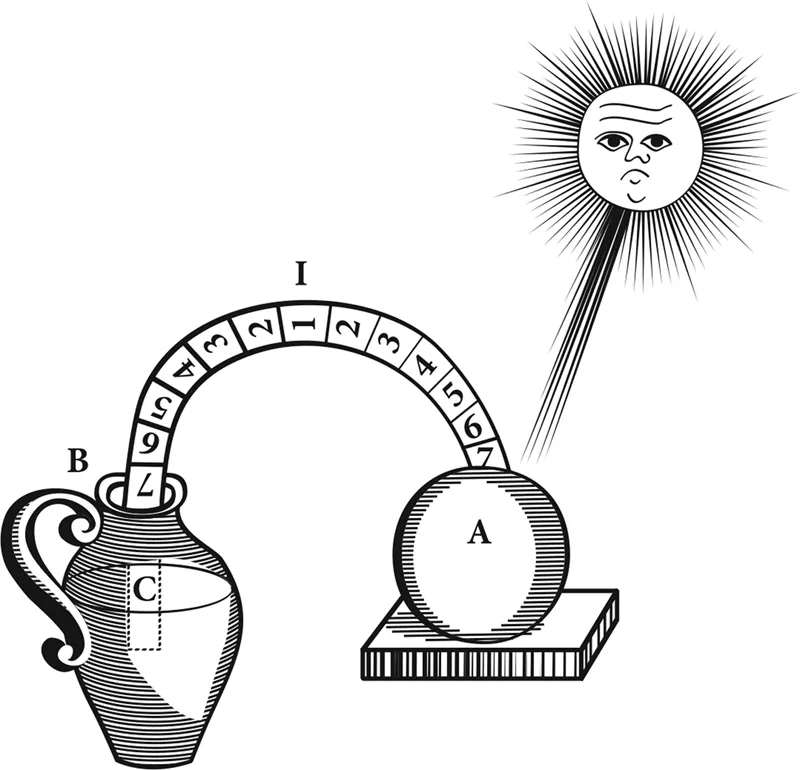
Figure 1.1 Philo’s thermometers as depicted by Robert Fludd in 1638.
The first “degrees” characterizing a heated body were mentioned by Hero of Alexandria (born c. AD 10, died c. AD 70, shown on the left of Fig. 1.2), Greek engineer and mathematician, the greatest experimenta...
Table of contents
- Cover
- Title page
- Table of Contents
- Copyright
- Preface
- Chapter 1: Introduction to Measurements of Temperature
- Chapter 2: Temperature and Ways of Measuring It
- Chapter 3: Luminescence: The Basics, Methods, and Instrumentation
- Chapter 4: Schemes for Temperature Read-Out From Luminescence
- Chapter 5: Methods of Analysis for Luminescence Thermometry Measurements
- Chapter 6: Lanthanide and Transition Metal Ion Doped Materials for Luminescence Temperature Sensing
- Chapter 7: Luminescence Temperature Sensing Using Semiconductor Quantum Dots
- Chapter 8: Luminescence Temperature Sensing Using Organic Materials
- Chapter 9: Applications of Luminescence Thermometry in Engineering
- Chapter 10: Biomedical Applications of Luminescence Thermometry
- Chapter 11: Temperature Measurements at the Nanoscale
- Chapter 12: Achieving Multifunctionality by Combining Thermometry With Other Luminescence Applications
- Index
Trusted by 375,005 students
Access to over 1.5 million titles for a fair monthly price.
Study more efficiently using our study tools.
Frequently asked questions
Yes, you can cancel anytime from the Subscription tab in your account settings on the Perlego website. Your subscription will stay active until the end of your current billing period. Learn how to cancel your subscription
No, books cannot be downloaded as external files, such as PDFs, for use outside of Perlego. However, you can download books within the Perlego app for offline reading on mobile or tablet. Learn how to download books offline
Perlego offers two plans: Essential and Complete
- Essential is ideal for learners and professionals who enjoy exploring a wide range of subjects. Access the Essential Library with 800,000+ trusted titles and best-sellers across business, personal growth, and the humanities. Includes unlimited reading time and Standard Read Aloud voice.
- Complete: Perfect for advanced learners and researchers needing full, unrestricted access. Unlock 1.5M+ books across hundreds of subjects, including academic and specialized titles. The Complete Plan also includes advanced features like Premium Read Aloud and Research Assistant.
We are an online textbook subscription service, where you can get access to an entire online library for less than the price of a single book per month. With over 1.5 million books across 990+ topics, we’ve got you covered! Learn about our mission
Look out for the read-aloud symbol on your next book to see if you can listen to it. The read-aloud tool reads text aloud for you, highlighting the text as it is being read. You can pause it, speed it up and slow it down. Learn more about Read Aloud
Yes! You can use the Perlego app on both iOS and Android devices to read anytime, anywhere — even offline. Perfect for commutes or when you’re on the go.
Please note we cannot support devices running on iOS 13 and Android 7 or earlier. Learn more about using the app
Please note we cannot support devices running on iOS 13 and Android 7 or earlier. Learn more about using the app
Yes, you can access Luminescence Thermometry by Miroslav Dramićanin in PDF and/or ePUB format, as well as other popular books in Technology & Engineering & Materials Science. We have over 1.5 million books available in our catalogue for you to explore.