- 619 pages
- English
- ePUB (mobile friendly)
- Available on iOS & Android
eBook - ePub
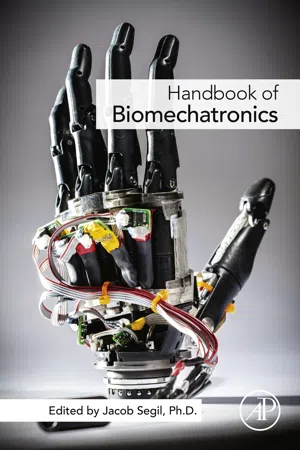
Handbook of Biomechatronics
About this book
Handbook of Biomechatronics provides an introduction to biomechatronic design as well as in-depth explanations of some of the most exciting and ground-breaking biomechatronic devices in the world today. Edited by Dr. Jacob Segil and written by a team of biomechatronics experts, the work begins with broad topics concerning biomechatronic design and components, followed by more detailed discussions of specific biomechatronic devices spanning many disciplines.
This book is structured into three main parts: biomechatronic design, biomechatronic components, and biomechatronic devices. The biomechatronic design chapter discusses the history of biomechatronics, conceptual design theory, biomechatronic design methods, and design tools. The next section discusses the technologies involved in the following components: sensors, actuators, and control systems. The biomechatronic devices chapters contains distinct examples of biomechatronic devices spanning visual prostheses to brain-machine interfaces. Each chapter presents the development of these biomechatronic devices followed by an in-depth discussion of the current state of the art
- The only book that covers biomechatronic design, components, and devices in one comprehensive text
- Accessible for readers in multiple areas of study, such as bioengineering, computer science, electrical engineering, mechanical engineering, and chemical engineering
- Includes the most recent and groundbreaking advances and work in the biomechatronics field through industry and academic contributors
Information
Part One
Biomechatronic Design and Components
Chapter One
Introduction
Ahmed R. Arshi Biomedical Engineering, Amirkabir University of Technology, Tehran, Iran
Abstract
Biomechatronics is a fascinating and sophisticated engineering and scientific field of study. It is concerned with the fusion of mechatronics and biological systems. The subject has an enormous potential for progress through biomimetics. The true elevation of biomechatronics is, however, in collaboration with neurosciences and neuromechanics toward performance enhancement, injury prevention, and rehabilitation of human being. Fusion of mechatronics and human body is a unique platform which broadly addresses four areas such as manipulation, locomotion, sensory interactions, and processing and control. Mathematical modeling in this multidisciplinary energetic engineering environment is a highly valuable segment of both analysis and synthesis. The biomechatronic school of thought requires an energy domain-independent approach to modeling and design of complex systems capable of interfacing with human body. Bond graph technology is presented as an exceptionally versatile modeling tool, with the capacity to include highly complex nonlinearities associated with soft and hard tissue biomechanics and the existing variabilities. Causal word graphs could provide the most rudimentary representation of synthesis. Here the ideal conceptual design, or ICD, could be considered as the criteria for any evaluations. The ICD can then be introduced to potential fields of activity or disciplines. A methodological progress plan is suggested in this chapter.
Keywords
Biomechatronics; Bond graph technology; Neuromechanics; Human physiology; Design and synthesis
Mechatronics is a fascinating field of study. It challenges the mind to think in multiple disciplines. No other engineering concept is so adept in encouraging instantaneous jumps from one field of engineering to another. An experienced mechatronic designer is in reality composing a piece of music for an orchestra of engineers. As individual musicians have a fluent command over their instrument, the mechatronic specialist is the script writer and produces the blue print for the route. Learning to play in, work with, or even lead a team of engineers is therefore an inseparable part of being a mechatronics specialist.
Mechatronics as the name implies brings mechanical concepts, electronic solutions, control strategies, and software technologies together under the same roof. A growing volume of literature provides ample supply of details addressing issues on each one of these fields. The subject aims at providing a wide range of technical competencies necessary to face multidisciplinary projects. Mechatronics mode of thought requires a systematic approach and the key role is perhaps played by experience in integration of diverse subsystems. A mechatronic specialist considers integration as an important part of design stage. Interaction with other systems is where the design or modeling teams define the outskirts of integration. In industrial or domestic environments, mechatronic systems assist interactions through action and response using actuator and control systems by processing information gained from sensory constructs. Such systems rely on feedback in closed circuits and prediction in open control strategies. That is why the nature and the characteristics of the environment with which the system is interacting play a key role.
Biological systems on the other hand, are inherently multiscale and multidisciplinary. Biologically inspired mechatronic or biomimetic systems are always eye-catching items on show at science and engineering exhibitions. The most fascinating technologies are however, those that interact with human body. Human body as a biological system is exceptionally sophisticated and when efforts are made to decipher its functional principles it turns out to be an awe-inspiring engineering system. One that imitating or surpassing its intricate potentials is exceedingly difficult. Today's technological advances are yet to grow to the level of sophistication exhibited by biological and in particular, physiological systems.
Human body as a physiological system is susceptible to deviations from physiological or normal states. Deviations in function better known as pathological states could be observed in individual organs or could even adversely affect the entire system. Changes in physiological states commonly encountered in human body are accompanied by an unending and ever-increasing necessity for identification, categorization, diagnosis, or intervention by engineering and in particular, mechatronic solutions. This amazing multidisciplinary physiological environment is in fact quite suitable for the implementation of mechatronic systems.
The simple but highly effective electrocardiogram or ECG test for example, which is routinely performed in cardiological assessments provides a portrayal of the electro-mechanochemical interactions taking place in the heart. A complete ECG test is a window to electrophysiological performance of all cellular groups in that organ. The device output, in the shape of an ECG signal, could be considered as an indicator of electrophysiological interactions at the cellular level. It is also an indication of the manner by which electrical signals are propagated throughout various cell families leading to contractions throughout the muscular structure and resulting in blood flow output. The traditional engineering approach when facing a uniquely challenging environment of this complexity, requires fundamental metamorphoses by subscribing to a new mode or school of thought.
Biomechatronics is the discipline that aims to integrate mechatronic and biological and in particular the human physiological systems. The potentials offered by hum...
Table of contents
- Cover image
- Title page
- Table of Contents
- Copyright
- Contributors
- Preface
- Part One: Biomechatronic Design and Components
- Part Two: Biomechatronic Devices
- Index
Trusted by 375,005 students
Access to over 1.5 million titles for a fair monthly price.
Study more efficiently using our study tools.
Frequently asked questions
Yes, you can cancel anytime from the Subscription tab in your account settings on the Perlego website. Your subscription will stay active until the end of your current billing period. Learn how to cancel your subscription
No, books cannot be downloaded as external files, such as PDFs, for use outside of Perlego. However, you can download books within the Perlego app for offline reading on mobile or tablet. Learn how to download books offline
Perlego offers two plans: Essential and Complete
- Essential is ideal for learners and professionals who enjoy exploring a wide range of subjects. Access the Essential Library with 800,000+ trusted titles and best-sellers across business, personal growth, and the humanities. Includes unlimited reading time and Standard Read Aloud voice.
- Complete: Perfect for advanced learners and researchers needing full, unrestricted access. Unlock 1.5M+ books across hundreds of subjects, including academic and specialized titles. The Complete Plan also includes advanced features like Premium Read Aloud and Research Assistant.
We are an online textbook subscription service, where you can get access to an entire online library for less than the price of a single book per month. With over 1.5 million books across 990+ topics, we’ve got you covered! Learn about our mission
Look out for the read-aloud symbol on your next book to see if you can listen to it. The read-aloud tool reads text aloud for you, highlighting the text as it is being read. You can pause it, speed it up and slow it down. Learn more about Read Aloud
Yes! You can use the Perlego app on both iOS and Android devices to read anytime, anywhere — even offline. Perfect for commutes or when you’re on the go.
Please note we cannot support devices running on iOS 13 and Android 7 or earlier. Learn more about using the app
Please note we cannot support devices running on iOS 13 and Android 7 or earlier. Learn more about using the app
Yes, you can access Handbook of Biomechatronics by Jacob Segil in PDF and/or ePUB format, as well as other popular books in Technology & Engineering & Biotechnology. We have over 1.5 million books available in our catalogue for you to explore.