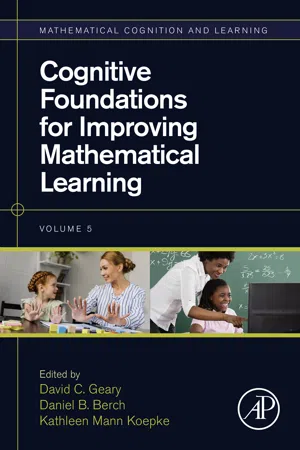
eBook - ePub
Cognitive Foundations for Improving Mathematical Learning
- 377 pages
- English
- ePUB (mobile friendly)
- Available on iOS & Android
eBook - ePub
Cognitive Foundations for Improving Mathematical Learning
About this book
The fifth volume in the Mathematical Cognition and Learning series focuses on informal learning environments and other parental influences on numerical cognitive development and formal instructional interventions for improving mathematics learning and performance. The chapters cover the use of numerical play and games for improving foundational number knowledge as well as school math performance, the link between early math abilities and the approximate number system, and how families can help improve the early development of math skills. The book goes on to examine learning trajectories in early mathematics, the role of mathematical language in acquiring numeracy skills, evidence-based assessments of early math skills, approaches for intensifying early mathematics interventions, the use of analogies in mathematics instruction, schema-based diagrams for teaching ratios and proportions, the role of cognitive processes in treating mathematical learning difficulties, and addresses issues associated with intervention fadeout.
- Identifies the relative influence of school and family on math learning
- Discusses the efficacy of numerical play for improvement in math
- Features learning trajectories in math
- Examines the role of math language in numeracy skills
- Includes assessments of math skills
- Explores the role of cognition in treating math-based learning difficulties
Information
Table of contents
- Cover image
- Title page
- Table of Contents
- Copyright
- Contributors
- Foreword: Cognitive Foundations for Improving Mathematical Learning
- Preface
- Chapter 1: Introduction: Cognitive Foundations for Improving Mathematical Learning
- Chapter 2: The Effects of SES, Grade-Repeating, and IQ in a Game-Based Approximate Math Intervention
- Chapter 3: Role of Play and Games in Building Children's Foundational Numerical Knowledge
- Chapter 4: Understanding the Link Between the Approximate Number System and Math Abilities
- Chapter 5: Mathematical Development in the Early Home Environment
- Chapter 6: From Cognition to Curriculum to Scale
- Chapter 7: Development of Mathematical Language in Preschool and Its Role in Learning Numeracy Skills
- Chapter 8: Early Numeracy Skills Learning and Learning Difficulties—Evidence-based Assessment and Interventions
- Chapter 9: Improving the Mathematical Knowledge of At-Risk Preschool Children: Two Approaches to Intensifying Early Math Intervention
- Chapter 10: The Use of Analogies in Mathematics Instruction: Affordances and Challenges
- Chapter 11: The Role of Visual Representations in Mathematical Word Problems
- Chapter 12: The Role of Cognitive Processes in Treating Mathematics Learning Difficulties
- Chapter 13: Explanations and Implications of Diminishing Intervention Impacts Across Time
- Index
Trusted by 375,005 students
Access to over 1.5 million titles for a fair monthly price.
Study more efficiently using our study tools.
Frequently asked questions
Yes, you can cancel anytime from the Subscription tab in your account settings on the Perlego website. Your subscription will stay active until the end of your current billing period. Learn how to cancel your subscription
No, books cannot be downloaded as external files, such as PDFs, for use outside of Perlego. However, you can download books within the Perlego app for offline reading on mobile or tablet. Learn how to download books offline
Perlego offers two plans: Essential and Complete
- Essential is ideal for learners and professionals who enjoy exploring a wide range of subjects. Access the Essential Library with 800,000+ trusted titles and best-sellers across business, personal growth, and the humanities. Includes unlimited reading time and Standard Read Aloud voice.
- Complete: Perfect for advanced learners and researchers needing full, unrestricted access. Unlock 1.5M+ books across hundreds of subjects, including academic and specialized titles. The Complete Plan also includes advanced features like Premium Read Aloud and Research Assistant.
We are an online textbook subscription service, where you can get access to an entire online library for less than the price of a single book per month. With over 1.5 million books across 990+ topics, we’ve got you covered! Learn about our mission
Look out for the read-aloud symbol on your next book to see if you can listen to it. The read-aloud tool reads text aloud for you, highlighting the text as it is being read. You can pause it, speed it up and slow it down. Learn more about Read Aloud
Yes! You can use the Perlego app on both iOS and Android devices to read anytime, anywhere — even offline. Perfect for commutes or when you’re on the go.
Please note we cannot support devices running on iOS 13 and Android 7 or earlier. Learn more about using the app
Please note we cannot support devices running on iOS 13 and Android 7 or earlier. Learn more about using the app
Yes, you can access Cognitive Foundations for Improving Mathematical Learning by David C. Geary,Daniel B. Berch,Kathleen Mann Koepke in PDF and/or ePUB format, as well as other popular books in Psychology & Applied Psychology. We have over 1.5 million books available in our catalogue for you to explore.