eBook - ePub
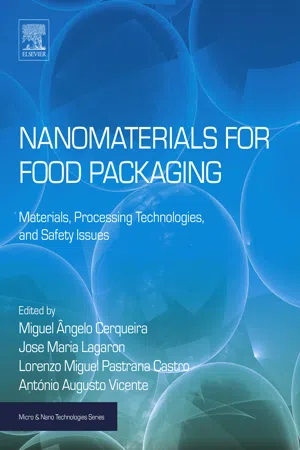
Nanomaterials for Food Packaging
Materials, Processing Technologies, and Safety Issues
- 346 pages
- English
- ePUB (mobile friendly)
- Available on iOS & Android
eBook - ePub
Nanomaterials for Food Packaging
Materials, Processing Technologies, and Safety Issues
About this book
Nanotechnology for Food Packaging: Materials, Processing Technologies, and Safety Issues showcases the latest research in the use of nanotechnology in food packaging, providing an in-depth and interdisciplinary overview of the field. Nanoscale advances in materials science, processing technology and analytical techniques have led to the introduction of new, cheaper and safer packaging techniques. Simultaneously, the increasing use of renewable nanomaterials has made food packaging more sustainable. Chapters provide a comprehensive review on materials used, their structure–function relationship, and new processing technologies for the application and production of nanotechnology-based packaging materials.
In addition, the book discusses the use of functional materials for the development of active, smart and intelligent packaging, possible migration and toxicity of nanomaterials for foods and regulatory aspects, and commercial applications.
- Provides detailed information on the use of nanomaterials and methodologies in food packaging, possible applications and regulatory barriers to commercialization
- Presents an interdisciplinary approach that brings together materials science, bioscience, and the industrial and regulatory aspects of the creation and uses of food packaging
- Helps those undertaking research and development in food packaging gain a cogent understanding on how nanotechnology is leading to the emergence of new packaging technologies
Information
Subtopic
Scienza dei materialiChapter 1
Nanotechnology in Food Packaging: Opportunities and Challenges
Miguel A. Cerqueira⁎; António A. Vicente†; Lorenzo M. Pastrana⁎ ⁎ International Iberian Nanotechnology Laboratory, Braga, Portugal
† Centre of Biological Engineering, University of Minho, Braga, Portugal
† Centre of Biological Engineering, University of Minho, Braga, Portugal
Abstract
The use of nanotechnology in the development of innovative packaging materials has had a remarkable growth in the last years and is expected to have an important impact on the food market in the near future. This growth is a consequence of the increasing knowledge about nanotechnology applications in food packaging, which brought to the academia and industry new tools for the development of new nanotechnology-based products with improved technological functionalities and properties, as well as the corresponding advances in materials science, processing technology, and analytical techniques. Simultaneously, the impact on sustainability and the interest on using renewable resources further contributed to reinforce growth perspectives in this area. This chapter provides an overview of the nanomaterials used in food packaging and new innovative solutions that have been presented by researchers in academia and industry. Also, the social and commercial acceptance of these systems and future perspectives are presented, providing a broad and comprehensive understanding of the use of nanotechnology in food packaging.
Keywords
Nanostructure; Food; Nanoscale; Nanotechnology; Packaging; Shelf life
Acknowledgments
This work was supported by Norte Regional Operational Program 2014-2020 (Norte2020) through the European Regional Development Fund (ERDF) Nanotechnology based functional solutions (NORTE-01-0145-FEDER-000019).
1.1 Nanomaterials in Food Packaging
Nanotechnology has a great potential to generate materials with unique properties and to produce innovative products for a great number of applications [1,2]. In a broad sense, nanotechnology involves the production, manipulation, use, and characterization of materials at nanoscale, being a nanomaterial defined as any material with one or more external dimensions in the size range 1–100 nm [3]. The definition of a nanomaterial will depend on the organization, agency, or committee by which it is presented, and once nanomaterials are provided for different purposes, different definitions can be found [4]. Nanomaterials’ definition is not limited to the nanoscale range but can also be classified based on the number of dimensions. This classification is based on the dimensions of their structural elements and can be zero-dimensional (0D), one-dimensional (1D), two-dimensional (2D), and three-dimensional (3D) nanomaterials. The 0D nanomaterials refer to materials where all dimensions are at nanoscale and include nanocluster materials, nanoparticles, and nanodispersions. 1D nanomaterials can be nanofibers and nanotubular materials with rod or tube length from 100 nm to few micrometers, and where one dimension is outside the nanoscale. 2D nanomaterials exhibit plate-like shape and can be films and coatings with nanometer thickness, and where two of the dimensions are not confined to the nanoscale. 3D nanomaterials are materials in which the 0D, 1D, and 2D structural elements can be present in close contact with each other and form interfaces [5–7].
The interest of using nanomaterials is related to their unique characteristics, only possible due to their nanosize. The materials at nanoscale exhibit physical and chemical properties that are substantially different from their micro- and macroscopic counterparts, showing in several cases great advantages for packaging materials. The impact of the nanoscale in materials and systems is often related with their large surface area-to-volume ratio, leading to enhanced surface area, distinct optical behavior, chemical and kinetic stability, and low density versus high mechanical properties [6].
These advantages over micro- and macroscale lead to a great interest from packaging industry in their use, once they can bring several advantages such as improved mechanical and barrier properties, thermal stability, and better optical properties. Recent studies involving the use of nanotechnology in food packaging showed a great potential to improve packaging materials’ main properties as well as adding new functionalities, such as active (e.g., antimicrobial) and intelligent (controlled release) features. Therefore nanotechnology can be used to overcome some of the main problems of conventional packaging (e.g., low gas barrier and controlled delivery of bioactive compounds). In the case of food packaging, the European Union has a specific regulation for materials and articles intended to come into contact with food, being given specifications to engineered nanomaterials [8].
The use of nanotechnology in packaging has been explored in the last years showing a great number of possible commercial applications. Recently, a market analysis showed that the use of nanotechnology in packaging will increase in the next years in applications such as active, intelligent, and smart packaging and was foreseen that intelligent and smart packaging will grow at the highest Compound Annual Growth Rate (CAGR) of 12.9% from 2016 to 2024 in terms of value [9].
Polymers are the main materials used in food packaging. Properties of these materials can be improved by incorporating other compounds in the polymer matrix. The use of nanomaterials in polymer science was first presented by Okada et al. in 1988, where they showed that the presence of a silicate in a polymer matrix of polyamide lead to the formation of a nanocomposite material with high mechanical strength and excellent high-temperature characteristics [10]. In 1993 the use of nanomaterials in food packaging was presented by the company AlliedSignal (that joined Honeywell in 1999). They showed the possibility of obtaining extruded films and film laminates from a polymer nanocomposite formed by a melted polymer with an exfoliated layered material derivatized with reactive organo silanes [11]. The possibility of using metal ions (e.g., silver) at nanoscale in a resin to produce packaging materials with antibacterial properties was presented in 1997 by Mawatari, Hamazaki [11]. Later on, Bayer AG patented a thermoplastic molding material containing polyamide, a nanosized filler and elastomer useful in the preparation of mono- or multilayer films or hollow bodies, for packaging foodstuffs, such as meat sausages, cheese, and drinks [12]. Since then, several commercial products using polyamide with nanoclays appeared in the market. Some examples are Imperm from Nanocor [13] and Nanoblend from Polyone [14] that are available for several applications, such as food packaging. Also silver nanoparticles are presented in several plastic food containers, and companies such as Kinetic, Always Fresh, and FresherLonger are presenting packaging materials where the use of antimicrobial silver nanoparticles allows the extension of food shelf life [15].
The incorporation of nanomaterials in packaging materials is supported by their influence in the mechanical (high strength and stiffness) and barrier (low permeability) properties. Both clays and silver nanoparticles are the most used nanomaterials in packaging, due to their capacity to improve barrier, thermal and mechanical properties but also due to their possible antimicrobial activity. In the last years, other metallic nanoparticles have been explored, and ZnO and TiO nanoparticles showed to be interesting alternatives when the aim is to improve barrier capacity and obtain antimicrobial properties. Fig. 1.1 shows the increasing number of works using metallic nanomaterials in packaging in the last 10 years.

Other possibilities are the use of bio-based and biodegradable nanomaterials in nanocomposites for packaging applications. The use of those materials in the development of new materials that can self-assemble into well-ordered structures at the nanometer scale increased, and the efforts on investigating the use of biological molecules (e.g., polysaccharides, proteins, waxes) for nanotechnology applications are growing [16]. They present different characteristics from inorganic and metallic materials, but due to their nontoxicity, biodegradability, and responsive behavior can open the door for a great number of possibilities in this field. Nanotechnology can help developing unique bio-based and biodegradable nanomaterials that can be used in packaging applications.
Some of these materials are starch and chitosan nanostructures that have been used for the reinforcement of packaging materials with success [17,18]. Other bio-based nanomaterials that showed to improve barrier, mechanical, and thermal properties are cellulose-based nanostructures. Both nanofibrillated cellulose (NFC) and cellulose nanocrystals (CNC) have been used to reinforce packaging materials, obtaining packaging materials with multifunctional capabilities [19,20].
1.2 Innovative Solutions in Food Packaging Using Nanomaterials
Packaging has as main functions the transportation and storage of foods, while protecting it from microorganisms, chemicals, oxygen, moisture, and light aiming at maintaining its quality and safety, and thus increasing shelf life. Nowadays, this is possible with the use of different materials that are used as packaging in different forms (e.g., film, bottle, and tray), being plastic-, metal-, glass-, and cellulose-based materials the most used for that purpose. Packaging is also used as a way to communicate with the consumers and all food chain, to guarantee traceability, to provide ingredients and nutritional information, and also as a tool for the marketing of the product, being the packaging design one of the most important factors in consumers’ decision [21]. There are several aspects that influence innovation in food packaging, and besides the technological interest, they are ruled by the socioeconomic needs, which are related with the consumers’ lifestyle and also to the function and price of the packa...
Table of contents
- Cover image
- Title page
- Table of Contents
- Copyright
- Contributors
- Foreword
- Chapter 1: Nanotechnology in Food Packaging: Opportunities and Challenges
- Chapter 2: Inorganic-Based Nanostructures and Their Use in Food Packaging
- Chapter 3: Lignocellulosic-Based Nanostructures and Their Use in Food Packaging
- Chapter 4: Bio-Based Nanocomposites in Food Packaging
- Chapter 5: Production and Processing of Polymer-Based Nanocomposites
- Chapter 6: Nanostructured Multilayer Films
- Chapter 7: Active Packaging
- Chapter 8: Intelligent Packaging
- Chapter 9: Safety Assessment and Migration Tests
- Chapter 10: Overview on European Regulatory Issues, Legislation, and EFSA Evaluations of Nanomaterials
- Chapter 11: Food Packaging: Surface Engineering and Commercialization
- Index
Trusted by 375,005 students
Access to over 1.5 million titles for a fair monthly price.
Study more efficiently using our study tools.
Frequently asked questions
Yes, you can cancel anytime from the Subscription tab in your account settings on the Perlego website. Your subscription will stay active until the end of your current billing period. Learn how to cancel your subscription
No, books cannot be downloaded as external files, such as PDFs, for use outside of Perlego. However, you can download books within the Perlego app for offline reading on mobile or tablet. Learn how to download books offline
Perlego offers two plans: Essential and Complete
- Essential is ideal for learners and professionals who enjoy exploring a wide range of subjects. Access the Essential Library with 800,000+ trusted titles and best-sellers across business, personal growth, and the humanities. Includes unlimited reading time and Standard Read Aloud voice.
- Complete: Perfect for advanced learners and researchers needing full, unrestricted access. Unlock 1.5M+ books across hundreds of subjects, including academic and specialized titles. The Complete Plan also includes advanced features like Premium Read Aloud and Research Assistant.
We are an online textbook subscription service, where you can get access to an entire online library for less than the price of a single book per month. With over 1.5 million books across 990+ topics, we’ve got you covered! Learn about our mission
Look out for the read-aloud symbol on your next book to see if you can listen to it. The read-aloud tool reads text aloud for you, highlighting the text as it is being read. You can pause it, speed it up and slow it down. Learn more about Read Aloud
Yes! You can use the Perlego app on both iOS and Android devices to read anytime, anywhere — even offline. Perfect for commutes or when you’re on the go.
Please note we cannot support devices running on iOS 13 and Android 7 or earlier. Learn more about using the app
Please note we cannot support devices running on iOS 13 and Android 7 or earlier. Learn more about using the app
Yes, you can access Nanomaterials for Food Packaging by Miguel Angelo Parente Ribei Cerqueira,Jose Maria Lagaron,Lorenzo Miguel Pastrana Castro,Antonio Augusto Martins de Oliveira Soares Vicente,Miguel Angelo Parente Ribeiro Cerqueira in PDF and/or ePUB format, as well as other popular books in Tecnologia e ingegneria & Scienza dei materiali. We have over 1.5 million books available in our catalogue for you to explore.