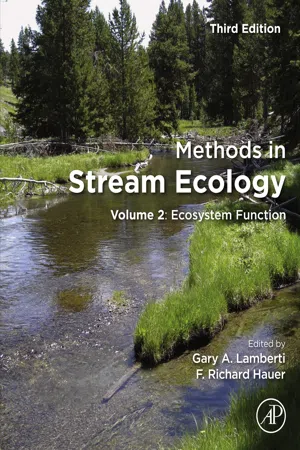
eBook - ePub
Methods in Stream Ecology
Volume 2: Ecosystem Function
- 372 pages
- English
- ePUB (mobile friendly)
- Available on iOS & Android
eBook - ePub
Methods in Stream Ecology
Volume 2: Ecosystem Function
About this book
Methods in Stream Ecology: Volume 2: Ecosystem Structure, Third Edition, provides a complete series of field and laboratory protocols in stream ecology that are ideal for teaching or conducting research. This new two-part edition is updated to reflect recent advances in the technology associated with ecological assessment of streams, including remote sensing. Volume two covers community interactions, ecosystem processes and ecosystem quality.
With a student-friendly price, this new edition is key for all students and researchers in stream and freshwater ecology, freshwater biology, marine ecology and river ecology. This book is also supportive as a supplementary text for courses in watershed ecology/science, hydrology, fluvial geomorphology and landscape ecology.
Methods in Stream Ecology, 3rd Edition, Volume 1: Ecosystem Structure, is also available now!
- Provides a variety of exercises in each chapter
- Includes detailed instructions, illustrations, formulae and data sheets for in-field research for students
- Presents taxonomic keys to common stream invertebrates and algae
- Includes website with tables and a links written by leading experts in stream ecology
Information
Section E
Ecosystem Processes
Introduction
Gary A. Lamberti
F. Richard Hauer
Stream ecosystem research has progressed from largely focused on biophysical structure to the comprehensive consideration of functional properties of these highly reactive systems. This evolution was initiated by the recognition that streams operate “differently” from many other ecosystems because of the downstream movement of water and the elements carried with that flow. The concept of a downstream “nutrient spiral” for important elements, such as carbon (C), nitrogen (N), and phosphorus (P), has stimulated much research on how nutrients cycle through microbial and macrobiotic compartments in streams. The seven chapters in this section address the dynamics of important functional processes in streams with a focus on the cycling of important elements and their ultimate fate in lotic biota, which may culminate in primary and secondary production. Chapter 30 presents the fundamental concepts and methods of investigation of nutrient spiraling in streams, with a focus on the theoretical basis for measuring the downstream advection and dispersion of bioreactive and nonreactive elements carried with water. Chapters 31–33 build on this foundation by presenting approaches for measuring the dynamics and transformations of specific reactive solutes in streams. Chapter 31 describes the use of nutrient diffusing substrates for determining the nutrient status of streams, as well as using constant releases of stable isotopes for measuring rates of nutrient uptake along stream courses. In Chapter 32, methods to measure specific transformations of N, a critical and highly reactive element in streams, are described in coupled field and laboratory protocols. Chapter 33 presents methods for determining the dynamics of P, a major nutrient playing a critical role in the biochemical apparatus of all organisms, and includes exercises using both stable and radioactive forms of P to interpret uptake and cycling. This section then shifts to methods to measure the productivity of streams and the incorporation of these critical elements into the biota. In Chapter 34, major advances in methods to determine the “metabolism” of streams from measures of dissolved oxygen dynamics are described, including modern modeling techniques for assessing production and respiration. Classical methods for measuring the secondary production of streams, with a focus on benthic macroinvertebrates, are described with detailed exercises in Chapter 35. Finally, Chapter 36 explains the emerging field of “ecological stoichiometry” whereby useful insights into stream function are provided by measuring the elemental content of stream biota, especially C, N, and P. Overall, this section presents a sound foundation for measuring the cycling and fate of important elements in streams and rivers and highlights how much is yet to be discovered about the functioning of these unique ecosystems.
Chapter 30
Conservative and Reactive Solute Dynamics
Michelle A. Baker1, and Jackson R. Webster2 1Department of Biology and the Ecology Center, Utah State University 2Department of Biology, Virginia Polytechnic Institute and State University
Abstract
Solute dynamics describe the coupled physical, chemical, and biological processes that govern transport and transformations of materials dissolved in water. In this chapter, we describe empirical and modeling approaches to evaluate dynamics of conservative and reactive solutes in streams. Such approaches provide a foundation upon which studies of transient storage and nutrient uptake are based.
Keywords
Modeling; Nutrient spiraling; Nutri...
Table of contents
- Cover image
- Title page
- Table of Contents
- Copyright
- List of Contributors
- Preface
- Section D. Organic Matter Dynamics
- Section E. Ecosystem Processes
- Section F. Ecosystem Assessment
- Glossary
- Index
Trusted by 375,005 students
Access to over 1.5 million titles for a fair monthly price.
Study more efficiently using our study tools.
Frequently asked questions
Yes, you can cancel anytime from the Subscription tab in your account settings on the Perlego website. Your subscription will stay active until the end of your current billing period. Learn how to cancel your subscription
No, books cannot be downloaded as external files, such as PDFs, for use outside of Perlego. However, you can download books within the Perlego app for offline reading on mobile or tablet. Learn how to download books offline
Perlego offers two plans: Essential and Complete
- Essential is ideal for learners and professionals who enjoy exploring a wide range of subjects. Access the Essential Library with 800,000+ trusted titles and best-sellers across business, personal growth, and the humanities. Includes unlimited reading time and Standard Read Aloud voice.
- Complete: Perfect for advanced learners and researchers needing full, unrestricted access. Unlock 1.5M+ books across hundreds of subjects, including academic and specialized titles. The Complete Plan also includes advanced features like Premium Read Aloud and Research Assistant.
We are an online textbook subscription service, where you can get access to an entire online library for less than the price of a single book per month. With over 1.5 million books across 990+ topics, we’ve got you covered! Learn about our mission
Look out for the read-aloud symbol on your next book to see if you can listen to it. The read-aloud tool reads text aloud for you, highlighting the text as it is being read. You can pause it, speed it up and slow it down. Learn more about Read Aloud
Yes! You can use the Perlego app on both iOS and Android devices to read anytime, anywhere — even offline. Perfect for commutes or when you’re on the go.
Please note we cannot support devices running on iOS 13 and Android 7 or earlier. Learn more about using the app
Please note we cannot support devices running on iOS 13 and Android 7 or earlier. Learn more about using the app
Yes, you can access Methods in Stream Ecology by Gary Lamberti,F. Richard Hauer,Gary A. Lamberti in PDF and/or ePUB format, as well as other popular books in Biological Sciences & Ecology. We have over 1.5 million books available in our catalogue for you to explore.