eBook - ePub
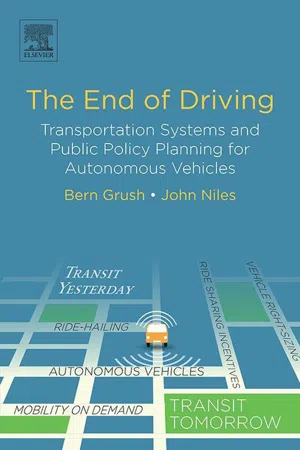
The End of Driving
Transportation Systems and Public Policy Planning for Autonomous Vehicles
- 332 pages
- English
- ePUB (mobile friendly)
- Available on iOS & Android
eBook - ePub
The End of Driving
Transportation Systems and Public Policy Planning for Autonomous Vehicles
About this book
While many transportation and city planners, researchers, students, practitioners, and political leaders are familiar with the technical nature and promise of vehicle automation, consensus is not yet often seen on the impact that will result, or the policies and actions that those responsible for transportation systems should take.
The End of Driving: Transportation Systems and Public Policy Planning for Autonomous Vehicles explores both the potential of vehicle automation technology and the barriers it faces when considering coherent urban deployment. The book evaluates the case for deliberate development of automated public transportation and mobility-as-a-service as paths towards sustainable mobility, describing critical approaches to the planning and management of vehicle automation technology. It serves as a reference for understanding the full life cycle of the multi-year transportation systems planning processes, including novel regulation, planning, and acquisition tools for regional transportation.
Application-oriented, research-based, and solution-oriented rather than predict-and-warn, The End of Driving concludes with a detailed discussion of the systems design needed for accomplishing this shift.
From the Foreword by Susan Shaheen: The authors … extend potential solutions through a set of open-ended exercises after each chapter. Their approach is both strategic and deliberate. They lead the reader from definitions and context setting to the transition toward automation, employing a range of creative strategies and policies. While our quest to understand how to deploy automated vehicles is just beginning, this book provides a thoughtful introduction to inform this evolution.
- Offers a workable public transit solution design melding the traditional "acquire-and-operate mode with the absorption of new technology
- Provides a step-by-step discussion of digital systems designs and effective regulation-by-data approaches needed for a new urban mobility
- Learning aids include case study scenarios, chapter objectives and discussion questions, sidebars and a glossary
Chapter 1
Critical Terminology and System Views
Summary
There are many instances of careless terminology usage and confusing descriptions of vehicle automation. While there is no standard or best way to describe this technology, this chapter provides one consistent interpretation of several commonly used terms and expands the scope of meaning of vehicle automation mobility beyond the immediate technology of the vehicle into the contextual systems in which such robotic machines would operate. This is done so that the remainder of the book communicates its ideas more clearly.
Keywords
Vehicle automation; self-driving; driverless; SAE levels
New technologies spawn new terminology, descriptive language, and mental models that are often a source of confusion and misunderstanding as expectations spread about changes, values, and fears regarding those new technologies. Words, descriptions, and timescales provided by innovators may not be fully understood by observers, who may further alter interpretations and meanings to fit their preferences or mental model of the technology and its effects. Followers who describe and explain may add nuance but blur meaning. Consider artificial intelligence or genetic engineering. The ensuing discourse across professionals, advocates, and journalists becomes hyped and polarized. Social media often serves to accelerate and expand the deepening confusion, making it increasingly difficult to construct a clear understanding of what may be likely or unlikely in the expected deployment of the subject technology. The confusion worsens as only a few innovators or observers consider more than a tiny fraction of the wider contexts into which the new technology will be deployed.
Nowhere has this been truer than in the case of autonomous vehicles. Beware of this hype and confusion as you read this book and its references. While we have tried to provide a consistent vocabulary, usage and descriptions may become dated or altered by changes in the field or new insights, necessitating that the reader revisit this chapter before studying another chapter or trying to mesh this book’s contents with those of other reports, papers, or proposals.
Beyond just vocabulary and mental models, limitations in human thinking about any new technology are legion. We often tend to think of immediate physical artifacts and first-order effects, but far less frequently do we consider the context of systems into which the innovation might be embedded, and its secondary or tertiary effects. For example, many see that automated vehicles are very expensive in 2018, so that many of these observers comment that they are only for the rich or for taxi services. Less often do we consider that new materials, breakthroughs in energy storage systems, and 3D printing may drive the average relative cost of owning a personal, automated vehicle in 2040 to be 25% of today’s average cost of a non-automated motor vehicle.
Digitization serves to drive out costs, but it does so with concurrent changes to every contextual system, so that it becomes impossible to make a detailed forward projection and almost impossible to make a backward determination. For example, it is not possible to make a reliable calculation of how the change from horse-powered personal mobility in 1890 to automotive-powered personal mobility today affected net family transportation costs in 2015, without considering many hundreds of related changes and interactions that have accrued over the intervening 125 years. As of early 2018, nobody has accepted this challenge, nor is that likely to happen.
We are clearly less capable of imagining future effects of a new technology interacting with a large number of systems, including the systems that will themselves engender changes in the new technology. Any projections about the impacts of vehicle automation in 2040 or 2050 would likely offer only approximate, simplified, polarized descriptions, at best. This is not a criticism of those individuals attempting to sketch such a future but an observation about the limitations of human predictive ability. We, the authors of this book, also have no crystal ball, since none exists. Nonetheless, we have tasked ourselves with building descriptive models for how changes might unfold over the next several decades.
Our only prediction—and we are hardly alone in this—is that planners are largely stuck with two approaches to this dimly understood future: wait to see what will happen or determine what is preferred and determine ways to achieve that. Our descriptive models are for the diffusion contexts in which these changes will unfold. We make no specific predictions. It will be up to creative, willful people to determine the details of that future. We hope our book will help them.
1.1 Terminology
1.1.1 Autonomous vs Automated
The relevant dictionary meaning of the word autonomous is something that is undertaken or carried out without outside control; self-contained, existing or capable of existing independently; responding reacting or developing independently of the whole (Merriam-Webster's Dictionary, 2018). If you consider that automated vehicles can be expected to be embedded in, or bound by, many contextual systems such as physical infrastructure, government regulations, human use preferences, funding systems for infrastructure improvements or readiness, security and privacy systems, criminal hacking, data management systems, and wireless connectivity systems, it takes little to see that the word “autonomous” has been misapplied to the vehicles we might expect in the coming several decades. Nearly autonomous vehicles are possible and there are current military instances that would readily qualify, but the ones described for ground-passenger transportation—even well after 2050—would not qualify as autonomous by this definition.
Nonetheless, “autonomous” appears in the title of this book, since it has become the accepted and most readily recognizable term for vehicle automation. We use it occasionally in the text for language conformance, and in direct quotes, but we prefer and will stick predominantly to the terms “automated” and “vehicle automation.”
1.1.2 Self-Driving vs Driverless
The terms self-driving and driverless are often used interchangeably. On closer inspection, “self-driving” often describes a vehicle placed in an automated mode (sometimes erroneously referred to as “fully automated”) by its driver, while “driverless” is more often applied to vehicles that do not require a driver, hence “driverless” would be reserved for the highest of the SAE levels (4 and 5 as described in the Section 1.1.3), regardless of whether such vehicles have an option for human operation.
Because of the ambiguity, we will not use “self-driving,” except in quoted material, with “[sic]” if we believe the term “driverless” should have been used. We will use the word driverless to mean a vehicle that does not require a driver when operating in its designed mode. Hence, a Level 4 or Level 5 vehicle operating with no driver present or having a licensed driver present but not in a responsible, active mode (for example, sleeping) is “driverless,” by definition. This holds even if a vehicle has optional driver controls.
1.1.3 SAE Levels for Vehicle Automation
The SAE standard J3016 describes six levels of vehicle automation (Kelechava, 2016). Level 0 (no automation) and Level 1 (driver assistance) do not involve automation. The next four levels of automation are the enablers of the changes that this book is written for. Indeed, our greatest focus is on Levels 3 and 4. Both of these technology levels will have a significant impact and both are available in 2018 in modest volumes.
Level 2, “Partial automation” is the first level of meaningful automation. It requires a licensed driver to be present, attentive, and to touch the vehicle controls frequently. It is becoming readily available at a modest price increment.
Level 3, “Conditional automation” implies a vehicle that still requires a driver to be present but is expected to soon be able to drive reliably for hours on a highway or in a growing number of non-highway circumstances until human intervention is required, i.e., some Level 3 vehicles of increasing competency started to appear at the end of 2017 and some models can be expected to reach average household affordability during the 2020s. This level of automation is targeted at household ownership. Some companies that market household vehicles call this “full automation.” In spite of ingenuous intention, this error is easily overlooked since there are increasingly long stretches of road and time wherein these vehicle systems need no driver intervention. Hence we are misled by the terminology.
Level 4, “High automation” implies a vehicle that does not require an attentive driver within certain circumstances such as geo-fenced bounds that the vehicle cannot depart while in automated mode without human override. The same for a specific subset of roadways, certain times of day, weather conditions, or limited speeds. These vehicles are often described as being able to maneuver themselves into a safe stopped position should the driver/passenger be unable to take control if and when required. For example, the Volvo Drive Me trial in the process of being set up in 2018 with Swedish government participation for 100 specially equipped household vehicles is intended to permit drivers to pay no attention to the driving task on the Gothenburg ring road except to take over control when leaving this limited access highway (Volvo, 2018).
High automation will be suitable for geographically limited taxi and shuttle operations, including those likely displacing municipal bus systems. It will also be suitable for households where one or more members require significant repetitive driving on the particular roads and highways for which such a vehicle is qualified for nonattentive operation.
High automation is also sometimes deceptively described as “full automation” by companies wishing to boost their prospects in the expected new ride-hailing market that will disrupt taxi and current ride-hailing operations, or by automotive brands looking to sell new models with more advanced features. Unfortunately, the expression “fully automated”—the description the SAE standard has given to Level 5—as it has been carelessly, and sometimes intentionally, used to describe both Levels 3 and 4, has led to exaggerated timescales, inflated expectations, and fears of numerous utopian and dystopian scenarios.
Level 5, “Full automation” in its SAE meaning, implies no requirement for a human driver, ever, anywhere and may be very far off in time—perhaps as far off as the last quarter of the 21st century. The Level 5 vehicle of this strict definition is not a subject for this book. But such a near-perfectly automated vehicle is unnecessary to affect many of the changes projected by utopian and dystopian scenarios.
Throughout this book, we will generally assume that conditionally automated vehicles, which demand a driver be present and alert, will be, in their majority, deployed as household vehicles from the next few decades. We ignore the potential for a taxi company to use these as fleet vehicles, once a highly automated vehicle can handle the driving task, since a driver would no longer be required for such short-haul spatially controlled taxi and shuttle trips.
We will also generally assume that highly automated vehicles, which do not require a driver in any of its intended design cases, will be initially deployed mostly as robotaxis and robo-shuttles. The reason is that initially the geographic and speed limitations will be too restrictive to be useful as a general household vehicle (see Section 6.3 in Chapter 6: Transitioning Through Multiple Automated Forms) Of course, an individual or household may wish to own a highly automated vehicle with optional human controls for any number of reasons. As well, we can expect highly automated vehicles to continue to improve to the point that they will tend toward the definition of Level 5 “full automation.” Likely, the definition of that will remain a pract...
Table of contents
- Cover image
- Title page
- Table of Contents
- Copyright
- Dedication
- List of Figures
- List of Tables
- Foreword
- Acknowledgments
- Introduction
- Chapter 1. Critical Terminology and System Views
- Chapter 2. Three Planning Contexts: Hype, Diffusion, and Governance
- Part I: Contexts
- Part II: Problem
- Part III: Solutions
- Conclusion and Recommendations
- Glossary
- References
- Index
Trusted by 375,005 students
Access to over 1.5 million titles for a fair monthly price.
Study more efficiently using our study tools.
Frequently asked questions
Yes, you can cancel anytime from the Subscription tab in your account settings on the Perlego website. Your subscription will stay active until the end of your current billing period. Learn how to cancel your subscription
No, books cannot be downloaded as external files, such as PDFs, for use outside of Perlego. However, you can download books within the Perlego app for offline reading on mobile or tablet. Learn how to download books offline
Perlego offers two plans: Essential and Complete
- Essential is ideal for learners and professionals who enjoy exploring a wide range of subjects. Access the Essential Library with 800,000+ trusted titles and best-sellers across business, personal growth, and the humanities. Includes unlimited reading time and Standard Read Aloud voice.
- Complete: Perfect for advanced learners and researchers needing full, unrestricted access. Unlock 1.5M+ books across hundreds of subjects, including academic and specialized titles. The Complete Plan also includes advanced features like Premium Read Aloud and Research Assistant.
We are an online textbook subscription service, where you can get access to an entire online library for less than the price of a single book per month. With over 1.5 million books across 990+ topics, we’ve got you covered! Learn about our mission
Look out for the read-aloud symbol on your next book to see if you can listen to it. The read-aloud tool reads text aloud for you, highlighting the text as it is being read. You can pause it, speed it up and slow it down. Learn more about Read Aloud
Yes! You can use the Perlego app on both iOS and Android devices to read anytime, anywhere — even offline. Perfect for commutes or when you’re on the go.
Please note we cannot support devices running on iOS 13 and Android 7 or earlier. Learn more about using the app
Please note we cannot support devices running on iOS 13 and Android 7 or earlier. Learn more about using the app
Yes, you can access The End of Driving by Bern Grush,John Niles in PDF and/or ePUB format, as well as other popular books in Law & Civil Law. We have over 1.5 million books available in our catalogue for you to explore.