eBook - ePub
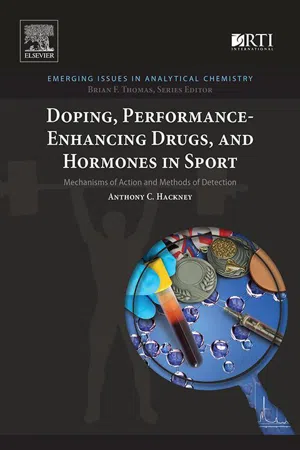
Doping, Performance-Enhancing Drugs, and Hormones in Sport
Mechanisms of Action and Methods of Detection
- 168 pages
- English
- ePUB (mobile friendly)
- Available on iOS & Android
eBook - ePub
Doping, Performance-Enhancing Drugs, and Hormones in Sport
Mechanisms of Action and Methods of Detection
About this book
Doping, Performance-Enhancing Drugs, and Hormones in Sport: Mechanisms of Action and Methods of Detection examines the biochemistry and bioanalytical aspects of performance-enhancing drugs (PEDs) and other questionable procedures used by athletes to enhance performance. The book informs the specialist of emerging knowledge and techniques and allows the non-specialist to grasp the underlying science and current practice of the discipline.
With clear and compelling language appropriate for a broad spectrum of readers, this book provides background on prevalence, types of agents, their actual or supposed benefits, and their negative effects on health. The technical aspects of detection are discussed, followed by a discussion of why detection is a problematic and still-evolving science. To facilitate comprehension, each chapter is organized in a uniform way with six sections: (1) standard medical uses, (2) why the drugs are used by athletes, (3) biological mechanism of action, (4) what research says about efficacy in improving performance, (5) major health side effects from use and abuse in sport, and 6) concluding key points.
- Presents the scientific concepts of how performance enhancers work, how they are used, and how they are detected and masked from detection
- Features language that is neither simplistic to scientists nor too sophisticated for a large, diverse global audience
- Provides a short "close-up in each chapter to illustrate key topics that engage, entertain, and create a novel synthesis of thought
Information
Topic
Physical SciencesSubtopic
Analytic ChemistryChapter 1
Overview
Doping in Sport
Abstract
Performance-enhancing substances have been used in athletic competition at least since the ancient Greeks. In the 1920s, sports governing bodies implemented restrictions because of health concerns for the athletes, but they had little effect because no testing was done. The development of synthetic hormones and their widespread abuse by athletes led the International Olympic Committee to issue a list of banned substances. Testing began with the 1968 Olympics, but abuse continued with banned and yet-to-be banned novel substances through the 1990s. To further combat the problem, the World Anti-Doping Agency (WADA) was established in 1999 to take on a full time “policing action” role. Scientists working with WADA developed better detection methods, but cheating remains a serious problem. Exceptions are granted by WADA to allow use of banned substances such as steroids for athletes who can show a legitimate medical need, but exceptions are difficult to obtain.
Keywords
Performance-enhancing drugs (PEDs); sports doping; sports ethics; anabolic steroids; World Anti-Doping Agency (WADA); sports cheating; health effects of performance-enhancing drugs
Performance-enhancing substances, drug or otherwise, have been used in athletic competition since ancient times. The Greeks documented use more than two millennia ago. But if the phenomenon is nothing new, its prevalence and the magnitude of associated health risk have made it a major public issue. Hardly a week goes by without a news story about a major athlete caught doping or a medical finding about morbidities associated with pharmaceutical and nutritional supplements used by athletes. This chapter is an introductory overview of doping in sport—the essentials of what is happening, why it is happening, and what is being done about it.
History and Current State of the Problem
The ancient Greeks used special diets and stimulating potions to fortify themselves in their Olympic Games. In the 19th and early 20th centuries, strychnine, caffeine, cocaine, and alcohol were commonly used, especially by distance runners and cyclists. An example of such early athletic use occurred in the 1904 St. Louis Olympic Games marathon. Thomas Hicks of the United States, the ultimate gold medalist, took raw eggs, injections of strychnine, and doses of brandy throughout the race. This was viewed as perfectly acceptable by the authorities, and many coaches and athletes developed their own concoctions and usage protocols.1
In the 1920s, sports governing bodies implemented restrictions on what came to be known as performance-enhancing drugs (PEDs) because of health concerns. However, these restrictions were essentially ineffective, because no testing was done to confirm or refute use. The pharmaceutical development of synthetic hormones such as testosterone in the following two decades made matters worse as these agents gained widespread use in sport. Public pressure on world sports authorities to introduce regular and rigorous testing was increased, in part due to the death from PED use of a Danish cyclist at the 1960 Rome Olympics and the media storm that followed. This very public event shocked the sporting world and lead to a public outcry. In 1967, the International Olympic Committee (IOC) took action and founded its Medical Commission, which established the first list of substances that athletes were prohibited from taking. Testing of athletes was finally introduced at the 1968 Winter Games in Grenoble and Summer Games in Mexico City that same year. Nonetheless, from the 1970s to the 1990s, PED use flourished as new designer drugs and techniques such as blood doping were devised by dishonest athletes and coaches. There were even large-scale state-sponsored doping programs. The former German Democratic Republic (East Germany) was a major culprit in such programs throughout its existence (1949–90), and recent evidence points to continued widespread state-sponsored doping by Russian sports agencies and the Russian government.1,2
Bioanalytical methods for detection of PEDs during the early period of test development lacked accuracy and reliability. This resulted in a lack of confidence in the results. In the 1990s, there was debate in the IOC, other international sports federations, and individual national governments about the exact definition of doping, enforcement policies, and ...
Table of contents
- Cover image
- Title page
- Table of Contents
- Copyright
- Dedication
- List of Contributors
- Foreword
- Preface
- Acknowledgments
- Chapter 1. Overview: Doping in Sport
- Chapter 2. Anabolic Androgenic Steroids
- Chapter 3. Stimulants
- Chapter 4. Glucocorticoids
- Chapter 5. Peptide–Protein Hormones
- Chapter 6. Beta-2 Agonists
- Chapter 7. Hormone and Metabolic Modulators
- Chapter 8. Narcotics
- Chapter 9. Beta Blockers
- Chapter 10. Athlete Testing, Analytical Procedures, and Adverse Analytical Findings
- Chapter 11. The Future of Performance Enhancement in Sport
- Index
Trusted by 375,005 students
Access to over 1.5 million titles for a fair monthly price.
Study more efficiently using our study tools.
Frequently asked questions
Yes, you can cancel anytime from the Subscription tab in your account settings on the Perlego website. Your subscription will stay active until the end of your current billing period. Learn how to cancel your subscription
No, books cannot be downloaded as external files, such as PDFs, for use outside of Perlego. However, you can download books within the Perlego app for offline reading on mobile or tablet. Learn how to download books offline
Perlego offers two plans: Essential and Complete
- Essential is ideal for learners and professionals who enjoy exploring a wide range of subjects. Access the Essential Library with 800,000+ trusted titles and best-sellers across business, personal growth, and the humanities. Includes unlimited reading time and Standard Read Aloud voice.
- Complete: Perfect for advanced learners and researchers needing full, unrestricted access. Unlock 1.5M+ books across hundreds of subjects, including academic and specialized titles. The Complete Plan also includes advanced features like Premium Read Aloud and Research Assistant.
We are an online textbook subscription service, where you can get access to an entire online library for less than the price of a single book per month. With over 1.5 million books across 990+ topics, we’ve got you covered! Learn about our mission
Look out for the read-aloud symbol on your next book to see if you can listen to it. The read-aloud tool reads text aloud for you, highlighting the text as it is being read. You can pause it, speed it up and slow it down. Learn more about Read Aloud
Yes! You can use the Perlego app on both iOS and Android devices to read anytime, anywhere — even offline. Perfect for commutes or when you’re on the go.
Please note we cannot support devices running on iOS 13 and Android 7 or earlier. Learn more about using the app
Please note we cannot support devices running on iOS 13 and Android 7 or earlier. Learn more about using the app
Yes, you can access Doping, Performance-Enhancing Drugs, and Hormones in Sport by Anthony C. Hackney,Anthony C Hackney in PDF and/or ePUB format, as well as other popular books in Physical Sciences & Analytic Chemistry. We have over 1.5 million books available in our catalogue for you to explore.