eBook - ePub
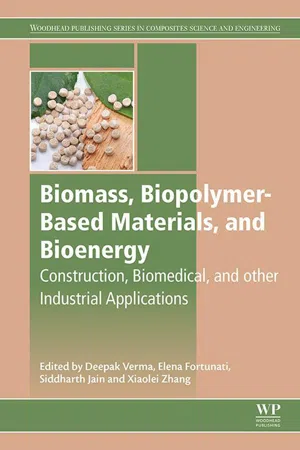
Biomass, Biopolymer-Based Materials, and Bioenergy
Construction, Biomedical, and other Industrial Applications
- 558 pages
- English
- ePUB (mobile friendly)
- Available on iOS & Android
eBook - ePub
Biomass, Biopolymer-Based Materials, and Bioenergy
Construction, Biomedical, and other Industrial Applications
About this book
Biomass, Biopolymer-Based Materials and Bioenergy: Construction, Biomedical and Other Industrial Applications covers a broad range of material types, including natural fiber reinforced polymer composites, particulate composites, fiberboard, wood fiber composites, and plywood composite that utilize natural, renewable and biodegradable agricultural biomass. In terms of bioenergy, the authors explore not only the well-known processing methods of biofuels, but also the kinetics of biofuels production pathways, a techno-economic analysis on biomass gasification, and biomass gasification with further upgrading into diesel additives and hybrid renewable energy systems for power generation.
Further chapters discuss advanced techniques for the development of biomass-based composites, biopolymer-based composites, biomass gasification, thermal kinetic design and techno-economic analysis of biomass gasification. By introducing these topics, the book highlights a totally new research theme in biopolymer-based composite materials and bioenergy.
- Covers a broad range of different research fields, including biopolymer and natural fiber reinforcement used in the development of composites
- Demonstrates key research themes in materials science and engineering, including materials processing, polymer science, biofuel processing, and thermal and kinetic studies
- Presents valuable information for those working in research and development departments, and for graduate students (Masters and PhDs)
Information
Part I
Biopolymers and Biomass-Reinforced Green Composites
Outline
1
Biopolymer processing and its composites
An introduction
Deepak Verma1 and Elena Fortunati2, 1Department of Mechanical Engineering, Graphic Era Hill University, Dehradun, India, 2Civil and Environmental Engineering Department, Materials Engineering Center, University of Perugia, UdR INSTM, Terni, Italy
Abstract
Global environmental concerns have ignited the search for alternative materials which can resolve the major issues caused by pollution. Researchers working in that area are developing various types of biofuels by utilizing different biomasses. Another major research is in progress toward the development of biocomposites. Previously, biocomposites were developed by reinforcing natural fibers, agro waste, or cellulose in polymer matrix materials, which already showed very good properties—specifically mechanical properties. However, there were still objections to the development of these biocomposites (which use polymer as a matrix material) as they already consist of conventional polymers (either thermosets or thermoplastics). In considering this point, researchers have developed a new class of biopolymers which are derived from plants and seeds. By using these biopolymers researchers have now developed a novel biocomposite which is fully biodegradable in nature. In this chapter, we discuss the types of biopolymers and their composites. We also discuss the mechanical properties and morphological studies of the developed composites.
Keywords
Biopolymers; composite materials; morphological studies; mechanical properties; manufacturing methods
1.1 Introduction
Due to growing environmental awareness, green chemistry and engineering have been combined for the development of a new class of materials by different processes [1–7]. The exhaustion of petroleum resources combined with increasing environmental ordinances is acting collaboratively to provide the momentum for the manufacture of novel materials and products that are environmentally friendly and not dependent on petroleum resources. By considering all of these factors, a new type of composite material—green composite—has been developed. On the other hand, bio-based materials are not only suitable for construction applications, that is, building construction, but are also best suited for industrial products in durable goods applications. These bio-based materials are developed from renewable resources such as wood, agro-waste, natural fiber plants, grasses, etc., which consist of carbohydrates and starch, lignin, cellulose, hemicellulose, proteins, etc. Most chemical products and materials were developed from renewable resources in the early 20th century [1]. Nowadays, environmental and economic concerns have forced the greater utilization of bio-based polymers and their composite materials [2–5]. A 2004 study observed that the production and utilization of chemicals and materials by bio-based feedstocks [1] was anticipated to be increased from the then 5% level to approximately 12% in 2010, approximately 18% in 2020, and by 2030, approximately 25%. It is also expected that around two-thirds of the $1.5 trillion global chemical industries will be based on renewable resources. The agricultural, forestry, and life sciences communities in the United States have created a vision [6] for the utilization of crops, trees, and agricultural waste for the development of industrial products and also have recognized crucial problems [7] in its execution. Research from the 1990s to the present has developed many novel bio-based products [8–14]. such as from corn polylactic acid (PLA); polyurethane products obtained from soy oil; lubricants from vegetable oil; thermoset and thermoplastic polymers obtained from soy and corn, and biocomposites from natural fibers combined with petroleum-based polymers such as polypropylene (PP) and polyethylene (PE), or biopolymers such as PLA, cellulose esters, polyhydroxyalkanoates (PHAs), etc. Recent advances in natural fiber development and composite engineering provide a notable opportunity for novel materials from renewable resources, which are biodegradable in nature. The availability of plastics in the environment, low landfill space, emissions from incineration, and ingestion hazards from these materials have motivated the development of biodegradable plastics. Some of the world’s renowned chemical companies, such as DuPont, Monsanto, Dow, and Cargill, have declared a greater shift in their technology from conventional petrochemical processing to life sciences [15]. Recently, DuPont and Monsanto have invested approximately $12.5 billion to obtain competence in agricultural biotechnology [16]. Biopolymers are now starting to replace conventional polymers, and also products made from biopolymers are forecast to replace conventional plastic products very soon. The most suitable examples of biopolymers obtained from renewable resources are cellulosic plastics, such as cellulose acetate, starch esters, and plastic obtained from corn, that is, PLA. The major challenge in substituting traditional plastics with biodegradable materials is designing of materials that show structural and functional stability through storage and use, yet are adaptable to microbial and environmental degradation upon disposal and without showing any noticeable environmental impacts.
1.2 Biodegradable/bio-based polymers as matrices for biocomposite applications
It has been generally observed that bio-based polymers may or may not show biodegradable properties. This not only depends on the composition of the biopolymers and their structure but also on the environment in which they a...
Table of contents
- Cover image
- Title page
- Table of Contents
- Copyright
- List of contributors
- Biographies
- Preface
- Part I: Biopolymers and Biomass-Reinforced Green Composites
- Part II: Biofuels
- Index
Trusted by 375,005 students
Access to over 1.5 million titles for a fair monthly price.
Study more efficiently using our study tools.
Frequently asked questions
Yes, you can cancel anytime from the Subscription tab in your account settings on the Perlego website. Your subscription will stay active until the end of your current billing period. Learn how to cancel your subscription
No, books cannot be downloaded as external files, such as PDFs, for use outside of Perlego. However, you can download books within the Perlego app for offline reading on mobile or tablet. Learn how to download books offline
Perlego offers two plans: Essential and Complete
- Essential is ideal for learners and professionals who enjoy exploring a wide range of subjects. Access the Essential Library with 800,000+ trusted titles and best-sellers across business, personal growth, and the humanities. Includes unlimited reading time and Standard Read Aloud voice.
- Complete: Perfect for advanced learners and researchers needing full, unrestricted access. Unlock 1.5M+ books across hundreds of subjects, including academic and specialized titles. The Complete Plan also includes advanced features like Premium Read Aloud and Research Assistant.
We are an online textbook subscription service, where you can get access to an entire online library for less than the price of a single book per month. With over 1.5 million books across 990+ topics, we’ve got you covered! Learn about our mission
Look out for the read-aloud symbol on your next book to see if you can listen to it. The read-aloud tool reads text aloud for you, highlighting the text as it is being read. You can pause it, speed it up and slow it down. Learn more about Read Aloud
Yes! You can use the Perlego app on both iOS and Android devices to read anytime, anywhere — even offline. Perfect for commutes or when you’re on the go.
Please note we cannot support devices running on iOS 13 and Android 7 or earlier. Learn more about using the app
Please note we cannot support devices running on iOS 13 and Android 7 or earlier. Learn more about using the app
Yes, you can access Biomass, Biopolymer-Based Materials, and Bioenergy by Deepak Verma,Elena Fortunati,Siddharth Jain,Xiaolei Zhang in PDF and/or ePUB format, as well as other popular books in Technology & Engineering & Materials Science. We have over 1.5 million books available in our catalogue for you to explore.