- 306 pages
- English
- ePUB (mobile friendly)
- Available on iOS & Android
eBook - ePub
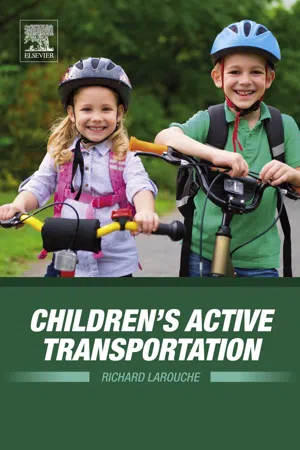
Children's Active Transportation
About this book
Children's Active Transportation is a rigorous and comprehensive examination of the current research and interventions on active transportation for children and youth. As the travel behaviors of these groups tend to be highly routinized, and their mobility faces unique constraints, such as parental restrictions, mandatory school attendance, and the inability to drive a motor vehicle before late adolescence, this book examines the key factors that influence travel behavior among children and youth, providing key insights into lessons learned from current interventions. Readers will find a resource that clearly demonstrates how critical it is for children to develop strong, active transportation habits that carry into adulthood.
- Discusses the correlates that exist between children's active transportation using a social and ecological model
- Summarizes active transportation interventions that show what works to increase non-motorized modes of travel in children
- Describes the factors that influence the implementation and effectiveness of interventions
Information
1
Public Health Benefits of Active Transportation
Christine Voss Department of Pediatrics, University of British Columbia, Vancouver, BC, Canada
Abstract
This chapter summarizes the current scientific evidence base regarding active transportation (AT) and health in children and adolescents. In particular, it describes how AT contributes significantly to greater physical activity levels in children and youth—an important health behaviour. Associations with physical health outcomes, such as cardiorespiratory fitness, weight status and cardiometabolic risk factors will also be reviewed. The chapter will conclude with recommendations for policy and practice implementation and future research in this important public health area.
Keywords
Active travel; Cardiovascular fitness; Health benefits; Obesity; Physical activity; Public health
Walking is man’s best medicine.
Hippocrates
1.1. Introduction
Ironically, the early landmark research studies from the 1950s that first alerted us to the critical importance of physical activity (PA) for health centred around active transportation (AT); one study identified a lower incidence of heart disease in men who used AT as part of their occupation compared with their more sedentary counterparts, such as bus conductors versus bus drivers and mail carriers versus telephonist. 1 Since then, AT has been largely ignored as a public health priority. Only in recent years has the scientific evidence on the link between AT and health become so overwhelmingly compelling that AT (walking and cycling, specifically) is now frequently featured in advocacy reports as a strategy to combat the significant global chronic disease burden. 2,3
This chapter will review the scientific evidence on the link between AT and health in children and adolescents, with particular emphasis on its meaningful contribution to PA levels. Direct links between AT and physical health outcomes, such as cardiorespiratory fitness, weight status and cardiometabolic risk factors, will also be reviewed. The chapter will conclude with recommendations for policy and practice implementation and future research in this important public health area.
1.2. Active Transportation and Physical Activity
PA is recognized as one of the most important health behaviours; in children and adolescents, the benefits of regular PA include cardiovascular and metabolic health, healthy bone and muscle development, maintenance of healthy body weight, and mental well-being. 4 In order to optimize these health outcomes, the World Health Organization recommends that children and adolescents aged 5–17 years engage in at least 60 min of moderate-to-vigorous PA (MVPA) every day. 5 In this context, it is important to note that the technical definition of PA is ‘any bodily movement produced by skeletal muscles that results in energy expenditure’. 6 Guidelines typically call for activities of moderate intensity or higher, which refers to any activities that slightly increase the heart rate and breathing, such as brisk walking. This is regardless of the purpose of the activity, meaning that leisure activities and exercise contribute to daily activity goals, as do occupational labour and AT. Despite our understanding of the importance of PA for health, we are currently experiencing a global physical inactivity crisis with estimates suggesting that fewer than 1 in 5 children worldwide achieve guidelines. 7
In light of the alarmingly low PA levels in children, AT in children and adolescents has been studied extensively over the last 2 decades. Several comprehensive review articles that vary in scope have critically evaluated and summarized the numerous original research articles on this topic. 8–13 Original research articles varied widely in terms of study design a (predominantly cross-sectional, few longitudinal or experimental), study setting (predominantly North America, Europe and Australia, few others), measures of PA (predominantly objective such as accelerometers and pedometers, fewer self-report), sample size and age group. Regardless of these differences, approximately 3 out of 4 studies reported that children and/or adolescents who used AT were significantly more active than those using passive transportation, 14–65 with the remainder of articles finding no association. 66–80 No study reported that children who used AT were less active. A positive association was slightly more common when objective measures of PA were used compared with self-report tools. This is not surprising because of the known recall error in younger children and the limitations of self-report tools to adequately capture dose and volume of PA, especially of non-organized activities such as walking.
1.2.1. How Active Transportation Causes Greater Physical Activity Levels
Walking, cycling and other types of ‘rolling’ (i.e., scooter) for transportation meets the technical definition of PA—namely, ‘any bodily movement produced by skeletal muscles that results in energy expenditure’ 6 —and can therefore be viewed as direct sources of PA. This concept is corroborated by several original research articles whose research methodologies allowed researchers to specifically assess travel-related PA. Objective devices timestamp PA data, which allows researchers to describe PA patterns at specific times of the day. In these studies, the PA levels were consistently higher during school travel windows in active travellers compared with passive travellers 19,23,26,43,47,51,52,54,63,76 (Fig. 1.1).
Some of these studi...
Table of contents
- Cover image
- Title page
- Table of Contents
- Copyright
- About the Editor
- About the Authors
- Preface
- 1. Public Health Benefits of Active Transportation
- 2. Environmental Benefits of Active Transportation
- 3. Economic Benefits of Active Transportation
- 4. Last Child Walking?—Prevalence and Trends in Active Transportation
- 5. Children’s Independent Mobility
- 6. An Ecological Model of Active Transportation
- 7. Individual Correlates of Active Transportation
- 8. Interpersonal Correlates of Active Transportation
- 9. Community Factors Related to Active Transportation
- 10. Built and Physical Environment Correlates of Active Transportation
- 11. Public Policy and Active Transportation
- 12. Prevalence and Correlates of Active Transportation in Developing Countries
- 13. Safe Routes to School (SRTS)
- 14. School Travel Plans
- 15. Walking School Buses and Bicycle Trains
- 16. Taming Traffic to Encourage Children’s Active Transportation
- 17. Active Transportation—Is the School Hiding the Forest?
- 18. Conclusion
- Glossary
- Index
Trusted by 375,005 students
Access to over 1.5 million titles for a fair monthly price.
Study more efficiently using our study tools.
Frequently asked questions
Yes, you can cancel anytime from the Subscription tab in your account settings on the Perlego website. Your subscription will stay active until the end of your current billing period. Learn how to cancel your subscription
No, books cannot be downloaded as external files, such as PDFs, for use outside of Perlego. However, you can download books within the Perlego app for offline reading on mobile or tablet. Learn how to download books offline
Perlego offers two plans: Essential and Complete
- Essential is ideal for learners and professionals who enjoy exploring a wide range of subjects. Access the Essential Library with 800,000+ trusted titles and best-sellers across business, personal growth, and the humanities. Includes unlimited reading time and Standard Read Aloud voice.
- Complete: Perfect for advanced learners and researchers needing full, unrestricted access. Unlock 1.5M+ books across hundreds of subjects, including academic and specialized titles. The Complete Plan also includes advanced features like Premium Read Aloud and Research Assistant.
We are an online textbook subscription service, where you can get access to an entire online library for less than the price of a single book per month. With over 1.5 million books across 990+ topics, we’ve got you covered! Learn about our mission
Look out for the read-aloud symbol on your next book to see if you can listen to it. The read-aloud tool reads text aloud for you, highlighting the text as it is being read. You can pause it, speed it up and slow it down. Learn more about Read Aloud
Yes! You can use the Perlego app on both iOS and Android devices to read anytime, anywhere — even offline. Perfect for commutes or when you’re on the go.
Please note we cannot support devices running on iOS 13 and Android 7 or earlier. Learn more about using the app
Please note we cannot support devices running on iOS 13 and Android 7 or earlier. Learn more about using the app
Yes, you can access Children's Active Transportation by Richard Larouche in PDF and/or ePUB format, as well as other popular books in Technology & Engineering & Law Theory & Practice. We have over 1.5 million books available in our catalogue for you to explore.