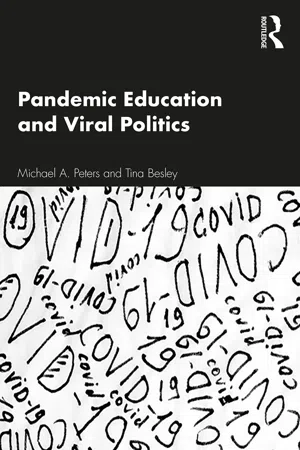
Viral modernity is a concept based upon the nature of viruses, the ancient and critical role they play in evolution and culture, and their basic application to understanding the role of information and forms of bioinformation in the social world. The concept draws a close association between viral biology on the one hand and information science on the other to understand 'viral' technologies, conspiracy theories and the nature of post-truth. The COVID-19 pandemic is a major occurrence and momentous tragedy in world history, with millions of infections and many deaths worldwide. It has disrupted society and caused massive unemployment and hardship in the global economy. Michael A. Peters and Tina Besley explore human resilience and the collective response to catastrophe, and the philosophy and literature of pandemics, including 'love and social distancing in the time of COVID-19'. These essays, a collection from Educational Philosophy and Theory, also explore the politicization of COVID-19, the growth of conspiracy theories, its origins and the ways it became a 'viral' narrative in the future of world politics.
- 118 pages
- English
- ePUB (mobile friendly)
- Available on iOS & Android
eBook - ePub
Pandemic Education and Viral Politics
About this book
Information
1
INTRODUCTION
Education, philosophy and viral politics
When severe acute respiratory syndrome coronavirus-2 (SARS-CoV-2)—the virus that causes COVID-19—first emerged in Wuhan, China, in December 2019, even the most experienced international public health experts did not anticipate that it would rapidly spread to create the worst global public health crisis in over 100 years. By January 2020, a few public health officials began sounding the alarm, but it wasn’t until March 11, 2020, that the World Health Organization declared a global pandemic.
(CIDRAP, p. 2)1
Globally, nations have responded very differently to the COVID-19 pandemic. Following epidemiological modelling, and aiming to ‘flatten the curve’ to avoid deaths and overloading their already limited public health services, some have closely followed a health model with severe staged lockdowns, wearing facemasks, using personal protective equipment (PPE), social distancing and sanitizer hand-washing (e.g., New Zealand, Vietnam, Taiwan, China, South Korea, Hong Kong, Norway, Denmark). Others, alarmed at the economic consequences and dismissive of the science (it is not ‘just a little flu’) with many people seemingly more concerned with their individual rights and liberties than the well-being of the Other, have limited recommending any or many of these measures until the virus has spread widely in their societies; consequently, we find that they have astonishingly high numbers of infections and deaths (e.g., USA, Brazil, UK; see rolling updated figures from Johns Hopkins University and elsewhere as presented in The Guardian2). With organisations and movements, both Left and Right, demonstrating solidarity in the name of freedom and civil rights, the public message is that COVID-19 will not be over soon, will complicate matters further and will create problems for all forms of mobility and mass movement of goods, people and services.
The COVID-19 crisis has suddenly brought epidemiology, the media and political use of multiple scenarios to the fore, so a brief history about the discipline seems timely, as outlined by Anderson (2019).
Epidemiology, from the ancient Greek, comprises the meaning of ‘epi’ meaning ‘upon or among’, ‘demos’ meaning ‘people’ and ‘logos’ meaning ‘study’. In the Western tradition of medicine, Hippocrates is often regarded as the first epidemiologist. He was first to note the ‘logic’ of disease and the relationship between the disease, its spread and the environment. He drew a distinction between ‘epidemic’ and ‘endemic’ to distinguish those diseases that reside within a population from those ‘visited upon’ a population. A major text and forerunner of modern epidemiology was De contaogione et contagiosis morbis written in 1546 by Girolamo Fracastoro3 (1478–1553), an Italian physician who wrote his texts in the form of poetry and who proposed a scientific theory of disease well before its empirical formulation by Louis Pasteur and Robert Koch. In particular, his study of the mode of syphilis transmission is one of the earliest examples of epidemiology, called Syphilis, or A Poetical History of the French Disease, where he writes: ‘I sing of that terrible disease, unknown to past centuries, which attacked all Europe in one day, and spread itself over a part of Africa and of Asia’.4 Naming it the French disease is similar to Donald Trump’s naming COVID-19 the Wuhan or Chinese virus.
Most definitions of epidemiology are similar and, as defined by the Centers for Disease Control and Prevention (CDC), epidemiology is a branch of medicine that deals with
the study (scientific, systematic, and data-driven) of the distribution (frequency, pattern) and determinants (causes, risk factors) of health-related states and events (not just diseases) in specified populations (neighborhood, school, city, state, country, global). It is also the application of this study to the control of health problems).5
Harvard’s PhD in Population Health Studies notes that ‘Various methods can be used to carry out epidemiological investigations: surveillance and descriptive studies can be used to study distribution; analytical studies are used to study determinants’.6 It is primarily a quantitative discipline that relies on probability theory based on causal reasoning and hypothesis testing that analyzes the outbreak, transmission, surveillance, monitoring and screening by using a combination of statistics, biology and social sciences to shape evidence-based policy, in particular public health policy.
In developing a National Institutes of Health (NIH) project in 2015 ‘to produce a systematic history of epidemiology and of the development of epidemiological techniques from the mid seventeenth to the mid twentieth century’, Alfredo Morabia mentions the work of John Graunt (1620–1674) using quantitative methods for the study of plague, and that epidemiology ‘struggled to achieve recognition as a scientific discipline’ until the turn of the 19th century, when new statistical methods (Pearsonian and Fisherian statistics) were developed in relation to chronic and cardiovascular diseases.7 Focusing on the Ebola outbreaks in West Africa that date back to 1976, James Webb in The Lancet (2015) points out that
Historians of medicine and public health have mostly paid scant attention to the historical study of viral disease control efforts and their epidemiological consequences. Most medical historians tend to focus their research efforts on the social history of disease in developed nations. Epidemiologists are deeply involved in the analysis of viral outbreaks, focusing principally on dynamic modelling. The twain rarely meet. One consequence is that physicians and public health specialists do not usually draw lessons from the historical record of disease control efforts. This can sometimes result in poor policy decisions.8
Unfortunately, we can see this playing out in many countries with the current pandemic. Yet only the precise patient history record and how this might align with environmental hazards—such as air and water quality and pollution, alongside with other health conditions, and including bacteriological threats—must accompany traditional temporal studies if we are to understand the globalization of viruses and the global pandemic threat they represent in the increasing interconnectivity of globalization. While the impact on some wealthy countries has been huge, arguably because of a failure of public health policies and political decisions, the great worry is that COVID-19 looks set to ravage countries with little public health infrastructure and very few hospitals with sufficient resources, and greater levels of poverty and congestion than elsewhere, e.g., India, Pakistan, Africa and other developing countries. The fear is that this will become a third global phase and may well become the source for a second- and third-wave global reinfection, if the developed world, still recovering from its viral infection, does not and cannot devote the necessary resources to these new crises. Humanitarian aid and the long-term recovery of the interconnected global economy depend upon recognizing the chances of continued transmission in an era of increasing interconnectivity.
As we go to press in mid-2020, new epidemiological models reveal that the COVID-19 pandemic is not about to disappear. It may be with us for a much longer period than first thought, extending well beyond the end of 2020. It indicates how little we know about the behaviour of this virus despite the mountain of scientific papers published since December 2020. Some scientists indicate that it may become endemic. A recent study from the Center for Infectious Disease Research and Policy (CIDRAP) at the University of Minnesota reveals the strong possibility of a second wave of the virus that will eclipse the first wave, necessitating the reintroduction of strict social distancing measures and the likely shut down of many public facilities, as well as businesses. What has become known as the Minnesota model9 uses the best comparative data provided by flu pandemics, of which there have been nine since the early 1700s. The report, COVID-19: The CIDRAP Viewpoint, suggests three scenarios:
- Scenario 1: The first wave of COVID-19 in spring 2020 is followed by a series of repetitive smaller waves that occur through the summer and then consistently over a 1- to 2-year period, gradually diminishing sometime in 2021 …;
- Scenario 2: The first wave of COVID-19 in spring 2020 is followed by a larger wave in the fall or winter of 2020 and one or more smaller subsequent waves in 2021. This pattern will require the reinstitution of mitigation measures in the fall in an attempt to drive down spread of infection and prevent healthcare systems from being overwhelmed …
- Scenario 3: The first wave of COVID-19 in spring 2020 is followed by a ‘slow burn’ of ongoing transmission and case occurrence, but without a clear wave pattern …10
Whatever is likely to happen, the report advises that we should plan for another 18 months to two years. We should plan for the worst scenario, and the pandemic ‘won’t be halted until 60% to 70% of the population is immune’. The report paints a troubling picture of the months ahead, including the possibility of a severe second wave in North America that eclipses the first, and the potential need for a reintroduction of strict public health measures. In this ‘panic’ environment politicians, especially those seeking re-election, must refrain from ‘fake news’, fake remedies, misinformation and disinformation. In this second and third wave period, public information requires careful scrutiny and must reflect the verified evidence-based scientific global consensus in order to avoid damaging conspiracy theories and the potential social conflicts and disorder that a second wave may incite. Education has a paramount role to play here, especially in developing criticality in relation to the generation of fake news and post-truth, misinformation and disinformation, which are often hard for people to distinguish, but also to help people—young and old—deal with ever-increasing existential fears and anxieties that have become increasingly apparent.
Existential fears and anxiety at present are not only related to the coronavirus pandemic, but to the accompanying global economic crisis and the existing climate and biodiversity crises; consequently, some people are feeling overwhelmed, depressed and hopeless, even to the point of s...
Table of contents
- Cover
- Half Title
- Title
- Copyright
- Contents
- Permissions
- 1 Introduction: education, philosophy and viral politics
- 2 Viral modernity? Epidemics, infodemics, and the ‘bioinformational’ paradigm
- 3 A viral theory of post-truth
- 4 On the epistemology of conspiracy
- 5 Love and social distancing in the time of COVID-19: the philosophy and literature of pandemics
- 6 The Plague: human resilience and the collective response to catastrophe
- 7 Philosophy and pandemic in the postdigital era: Foucault, Agamben, Žižek
- 8 The disorder of things: quarantine unemployment, the decline of neoliberalism, and the COVID-19 lockdown crash
- 9 ‘Reality is an activity of the most august imagination’. When the world stops, it’s not a complete disaster—we can hear the birds sing!
- 10 The Chinese dream encounters COVID-19
- 11 Biopolitics, conspiracy and the immuno-state: an evolving global politico-genetic complex
- Index
Trusted by 375,005 students
Access to over 1.5 million titles for a fair monthly price.
Study more efficiently using our study tools.
Frequently asked questions
Yes, you can cancel anytime from the Subscription tab in your account settings on the Perlego website. Your subscription will stay active until the end of your current billing period. Learn how to cancel your subscription
No, books cannot be downloaded as external files, such as PDFs, for use outside of Perlego. However, you can download books within the Perlego app for offline reading on mobile or tablet. Learn how to download books offline
Perlego offers two plans: Essential and Complete
- Essential is ideal for learners and professionals who enjoy exploring a wide range of subjects. Access the Essential Library with 800,000+ trusted titles and best-sellers across business, personal growth, and the humanities. Includes unlimited reading time and Standard Read Aloud voice.
- Complete: Perfect for advanced learners and researchers needing full, unrestricted access. Unlock 1.5M+ books across hundreds of subjects, including academic and specialized titles. The Complete Plan also includes advanced features like Premium Read Aloud and Research Assistant.
We are an online textbook subscription service, where you can get access to an entire online library for less than the price of a single book per month. With over 1.5 million books across 990+ topics, we’ve got you covered! Learn about our mission
Look out for the read-aloud symbol on your next book to see if you can listen to it. The read-aloud tool reads text aloud for you, highlighting the text as it is being read. You can pause it, speed it up and slow it down. Learn more about Read Aloud
Yes! You can use the Perlego app on both iOS and Android devices to read anytime, anywhere — even offline. Perfect for commutes or when you’re on the go.
Please note we cannot support devices running on iOS 13 and Android 7 or earlier. Learn more about using the app
Please note we cannot support devices running on iOS 13 and Android 7 or earlier. Learn more about using the app
Yes, you can access Pandemic Education and Viral Politics by Michael A. Peters,Tina Besley in PDF and/or ePUB format, as well as other popular books in Education & Education General. We have over 1.5 million books available in our catalogue for you to explore.