- 192 pages
- English
- ePUB (mobile friendly)
- Available on iOS & Android
eBook - ePub
Running a Successful Photography Business
About this book
Running a Successful Photography Business is the definitive business bible for every professional photographer – a one-stop resource covering everything you need to know to make your business a success. This handy book contains guidance on the key areas of running your business: fine-tuning your brand, attracting new clients and keeping existing ones, costing and producing shoots, professional ethics and codes of practice, contracts, preparing a business plan, operating your business effectively, legal obligations, working with agents and agencies and how to evolve and prosper in this ever changing industry. Everything a working photographer needs to know in order for their business to flourish.Written from the unique point of view of a leading photographers' agent, the author knows from first-hand experience what it takes to survive and succeed as a professional photographer. This book builds on the author's popular first book, Setting up a Successful Photography Business, aimed at those starting out in freelance photography.

SIR DAVID ATTENBOROUSH. © CHRIS FLOYD.
1 How's business? A business health check
How's business?
As a photographer I bet you probably get asked this question a lot. And I’m sure a lot of the time the answer is along the lines of…
‘Not bad, ticking along’
‘All good, pretty busy.’
But how often do you ask yourself, really, honestly, how is your business doing?
The yardstick of success isn’t necessarily just being busy, as we’ve touched on in the preface. You might feel busy, but in reality, you might not feel creatively fulfilled if you don’t find your work stimulating anymore. You might love taking the pictures but feel you are running around like a headless chicken dealing with peripheral red tape and administrative chores that goes hand-in-hand with earning a living from your photography. Maybe you are even feeling stressed and that you aren’t managing things properly. So just because you feel ‘busy’, that doesn’t necessarily mean you feel, or even are, successful.
In this business it’s all too easy to become reactive rather than proactive. You may find yourself dealing with day-to-day tasks without planning for the future. Maybe you have even lost sight of why you became a photographer in the first place. For the majority of photographers I’ve met, making money isn’t the number one priority, although it’s obviously a bonus. It could be worth having a look at how you might be able to improve things, giving yourself a bit of a business health check. As well as adding to you enjoyment and fulfillment, it might even lead to a more profitable business.
I’ve prepared twenty questions to help you get focused, spot any weak areas and enable you to capitalise on your strengths.
1) What is my business?
This seems like a fairly straightforward question but it’s amazing how many photographers aren’t quite sure. Be clear about what you are offering and who wants to buy it, because if you’re not, neither will your customers be.
Family portrait photographer Helen Bartlett has certainly nailed this one.
'My style of photography has always been clearly defined – I only shoot on location in black and white; I’m not a studio photographer. This began with my father, who took a lot of black and white photographs of my brothers and I growing up: pictures with real memories attached, of the parks we played at, my home and garden, and all of us having fun. I really value the joy they give me as an adult, and I noticed that they didn’t seem to date. The fads and fashions which can be common in family photography didn’t show up in these images; they stood out as real moments in my childhood. In my own work, I try to give my clients the same thing – natural images that capture their families’ different personalities, as well as their homes and the places they enjoy visiting together. It’s all about recording children and families as they are.’
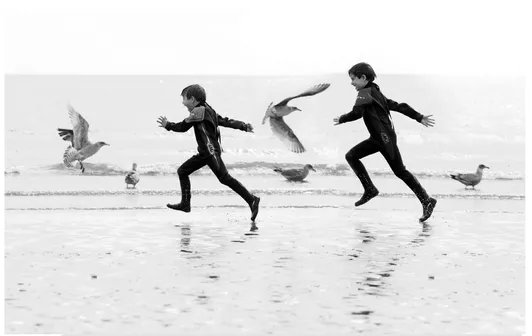
‘My style of photography has always been clearly defined – I only shoot on location in black and white; I’m not a studio photographer.’
© HELEN BARTLETT.
© HELEN BARTLETT.
Another photographer said to me recently, ‘If someone wants a plumber, they aren’t going to hire someone who calls themselves a plumber and a plasterer!’ It’s very important to have a finely tuned brand (see Chapter 3: Fine-tuning your brand).
2) What are my strengths?
This could be related to the type of photography you do or some other skill. It could be something as simple as recognizing you are great with gathering the right crew of people and always create a great atmosphere on set; if so, why not spread the word with some behind the scenes shots on social media?
If you are good at public speaking maybe you are missing a trick and should do a bit more of this. For example, many photographers guest lecture at universities as a sideline. Any public speaking at events – paid or non-paid – can be great publicity.
3) What are my weaknesses?
Recognise your limitations.
Maybe it’s time to get a bookkeeper if you are struggling to keep your accounts in order. Are you a bit intimidated by legal jargon and haven’t got a set of watertight terms and conditions in place? Maybe it’s time to devote some attention to that area (see Chapter 7: Please read the small print: business terms and photography contracts).
Do feel you are stuck in a rut and quoting fees too low? It’s rarely a good idea to undersell yourself (see Chapter 5: Pricing).
4) Could I improve my working environment?
I have met several photographers who have stopped working at home and rented a studio or workspace instead. Just going somewhere each day with fewer domestic distractions and mixing with like-minded people can do wonders for your motivation. Or would it suit you to combine your home with a set up that suits your business too – a studio or big enough home office for example?
5) Am I working with the right people?
The people you surround yourself with are crucial to your business, whether you employ them on a full time or freelance basis, work with them as a team or just share an office with them. If, for example, you employ someone to help with office administration and they have an unhelpful attitude when they answer the phone this will not be good for business, so this is another key area to get right (see Chapter 12: Getting help).
'I have a wonderful PA who helps me so much with the administrative side of things. In the early days, ensuring invoices and money flow as they should can be quite manageable by yourself, but when there are several diaries to coordinate, several hundred invoices a year to track, and dozens of jobs in the sales pipeline at any one time, you definitely need someone to keep an eye on that side of things.’
PAUL CLARKE.
6) Am I making enough money?
Do you know how much money are you making? There are many photographers for whom money isn’t the main motivation. However, if you earn your living from photography, you need to get control of your finances if your business is to survive (see Chapter 2: The photographer’s business plan).
7) Am I spending too much money?
Should you reduce your overheads? Cash flow, or lack of it, is the number one reason why businesses cease to trade. Are you spending too much on office rent, staff, marketing, new equipment or even on your lifestyle?
8) Am I investing enough money back into my business?
Maybe you aren’t buying enough new equipment to remain competitive to your peers or investing enough in your marketing. Probably the best time to have a good think about this and the previous two questions is when you do your annual tax return, as you’ll need to work your figures out then.
9) Am I getting new clients?
It’s easy to be complacent and just stick with the clients you regularly work with if they are ‘paying the rent’. I met a photographer recently whose work was perfect for design agencies but he had only ever worked for PR companies and magazines – this was the work he seemed to get by word of mouth. We tweaked his website, edited an appealing set of images to show design agencies and (obviously with his own efforts) started picking up work from a completely different market.
You don’t necessarily have to take such a radical approach as seeking new clients in a completely different area; you could just cast your net into other areas of the country or the world, or just to different businesses. To get new clients it’s important to promote yourself in the right way to the right people. If you have something people want to pay for, you just need to let them know about it (see Chapter 3: Fine-tuning your brand, and Chapter 4: Twenty ways to get noticed).
10) Am I keeping old clients?
This is just as important, maybe more so, than the previous question. Even in wedding photography, whilst you’d hope not to be shooting the bride or groom more than once(!), to get repeat business from a venue or a wedding planner gives your business stability. As a photographers’ agent I work with several photographers and am in a good position to pin point why some get repeat business more than others. There’s usually a fairly obvious answer. Why do you go back and use the same service or recommend it to others, whether a restaurant or an airline or any type of business? Usually because you have got not only what you paid for and had a pleasant experience, but got a bit of extra value for money. As a photographer this could be simply because you are a joy to work with, shoot some fabulous images and always go that extra mile. Commercial photographer Patrick Harrison appreciates and demonstrates the importance of this, and it has really paid off for him.

‘It shouldn't ever be about the photographer or their ego, it's about looking after everyone else and making them shine.’
© PATRICK HARRISON.
© PATRICK HARRISON.
'You’ve just got to be good at what you do, make it look effortless, be confident yet easy to get along with and obviously make a good picture that’s on brief. If you’re photographing people it’s the main part of what you do. It shouldn’t ever be about the photographer or their ego, it’s about looking after everyone else and making them shine. Be yourself.’
Do you make an effort to stay in touch with the clients you have worked for? Most photographers are successful because they nurture relationships (see Chapter 11: Keeping clients).
11) Am I working with clients I don't want to work with?
Might seem like a strange question, but what’s the point of working with clients that pay below the industry going rate, ask you to sign unreasonable contracts, take ages to pay, are a pain to work with and don’t even give you particularly inspiring briefs. Unless you can address these issues, improve the situation or find one-off justifiable reasons, you’ve got to ask yourself why you’re working with them. Better to invest your time attracting new, better clients.
12) Is my price structure right?
A good indication of this is how many estimates you are converting to jobs. It could be that you are undercharging or overcharging – both are as bad as each other. Undercutting the competition isn’t going to do you any favours in the long run. It’s much better to acknowledge your value and charge accordingly, as most clients respect that you get what you pay for. You could be giving out a message that you are in a lower league if you are significantly cheaper than your competition. Likewise, if you are quoting higher fees than others, you not only have to have a very good reason for this, but also be confident that your client can see the benefit and justify the extra expense if you are to work with them again or even at all.
Getting your pricing structure right is not just about how much your fee is. It’s also how you present your whole pricing package, including your expenses (se...
Table of contents
- Cover
- Half Title
- Title Page
- Copyright Page
- Contents
- Preface
- Introduction
- 1 How's business? A business health check
- 2 The photographer's business plan
- 3 Fine-tuning your brand
- 4 Twenty ways to get noticed
- 5 Pricing
- 6 Pitching for a job and sealing the deal
- 7 Please read the small print: business terms and photography contracts
- 8 The perfect photoshoot: a step-by-step guide
- 9 Photoshoot legal obligations and codes of practice
- 10 Are you covered? Insurance
- 11 Keeping clients
- 12 Getting help
- 13 Going forward
- Contributor biographies
- Appendices
- Acknowledgements
- Index
Trusted by 375,005 students
Access to over 1.5 million titles for a fair monthly price.
Study more efficiently using our study tools.
Frequently asked questions
Yes, you can cancel anytime from the Subscription tab in your account settings on the Perlego website. Your subscription will stay active until the end of your current billing period. Learn how to cancel your subscription
No, books cannot be downloaded as external files, such as PDFs, for use outside of Perlego. However, you can download books within the Perlego app for offline reading on mobile or tablet. Learn how to download books offline
Perlego offers two plans: Essential and Complete
- Essential is ideal for learners and professionals who enjoy exploring a wide range of subjects. Access the Essential Library with 800,000+ trusted titles and best-sellers across business, personal growth, and the humanities. Includes unlimited reading time and Standard Read Aloud voice.
- Complete: Perfect for advanced learners and researchers needing full, unrestricted access. Unlock 1.5M+ books across hundreds of subjects, including academic and specialized titles. The Complete Plan also includes advanced features like Premium Read Aloud and Research Assistant.
We are an online textbook subscription service, where you can get access to an entire online library for less than the price of a single book per month. With over 1.5 million books across 990+ topics, we’ve got you covered! Learn about our mission
Look out for the read-aloud symbol on your next book to see if you can listen to it. The read-aloud tool reads text aloud for you, highlighting the text as it is being read. You can pause it, speed it up and slow it down. Learn more about Read Aloud
Yes! You can use the Perlego app on both iOS and Android devices to read anytime, anywhere — even offline. Perfect for commutes or when you’re on the go.
Please note we cannot support devices running on iOS 13 and Android 7 or earlier. Learn more about using the app
Please note we cannot support devices running on iOS 13 and Android 7 or earlier. Learn more about using the app
Yes, you can access Running a Successful Photography Business by Lisa Pritchard in PDF and/or ePUB format, as well as other popular books in Art & Marketing. We have over 1.5 million books available in our catalogue for you to explore.