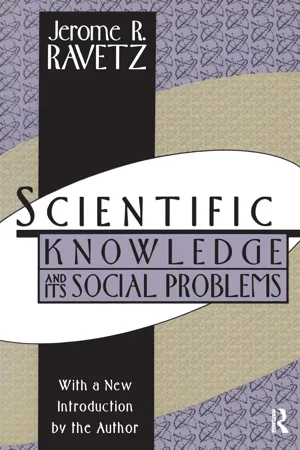
Science is continually confronted by new and difficult social and ethical problems. Some of these problems have arisen from the transformation of the academic science of the prewar period into the industrialized science of the present. Traditional theories of science are now widely recognized as obsolete. In Scientific Knowledge and Its Social Problems (originally published in 1971), Jerome R. Ravetz analyzes the work of science as the creation and investigation of problems. He demonstrates the role of choice and value judgment, and the inevitability of error, in scientific research. Ravetz's new introductory essay is a masterful statement of how our understanding of science has evolved over the last two decades.
- 478 pages
- English
- ePUB (mobile friendly)
- Available on iOS & Android
eBook - ePub
Scientific Knowledge and Its Social Problems
About this book
Information
Part I
THE VARIETIES OF SCIENTIFIC EXPERIENCE
1
‘WHAT IS SCIENCE?’
THE SUCCESS and vigour of scientific research, and the effectiveness of its technological application, are generally accepted as indicators of the quality of a nation’s life. Science is so important, and expensive, that the major policy decisions concerning its development are increasingly being taken by the State, rather than being left to the judgement of the scientists and their private patrons. Accordingly, the progress of science becomes a matter of politics; everyone in the community is involved in the consequences of decisions on ‘science policy’, and every citizen is responsible, however indirectly, for the formation of those decisions. This social involvement of science will necessarily increase over the decades to come. An increasing number of practical problems will need to be solved through planned programmes of scientific and technological research, and the rising cost of the many-sided work of science will call for the most direct involvement of the State in its planning.
In such a situation, it is most important that there should be a common knowledge of what it is that is being discussed and planned, and what are the special features that distinguish it from other objects of public concern. Such a common understanding should eventually develop, but we are as yet a long way from it. At present, we find a variety of partial views on the nature of science. Each of these derives from some special experience of a very complex activity, and from traditional views of science that were developed in response to problems that have since vanished. Such a variety is natural; but the present situation has the potentially dangerous feature that there is no general awareness of this variety. Each view of ‘science’ seems obvious common sense to its proponent; and in discussions of science, one can find the participants using the same word to refer to radically different things.
Thus, the common sense of science actually includes several varieties of scientific experience. The understanding of science is truly fragmented; but each of these fragments reflects an important aspect of the total thing. It would be impossible to fit these fragments together into a coherent whole, as if they were pieces of a jigsaw puzzle; but any attempt at unified understanding of science must take account of the experience (of the past and of the present) from which these views take their origin.
Views of science
Since natural science depends on the general public for its support, in this period as never before, the public understanding of science is crucial, in the long run, for the continued health of the community of science. In many ways, the public appreciation of science leaves nothing to be desired. We are all grateful for the comfort and security of life that is achieved by modern technology, and prepared to accept the claim that all these good things are the by-products of scientific research. Moreover, in the common-sense understanding of man’s relations with his natural environment, and even with his fellows, ‘science’ reigns supreme. Supernatural explanations of natural events, even of great disasters, are no longer taken seriously. The areas of ordinary life where inherited craft-wisdom is valued more highly than the judgements of scientific experts, are shrinking down to the vanishing point. This arises partly from the increasing artificiality of our material environment, and from the rapid changes in it as well as in our social environment. A sign of the triumph of ‘science’ is the reliance on textbooks for such personal crafts as rearing children and even achieving a happy married life. This tendency is more marked in the United States than anywhere else; there the prevailing assumption is that every problem, personal and social as well as natural and technical, should be amenable to solution by the application of the appropriate science.
Without such a general appreciation of science, it would be impossible for the scientific community to continue to grow, and to lay claim to an ever-increasing share of the national wealth. But the limitations of this appreciation must be understood if the support is to continue on a genuine and healthy basis. First, what the public appreciates is not the same as that for which the support is required. In all the varied activities of science (including popularization, teaching at all levels, technological application, and administration and decision-making) it is research that lies at the nerve-centre. Without research—the continuous, disciplined advance from the known into the unknown—these other activities would either lose their meaning, or become stale, sterile and eventually corrupted. Yet scientific research is most difficult, if not impossible, for a layman to comprehend. The work itself cannot be appreciated without some prior familiarity with the very specialized activity of investigating problems in the context of an abstract, technical discipline; while it has some similarities to the running of a business, or even to the driving of a bus, its special character can be communicated only to a layman with a well-developed imagination. And the object of the research work, the new scientific result, is almost always so techninical, so dependent for its meaning and significance on the context of the existing information in the special field, that the layman can never get more than the most general idea of what it is all about. In this respect, the ‘layman’ may equally well be a scientist in another field, for the problem of internal communication within the world of science is certainly severe. But at least one working scientist can recognize the moves in an exposition by another, in spite of not understanding the content; while the man in the street would find a detailed account of a new discovery to be totally incomprehensible.
Hence what the general public appreciates in science is not what the scientists are doing. Rather, it can be classed under two headings: techniques and natural magic. The first is the collection of devices that make life easier to live, or the destruction of life more efficient. The second is the production of strange and wonderful effects without recourse to supernatural agents. Although the term ‘natural magic’ fell into disuse some time ago, it is quite natural for this interpretation of science to persist. When the layman (child or adult) sees a demonstration of some astonishing effect, can he imagine the human endeavour and intricate technical work which led to its creation? No; it is the effect itself which captures the imagination, and produces wonder and delight: this is natural magic. Of course, the audience for the ‘wonders of science’ is told that these achievements are simply the application of the laws of Nature, and that the creator of the effect is in no sense a magician. But since the audience cannot understand the laws of Nature that are relevant to the production of the effect, it is strange and wonderful (until it becomes a commonplace part of the environment) and so differs little from natural magic of the old sort. We can see the strength of this attitude from the great popularity of projects that are politely described as science but which are clearly recognizable as nearly pure natural magic; the manned exploration of space is the best example.
In earlier ages, when natural science was pursued by a small band of enthusiasts with the support of a handful of patrons, the ignorance of the general public did not usually matter. But it is now the general public which, indirectly or directly, pays the piper, and which, through its elected representatives, ever more frequently wishes to call the tune. No amount of popularizing effort will overcome the fact that at the present stage of civilization scientific research is a rather esoteric activity. Even in their relations with their patrons in the past scientists have sometimes been tempted to play something of a confidence game, inventing a middle ground between what was important to their patrons and what was worthwhile to them. The temptation is even stronger now, but it must be resisted. If relations between the scientists and the general public are to remain healthy, they must be based on mutual respect between people in different worlds. The scientist must not dismiss the layman as an ignoramus, and the layman must trust the scientist as a man whose work, while incomprehensible, is genuinely worthwhile for its own sake. Such mutual respect cannot be achieved until both sides recognize the difficulties in the way of genuine communication; and of course there is a special responsibility on the scientist to be worthy of the trust placed in him.
Between the general public and the professional scientists lies a rather large group, roughly between five and ten per cent of the population, who have some detailed acquaintance with scientific knowledge, although no experience of research. These are the people who have made a disciplined study of some branch of science; students, present or past. It is widely hoped that a higher proportion of places of responsibility in public life will be taken by such people, so that there will be an intelligent and competent mediation between the scientific community and the general public. In the student’s view of science there is assuredly little of magic; but unfortunately it is false to suppose that the experience of learning a selection from the body of existing scientific knowledge confers any insight into the process of its creation.
Up until very recently the overwhelming impression of science imparted to a student by all but a few eccentric and gifted teachers was that of a mass of accomplished, solid facts. The student’s task was to assimilate a pre-sorted sample of these and to be capable of reproducing them under examination conditions. The facts could be of many types: special bits of information, techniques of manual or mental manipulation, and general laws and theories. Whatever their sort, they were recognizably hard, and announced to be clear. For a student in such an environment, the frontiers of science would be located on the remote heights of a pyramid of facts, and the work of research would be imagined as the addition of some more hard facts on top.
Much of the teaching of science in the later years of secondary schools and in universities is still conducted within this framework. But in recent years there has been a massive onslaught from the proponents of the many reformed syllabuses for the teaching of science. The difficulties encountered by these reforms may serve to remind us that while this older view of science is dangerously onesided it is by no means without foundation. The great achievement of the natural science of the past few centuries, unique in the history of civilization, is the wealth of facts (of all the sorts I mentioned above) which it has produced. And these facts are, to an astonishing degree, hard and reliable, and are usually sufficiently clear to serve their purpose. Moreover, scientific research, even of the most inspired and revolutionary sort, is not accomplished by a great man opening his eyes to the world about him, but necessarily grows out of the matrix of a body of highly technical special results. Except in the very rare cases when a whole field is created, it is on the basis of old facts that new ones are made. Finally, to be able to do this work, the scientist must be an accomplished craftsman; he must have undergone a lengthy apprenticeship, learning how to do things without being able to appreciate why they work.
Thus, the problem of imparting a correct view of science to students cannot be solved by throwing out the dry old facts and bringing in the excitement of open-ended research. Some sorts of students may enjoy this much more, and those who go out into the world will have a better appreciation of research than students of earlier generations trained under the former discipline. But one cannot be a craftsman unless one can manipulate one’s tools; and one cannot appreciate craftsmanship in others, as in judging between solid and spurious research, unless one has been trained up to it oneself. Thus the students of the present day may have either one of two diametrically opposed views of science, depending on whether they have been the subjects of pedagogical experimentation. Coming out of the old school, they will tend to see science as the mountain of facts; and coming out of the new school, they will tend to see it as questions with ends opening in all directions. Some of the new syllabuses manage to strike a balance; but in the difficult and delicate task of training inexperienced and immature minds to appreciate the complex interplay of facts and problems it is too much to expect uniform success within a short time.
It might seem that the group of people whose view of science is the most important and valid are the working research scientists themselves. But although research is at the centre of scientific activity, it remains as one very specialized part of a large and complex whole. The experience of the research worker will, in its own way, be as specialized as that of the student. His task is to achieve new results in a special field; even if he teaches part-time (as at a university) there will usually be little or no connection between the new results he is creating and the established knowledge which he is passing on. Also, unless he is already in a position of seniority and responsibility, he will have little involvement in the work which requires him to see his own efforts in the context of the field as a whole, in making the judgements and decisions which determine the directions of future research.
Over the generations there has developed a view of science which is well suited to produce the intensely committed, completely specialized activity which modern science has required from the majority of its practitioners. For them, ‘research’ is not merely the centre of scientific activity; it is science. Even if this is not stated explicitly, it can be inferred from the attitudes towards those involved in other aspects of scientific work. Those who have tried research, but abandoned it for easier things, are objects of some contempt; those who have never even tried, but are merely teachers, are to be pitied.
This exclusive, sometimes fanatical, concentration on the production of isolated scientific results can be traced back to the German scientific research schools of the last century. It is conducive to the production of solid work, but it is also anarchic and selfish. Its prevalence has discouraged the growth to intellectual maturity of many scientists who would otherwise have been capable of it. It creates personal difficulties for scientists who, in their middle years, would be more happily and productively employed on other sorts of work related to science; but they are reluctant to have it said of them that ‘he has given up research’. The conditioning produced by years of concentrated and narrow research has the effect of making it more difficult for the leaders of science to see the work of themselves and their colleagues in its broader context, both within science and in relation to the outside world. And finally, any social activity which depends for its recruits on a supply of single-minded enthusiasts is dangerously vulnerable to changes in intellectual fashion.
Science as the Pursuit of Truth
The question ‘What is Science?’ supplies the title or the subject-matter of many books on the ‘philosophy of science’. In them the question usually takes the form, ‘What sort of truth is embodied in completed scientific knowledge?’ Ideas developed in the course of an attempt to answer such a question will not be well suited for describing science as a human activity, always changing and never perfect. Treatises on ‘Scientific Method’ written within such a framework of ideas seem to have little relation to the real work of discovering new knowledge and are frequently scorned by practising scientists who have become amateur philosophers of science.
It would be a serious mistake to dismiss all this effort as irrelevant to the understanding of science. The question itself is one of deep and perennial philosophical problems, considered in the special context of modern science. The essays in ‘scientific method’ are an attempt to reveal the anatomy of scientific knowledge, analogous to the way that Aristotle’s logic of syllogisms functions for correct verbal arguments. Moreover, many of th...
Table of contents
- Cover
- Half Title
- Title Page
- Copyright Page
- Dedication
- Table of Contents
- Introduction to the Transaction Edition
- Preface
- Introduction
- Part I. The Varieties of Scientific Experience
- Part II. The Achievement of Scientific Knowledge
- Part III. Social Aspects of Scientific Activity
- Part IV. Science in the Modern World
- Part V. Conclusion: The Future of Science
- Index of Names
- Index of Topics
- General Index
Trusted by 375,005 students
Access to over 1.5 million titles for a fair monthly price.
Study more efficiently using our study tools.
Frequently asked questions
Yes, you can cancel anytime from the Subscription tab in your account settings on the Perlego website. Your subscription will stay active until the end of your current billing period. Learn how to cancel your subscription
No, books cannot be downloaded as external files, such as PDFs, for use outside of Perlego. However, you can download books within the Perlego app for offline reading on mobile or tablet. Learn how to download books offline
We are an online textbook subscription service, where you can get access to an entire online library for less than the price of a single book per month. With over 1.5 million books across 990+ topics, we’ve got you covered! Learn about our mission
Look out for the read-aloud symbol on your next book to see if you can listen to it. The read-aloud tool reads text aloud for you, highlighting the text as it is being read. You can pause it, speed it up and slow it down. Learn more about Read Aloud
Yes! You can use the Perlego app on both iOS and Android devices to read anytime, anywhere — even offline. Perfect for commutes or when you’re on the go.
Please note we cannot support devices running on iOS 13 and Android 7 or earlier. Learn more about using the app
Please note we cannot support devices running on iOS 13 and Android 7 or earlier. Learn more about using the app
Yes, you can access Scientific Knowledge and Its Social Problems by Jerome R. Ravetz in PDF and/or ePUB format, as well as other popular books in Filosofía & Epistemología en filosofía. We have over 1.5 million books available in our catalogue for you to explore.