In every area of life, traditional, centralized party politics has been failing and the seeds of a new form of political life are being sown. This is true in housing, health, education, consumption and transport, where public policy is attracting increasing criticism. In an age of social alienation and urban despondency Richer Futures is a timely response to the growing interest in community-based, self-help action. It introduces new forms of communication and decision-making and sets out a programme for a sustainable politics.
Contributions from some of the best-known thinkers and writers on contemporary urban, cultural and social policy (and campaigns) in Britain today pay tribute to the ideas and industrious activities of the influential writer and commentator Colin Ward. This uplifting collection of essays looks forward to a new politics of self-management and environmentally aware and sustainable lifestyles.
Ken Worpole has written a number of books on urban and cultural policy, and a series of influential reports for Comedia, Demos and the Department of the Environment.
Originally published in 1999
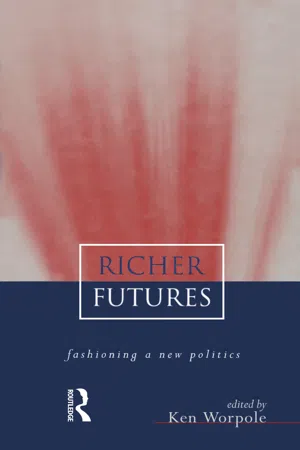
- 208 pages
- English
- ePUB (mobile friendly)
- Available on iOS & Android
eBook - ePub
About this book
Information
Part I
People and Ideas
1 The Anarchism of Colin Ward
David Goodway
As Ken Worpole has explained in his introduction, this book is a tribute to Colin Ward and his ideas, and Ward’s influence proceeds to connect the succeeding chapters, implicitly as well as explicitly. Ward is indeed one of the great radical figures of the last thirty to forty years, but his impact has been subterranean. His name is little mentioned by commentators and is scarcely known to the wider public. A striking indication of his intellectual and institutional marginality is that he has never possessed a regular commercial publisher.
Ken Worpole has demonstrated the correspondence between Ward’s concerns and contemporary debates and problems. I suspect that Ward himself would contend that this linkage can be made because of the commonsensical, realistic, necessary nature of anarchism as such (and not just his especial brand), and its relevance to the needs — political, social, economic, ecological — of the 21st century; and with this I myself would agree to a considerable extent. But equally there can be no gainsaying the very real originality of his oeuvre.
Colin Ward was born on 14 August 1924 in Wanstead, in suburban Essex, the son of Arnold Ward, a teacher, and Ruby Ward (née West), who had been a shorthand typist.1 He was educated at the County High School for Boys, Ilford (whose other principal claim to fame is that for 38 years its English teacher was the father of Kathleen Raine, who was to write so venomously of him, the school and Ilford in her first volume of autobiography, Farewell Happy Fields). He was an unsuccessful pupil and left school at fifteen.
Arnold Ward taught in elementary schools, eventually becoming a headmaster in West Ham which, although a county borough outside the London County Council, contained the depths of poverty of Canning Town and Silvertown. He was a natural Labour supporter and the family car (a Singer Junior) was much in demand on polling days.
To grow up in a strongly Labour Party environment in the 1930s was far from stultifying as is attested by Colin Ward, having both heard Emma Goldman speak in 1938 at the massive May Day rally in Hyde Park and attended the Festival of Music for the People at the Queen’s Hall in April 1939. At this festival Benjamin Britten’s Ballad of Heroes, with a libretto by WH Auden and Randall Swingler, and conducted by Constant Lambert, saluted the fallen of the International Brigades. Ward also recalls the milk tokens, a voluntary surcharge on milk sales, by which the London Cooperative Society raised a levy for Spanish relief.
It was Ward’s experiences during the Second World War that shaped, to a very large extent, his later career. His first job was as a clerk for a builder erecting (entirely fraudulently) Anderson shelters. His next was in the Ilford Borough Engineer’s office, where his eyes were opened to the inequitable treatment of council-house tenants, with some having requests for repairs attended to immediately, while others had to wait — since they ranked low in an unspoken hierarchy of estates. He then went to work for the architect Sidney Caulfield. Caulfield was a living link with the Arts and Crafts Movement, since he had been articled to John Loughborough Pearson (for whom he had worked on Truro Cathedral), been taught lettering by Edward Johnson and Eric Gill, and also, at the Central School of Arts and Crafts, studied under and later worked as a colleague of WR Lethaby, whom Caulfield revered.2 Lethaby, a major architectural thinker as well as architect, is one of the nine people whom Ward was to name in 1991 as his ‘influences’. Next door to his office, Caulfield let a flat at 28 Emperor’s Gate to Miron Grindea, the Romanian editor of the long-running little magazine, Adam. It was Grindea who introduced Ward to the work of such writers as Proust, Gide, Thomas Mann, Brecht, Lorca and Canetti.3
On demobilization from the British Army in 1947, Ward went back to work for Caulfield for eighteen months, before moving to the Architects’ Co-Partnership (which had been formed before the war as the Architects’ Cooperative Partnership by a group of Communists who had been students together at the Architectural Association School). From 1952 to 1961 he was senior assistant to Shepheard & Epstein, whose practice was devoted entirely to schools and municipal housing, and then worked for two years as director of research for Chamberlin, Powell & Bon. After a career change to teaching in 1964 — being in charge of liberal studies at Wandsworth Technical College from 1966 — he returned to architecture and planning in 1971 by becoming education officer for the TCPA (founded by Ebenezer Howard as the Garden City Association) and for which he edited BEE the Bulletin of Environmental Education. He resigned in 1979, moved to the Suffolk countryside, and has ever since been a self-employed author.
Ward had been conscripted in 1942 and it was then that he came into contact with anarchists. Posted to Glasgow, he received ‘a real education’ on account of the eyecatching deprivation he witnessed, his use of the Mitchell Library and, as the only British city ever to have had a significant indigenous anarchist movement (in contrast to London’s continental exiles and Jewish immigrants), the dazzling anarchist orators on Glasgow Green. He also frequented their Sunday-night meetings in a room above the Hangman’s Rest in Wilson Street and bookshop in George Street. He was particularly influenced by Frank Leech, a shopkeeper and former miner, who urged him to submit articles to War Commentary in London. His first article, ‘Allied Military Government’, on the new order in liberated Europe, appeared in December 1943. After visiting Leech, sentenced for failing to register for firewatching and refusing to pay the fine, while on hunger strike in Barlinnie Prison, Ward, who had no clothes to wear other than his uniform, found himself transferred to Orkney and Shetland for the remainder of the war.4
It was in April 1945, as the war drew to a close, that the four editors of War Commentary were prosecuted for conspiring to cause disaffection in the armed forces. They were anticipating a revolutionary situation comparable to that in Russia and Germany at the end of the First World War, with one of their headlines insisting ‘Hang on to Your Arms!’ — and Ward was among four servicemen subscribers who were called to give evidence for the prosecution. All four testified that they had not been disaffected, but John Hewetson, Vernon Richards and Philip Sansom were each imprisoned for nine months (Marie Louise Berneri was acquitted on the technicality that she was married to Richards).5 The following year, still in the army, but now in the south of England, Ward was able to report on the postwar squatters’ movement in nine articles in Freedom (War Commentary having reverted to its traditional title). When he was eventually discharged from the army in the summer of 1947, he was asked to join Freedom’s editorial group, of which George Woodcock had also been a member since 1945. This was his first close contact with the people who were to become his ‘closest and dearest friends’.
This Freedom Press Group was extremely talented and energetic and, although Woodcock emigrated to Canada in 1949 and Berneri died the same year, was able to call upon contributions from anarchists like Herbert Read (until ostracized in 1953 for accepting a knighthood), Alex Comfort and Geoffrey Ostergaard and such sympathizers as Gerald Brenan. The file of Freedom for the late 1940s and early 1950s makes impressive reading. During the 1940s War Commentary, followed by Freedom, had been fortnightly, but from summer 1951 the paper went weekly. In 1950 Ward had provided some 25 items, rising to no fewer than 54 in 1951, but the number declined as he began to contribute long articles frequently spread over four to six issues. From May 1956 until the end of 1960, and now using the heading of ‘People and Ideas’, he wrote about 165 columns. Given this daunting, sparetime journalistic apprenticeship, it is hardly surprising that his stylistic vice continues to be the excessive employment of lengthy, barely digested quotations.
By the early 1950s characteristic Ward topics had emerged: housing and planning, workers’ control and self-organization in indust...
Table of contents
- Cover
- Half Title
- Title Page
- Copyright Page
- Contents
- Acronyms and Abbreviations
- About the Contributors
- Introduction
- Part I People and Ideas
- Part II Growing Up Absurd
- Part III A Roof Over Your Head
- Part IV Other Landscapes, Other Ways
- Part V Dig Where You Stand
- Part VI Fashioning a New Politics
- Index
Trusted by 375,005 students
Access to over 1.5 million titles for a fair monthly price.
Study more efficiently using our study tools.
Frequently asked questions
Yes, you can cancel anytime from the Subscription tab in your account settings on the Perlego website. Your subscription will stay active until the end of your current billing period. Learn how to cancel your subscription
No, books cannot be downloaded as external files, such as PDFs, for use outside of Perlego. However, you can download books within the Perlego app for offline reading on mobile or tablet. Learn how to download books offline
Perlego offers two plans: Essential and Complete
- Essential is ideal for learners and professionals who enjoy exploring a wide range of subjects. Access the Essential Library with 800,000+ trusted titles and best-sellers across business, personal growth, and the humanities. Includes unlimited reading time and Standard Read Aloud voice.
- Complete: Perfect for advanced learners and researchers needing full, unrestricted access. Unlock 1.5M+ books across hundreds of subjects, including academic and specialized titles. The Complete Plan also includes advanced features like Premium Read Aloud and Research Assistant.
We are an online textbook subscription service, where you can get access to an entire online library for less than the price of a single book per month. With over 1.5 million books across 990+ topics, we’ve got you covered! Learn about our mission
Look out for the read-aloud symbol on your next book to see if you can listen to it. The read-aloud tool reads text aloud for you, highlighting the text as it is being read. You can pause it, speed it up and slow it down. Learn more about Read Aloud
Yes! You can use the Perlego app on both iOS and Android devices to read anytime, anywhere — even offline. Perfect for commutes or when you’re on the go.
Please note we cannot support devices running on iOS 13 and Android 7 or earlier. Learn more about using the app
Please note we cannot support devices running on iOS 13 and Android 7 or earlier. Learn more about using the app
Yes, you can access Richer Futures by Ken Worpole in PDF and/or ePUB format, as well as other popular books in Biological Sciences & Ecology. We have over 1.5 million books available in our catalogue for you to explore.