Sustainable development cannot be achieved solely at the international level. Without the creation of more sustainable livelihoods, it will remain a utopian and elusive goal. Yet given the huge differences in economic development and levels of consumption between North and South, how might this be
brought about?
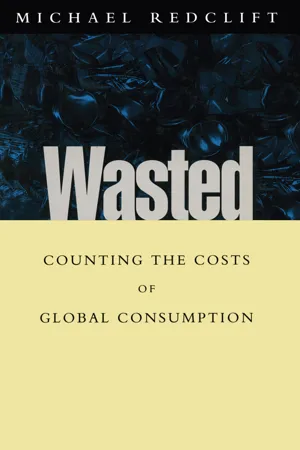
Taking the 1992 Rio Summit as its point of departure, Wasted examines what we now need to know, and what we need to do, to live within sustainable limits. One of the key issues is how we use the environment: converting natural resources into human artifices, commodities and services. In the process of consuming,
we also create sinks. Today, these sinks - the empty back pocket in the global biogeographical system - are no longer empty. The fate of the global environment is indissolubly linked to our consumption: particularly in the energy-profligate North.
To understand and overcome environmental challenges, we need to build the outcomes of our present consumption rates into our future behaviour: to accept sustainable development as a normative goal for societies; one that is bound up with our everyday social practices and actions. In this absorbing book, Michael Redclift argues that the way we understand and think about the environn1ent conditions our responses, and our ability to meet the challenge, and discusses tangible policies for increased sustainability that are grounded in recent research and practice.
MICHAEL Redclift
Is Professor of International Environmental Policy at the Department of Geography, King's College London. He was previously Professor of International Environmental Policy at the University of Keele and before that Professor of Environmental Sociology at Wye College, University of London, and Director of the ESRC Global Environmental Change Programme. He is author and editor of numerous books, including Sustainable Development: Exploring the Contradictions (1987), Social Theory and the Global Environment (1994) and Sustainability: Life Chances and Lifestyles (1999).
Originally published in 1996
- 196 pages
- English
- ePUB (mobile friendly)
- Available on iOS & Android
eBook - ePub
About this book
Information
Chapter One
Introduction
This book was written from a sense of acute unease with the rhetoric that has accompanied ‘sustainable development’ since the report of the Brundtland Commission, Our Common Future, was published (WCED 1987). My unease was compounded by the events during and after the Earth Summit, which was held in Rio de Janeiro in 1992. This story has been told elsewhere (Chatterjee and Finger 1994). My purpose in this book is to examine the assumptions behind our understanding of ‘sustainable development’, and the idea that environmental management can, and should, be practised at a global level.
We cannot begin to ‘manage’ the environment successfully at the global level without first achieving progress towards sustainability at the local level. This we have signally failed to do, and yet we are seeking to construct an apparatus to deal with specifically ‘global’ problems, through institutions like the Global Environment Facility. We are, in effect, inventing new institutional structures for managing the environment, which bear little or no relation to the processes through which the environment is transformed. There is little correspondence between the processes that drive unsustainable development, and the management tools and political institutions which are supposed to achieve greater global sustainability.
It is the contention of this book that sustainable development is a normative goal for societies, one that is imbued with values, and frequently implies value judgements. It is also a concept or model for understanding ecosystems. As a social goal sustainability is bound up with everyday practices, and familiar social institutions. To achieve sustainable development we should look no further than our own behaviour, and the economic and social institutions we have constructed which need to be radically overhauled. We are accustomed to speak about bequeathing the environment to future generations, but frequently baulk at the idea that we are also bequeathing social institutions with which to manage the environment. Sustainability will not be achieved by inventing management techniques to combat the contradictions of development. It can only be achieved by incorporating a knowledge of the consequences of our behaviour into the behaviour itself. This book outlines the importance of this objective, and its implications, particularly for those of us in the industrialised world. To achieve sustainability we need to recover our control over consumption, rather than invent new institutions to manage its consequences.
To some extent my position owes much to those who have already identified the deficiencies of both our economic policies, and the models which we use to interpret them. Foremost among these is Herman Daly, and his advocacy of ‘steady-state’ economics, as an antidote to ‘growthmania’. Daly writes:
The economy grows in physical scale, but the ecosystem does not. Therefore, as the economy grows it becomes larger in relation to the ecosystem. Standard economics does not ask how large the economy should be relative to the ecosystem.(Daly 1987, 180)
Herman Daly’s insight is discussed further in Chapter Six below. My intention in this book, however, is to take the discussion beyond the environment and economic theory, and to address the social processes which underpin our economic behaviour, and the structure of global political economy which makes the achievement of sustainable development so difficult.
At the heart of the matter lies the question of consumption. In a highly provocative paper about sustainability, Robert Goodland, an economist with the World Bank, makes a very challenging assertion. He argues that raising per capita incomes in poor countries to between $1500 and $2000 is quite possible. If this were to be done then people living at this level of consumption would benefit from 80 per cent of the basic welfare provided by incomes ten times as high in the North (c$15,000–$20,000). He adds:
[those] working on Northern overconsumption should address the corollary — can $21,000 per capita countries (OECD) cut their consumption by a factor of ten, and suffer ‘only’ a 20 per cent loss of basic welfare?(Goodland 1994, 8)
In the context of continuing economic growth we surely need to ask some leading questions: how much more welfare does additional material consumption actually buy? What would be the environmental and social benefits of reducing our consumption to more modest proportions? Could we design an alternative vision which enabled progress to be made in improving human welfare, without damaging the environment, and without significant welfare costs for most people in the North?
The urgency of these questions, as discussed in Chapter Three, is underlined by the growth of emulative consumption in much of the South, particularly the fast-growing economies of Asia. In the South, television ownership increased by 400 per cent between 1975 and 1989. In India there is evidence of more ‘television-friendly’ foods being consumed. For example, wheat-based chappatis are less often served on Sunday evenings when the evening movies are screened. And, of course, the images and advertising that fill the television screens (from STAR and ARABSAT and CNN) are of developed-country consumption. (The environments that are captured on television screens, North and South, as a part of the global tourist industry, are often — significantly — those of the South).
The problem with the ‘development’ agenda, then, is that in the real world meeting economic and social targets is impossible without raising consumption, both the volume and the kinds of goods we produce. Given the absolute limits on our natural resources, and the fact that our ‘development’ is placing more emphasis on the ‘sink’ functions of our natural forests and grasslands, we are clearly increasing the vulnerability of natural resource systems. As Wolfgang Sachs has put it, our
unfettered enthusiasm for economic growth in 1945 reflected the West’s desire to restart the economic machine after a devastating war.(Sachs 1991, 252)
We have still not outgrown this preoccupation.
However, faced with the difficulties, constraints and contradictions of ‘development’, we have begun to cast the argument for growth differently, relying on the qualifying adjective, ‘sustainable’, and the idea of development, to help ourselves out of the impasse. Environment and development is indeed, as Sachs suggests, the story of a dangerous liaison …
Is there an alternative to unsustainable development, besides grandiose, and unworkable, schemes for global management? I think there is, and want to argue that it begins with redefining the problem, following Daly, around ways of making consumption more sustainable. ‘Recovering’ consumption means both reducing existing waste and producing less waste in future. It also means conserving sinks, not merely because forests and water sources contain valuable species, but because without them we cannot consume at all. It means, to coin a phrase from the current policy discourse in Britain, replacing ‘technology foresight’ (increasing the United Kingdom’s competitiveness in international markets) with ‘environmental foresight’ (ensuring that we add to, rather than detract from, the accumulative value of natural capital stock).
As we shall see, increasing the lifespan of goods and services, and reducing adverse environmental impacts, also carries implications for our attitudes to consumption itself, and to such modern cultural icons as fashion, disposability and novelty. Although this book does not attempt it, any comprehensive treatment of modern consumption needs to grapple with its cultural concomitants: why do we need to consume? As the cultural historians John Brewer and Roy Porter make clear, material culture in the seventeenth and eighteenth centuries provides illuminating insights into society itself (Brewer and Porter 1993). There is every bit as much to be gained from examining the material culture of our own period, for insights into the preferences and prejudices of our own societies.
This book is also concerned to build bridges between sociological analysis, and the analysis of the underlying social commitments which define consumption, and global political economy. This is because, in my judgement, we need both. We need to understand why our commitments, and practices, carry implications for the environment that are difficult (although not impossible) to change. We also need to examine the economic structures, particularly those linking the developed and developing countries, which serve to maintain patterns of consumption and to ignore the consequences. It is important, if we are to explain the links between physical processes and social behaviour, to understand the logic of market capitalism, and the forces that drive the world economic system.
Much of the argument about deregulation today, and increasingly ‘re-regulation’ around the environment, is conducted as if there were no issues surrounding the economic ideology and structures which caused the problems in the first place.
CONSUMPTION AND THE ENVIRONMENT
The study of consumption has a long and distinguished pedigree, encompassing a number of disciplines, among which perhaps history and anthropology are the most notable. As Brewer and Porter comment, historians have, for the most part, regarded the ‘world of goods’ in a relatively unsystematic way, rarely bringing the insights of cultural, economic and political historians together (Brewer and Porter 1993). A number of useful, and occasionally brilliant, studies exist of individual commodities and goods but few studies of the history of consumer societies. Pioneering work, like that of Veblen, has failed to galvanise the interest of the social sciences during most of the twentieth century (Veblen 1899).
In the United Kingdom the analysis of ‘goods and things’, as the historian Asa Briggs described them, has frequently led to useful insights about the society from which they sprang (Briggs 1988). Some studies have shown how the development of class taste, and its manifestation in increasing consumption, is closely linked to economic expansion at the level of cities and the nation state. The Edwardian house, to give but one illustration, provides a window onto the fortunes of whole classes, involved in its construction, furnishing and occupation (Long 1993).
In particular, little attention has been given, until recently, to the way in which our consumption influences our environmental perceptions and values. Even our food preferences are rarely associated with transformations in the ‘natural’ environment (Goodman and Redclift 1991).
Another increasingly important contribution to the discussion of consumption, is that of anthropology (Miller 1987, Miller 1995). Anthropologists have always been interested in ‘goods’, in terms of exchange and value, taking their cue from Marcel Mauss’ classic study (Mauss 1954). The study of mass consumption, and of ideas about objectification and material culture, has emerged, together with ‘cultural studies’, as an important area for analysts of contemporary culture (Lee 1993). Baudrillard, among others, presents an account of the way in which commodities are interchanged, which reduces human relations to questions of style (Baudrillard 1981). However, as Campbell comments, the theorists within the social sciences who are usually quoted in connection with consumption (Walter Benjamin, Erving Goffman, Henri Lefebvre) are more properly theorists of culture, or of post-modernity, rather than theorists of consumption. (Campbell 1995).
More recent post-modern theory has given considerable attention to consumption. One example is Lash, who draws our attention to the differences between the semiotics of consumption, the ‘sign values’ communicated by style, taste and fashion, and the kind of objective limits to consumption which are established by markets. What Lash calls the ‘coherent limits to the level of human demands’ constitute the principal focus of this book, and it is a focus which has been largely ignored by post-modernism (Lash 1990,40). Partial exceptions are the recent interest not only in the symbolic importance of landscape, tourism and leisure, but the sense of ‘place’ which this engenders (Bird, Curtis, Putnam, Robertson and Tickner 1993, Urry 1995).
Without wishing to minimise the importance of consumption to societies in the wider sense, the argument of this book is about the material parameters within which consumption occurs. It is not principally concerned with globalisation as a cultural process (Featherstone 1990) although, as Barth argues, ‘the two ranges of issues become so closely interconnected that they will need to be addressed within some kind of encompassing perspective’ (Barth 1996, 21). The principal focus is the material consequences of the way that the environment is constructed socially, a construction which is increasingly global in reach. It is argued that we need to begin to assume responsibility for the material consequences of our actions, the effects of enhanced consumption on the environment and social welfare, before we can make any real inroads into the log-jam of global agreements.
One point of departure is the concern which some Green thinkers, and many more environmental groups, have expressed with Northern ‘overconsumption’ during the last few decades. Recent studies have commented on the way in which those in (formal) employment seek to maximise their income, rather than their leisure, in order to consume more. This is what Schor has called the ‘work and spend’ cycle (Schor 1995). There is some evidence that people in the developed countries today are less likely than their parents or grandparents were to trade-off increased leisure time against working time. Similarly, those in formal employment are also likely to play a dominant role in informal or ‘black economy’ work (Pahl and Wallace 1985). There are a number of facets to this prioritisation of work, and consumption, over leisure. Schor adds:
The existence of a work and spend cycle has a number of implications. First, it suggests an addictive aspect to consumption. Over time, people become habituated or “addicted” to the level of consumption which they are attaining. Goods which are originally experienced as luxuries come to be seen as necessities.(Schor 1995, 74)
The Role of NGOs
What can loosely be termed ‘Green thinking’ has often focused upon the importance of distinguishing between ‘needs’ and ‘wants’ (Illich 1975, Schumacher 1973, Porritt 1984).Essentially, needs require satisfaction, but the way that they are satisfied can vary widely, and consumer societies may successfully create new ‘wants’ without satisying even basic needs. The idea of a hierarchy of needs, first put forward by Maslow (1954), is often understood at an intuitive level by the population at large, and prompts the interest both in reducing waste (recycling and re-use) and in the vast expansion of voluntary-sector activities, on behalf of the homeless and others, which have helped to fill the gap left by the retreat of the state since the early 1980s. Non-governmental organisations (NGOs) such as Friends of the Earth, Greenpeace and Oxfam, have been at the forefront of demands to place Northern consumption within the context of North/South trade, global environmental destruction and the transport of wastes. Attention has been given to ways in which Northern consumers can make choices that are less prejudicial to the developing countries without ceasing to be ‘global consumers’ (Wells and Jetter 1991).
The presence of NGOs, and the pressure mounted by them, was a major factor in stimulating the events leading up to the Rio Summit in 1992, and since then it is largely the NGOs, increasingly in alliance, that have forced national governments to consider the relationship between levels of consumption, waste and the environment. At the same time it is important to separate NGO environmental campaigns in the North from grass-roots activities in the South. As Parnwell and Bryant (1996) point out, in South East Asia, NGOs have been unable to match global concern with reversals in official policy, despite unrelenting campaigns.
HOW CAN WE RECOVER CONSUMPTION?
These issues of the relationship between the environment and consumption, and the impact on North/South relations, are taken up at different stages in this book. It is argued that we need to begin ...
Table of contents
- Cover
- Halftitle Page
- Title Page
- Copyright Page
- Dedication
- Contents
- Acknowledgments
- List of Figures
- List of Tables
- Chapter One Introduction
- Chapter Two The Earth Summit
- Chapter Three Meeting Environmental Targets
- Chapter Four The Global Economy and Consumption
- Chapter Five Managing Global Resources
- Chapter Six Metabolising Nature
- Chapter Seven Sustainability and Social Commitments
- Chapter Eight Local Environmental Action
- References
- Index
Trusted by 375,005 students
Access to over 1.5 million titles for a fair monthly price.
Study more efficiently using our study tools.
Frequently asked questions
Yes, you can cancel anytime from the Subscription tab in your account settings on the Perlego website. Your subscription will stay active until the end of your current billing period. Learn how to cancel your subscription
No, books cannot be downloaded as external files, such as PDFs, for use outside of Perlego. However, you can download books within the Perlego app for offline reading on mobile or tablet. Learn how to download books offline
Perlego offers two plans: Essential and Complete
- Essential is ideal for learners and professionals who enjoy exploring a wide range of subjects. Access the Essential Library with 800,000+ trusted titles and best-sellers across business, personal growth, and the humanities. Includes unlimited reading time and Standard Read Aloud voice.
- Complete: Perfect for advanced learners and researchers needing full, unrestricted access. Unlock 1.5M+ books across hundreds of subjects, including academic and specialized titles. The Complete Plan also includes advanced features like Premium Read Aloud and Research Assistant.
We are an online textbook subscription service, where you can get access to an entire online library for less than the price of a single book per month. With over 1.5 million books across 990+ topics, we’ve got you covered! Learn about our mission
Look out for the read-aloud symbol on your next book to see if you can listen to it. The read-aloud tool reads text aloud for you, highlighting the text as it is being read. You can pause it, speed it up and slow it down. Learn more about Read Aloud
Yes! You can use the Perlego app on both iOS and Android devices to read anytime, anywhere — even offline. Perfect for commutes or when you’re on the go.
Please note we cannot support devices running on iOS 13 and Android 7 or earlier. Learn more about using the app
Please note we cannot support devices running on iOS 13 and Android 7 or earlier. Learn more about using the app
Yes, you can access Wasted by Michael Redclift in PDF and/or ePUB format, as well as other popular books in Politics & International Relations & Ecology. We have over 1.5 million books available in our catalogue for you to explore.