eBook - ePub
Business Solutions for Budget Managers in Health and Personal Social Services
- 152 pages
- English
- ePUB (mobile friendly)
- Available on iOS & Android
eBook - ePub
Business Solutions for Budget Managers in Health and Personal Social Services
About this book
Managers responsible for spending public money in health and social welfare are facing unprecedented pressures to deliver better services against a background of fierce competition for resources, profound organizational change and the creation of internal market places. In this practically-directed book, William Bryans explains how business principles can be applied in the public service context to enable managers to meet this challenge. The author demonstrates how it is possible to create a surplus for service development by effective strategic management of external and internal financial environments, operational management of workloads and resources, and tactical intervention to limit budget fluctuations to tolerable levels. Each chapter includes a purpose statement, an outline of relevant theory and practice, a keypoint summary and a case study based on real world situations.
Information
1
Defining the problem(s)
Objectives
The objectives of this chapter are to examine the main issues and in general terms set out the various problems which confront modem budget managers. Budget problems are usually first manifested in budget reports, but the underlying causes are complex. This is mainly the result of the reform programme.
Appropriate solutions are dependent on the correct diagnosis of the problem, or problems. In this chapter these problems are connected to the business culture topics:
• The main business elements that regulate financial management are identified.
• The need for an integrated approach is discussed.
• The outline effect of the budget manager’s market share on income and budget is shown.
• The relationship between cost, case load and budget is defined.
• The impact of case mixtures and an alteration in care balance on resource consumption through increased dependency is demonstrated.
• The contract capability and criteria for the measurement of income are identified.
• Examples of significant variations and the need for planned intervention is emphasised.
The chapter continues with:
• An analysis of the main problems.
• A summary of their causes.
• An outline of various business solutions.
• A competence based approach to budget security.
Arising from this, the overall structure of the book is established.
Familiar territory
In every age where money has been the currency of business, budget managers have experienced the basic problem that they have too little. Inevitably their problems have been compounded by their masters requiring too much. Where a financial plan produces a surplus, demands upon savings always outstrip the reality. If there is a deficit, then the manager is automatically to blame. In the unlikely case of a balance being achieved there is usually an inference that the performance was still somehow disappointing.
The last decade has seen the growth of a business culture in health and social services management. Coterminous with this has been a subtle shift away from the concept of budget holding and towards an emphasis upon budget management. In many ways this change can be viewed as a move from simpler passive control of a budget to the much more complex active intervention in order to compete.
In comparison with their predecessors, who enjoyed the benefit of a fairly consistent financial growth rate, modem budget managers are confronted with more complex tasks. A near-0 financial growth rate, together with requirements to alter the balance of care consistent with the mixed economy, results in significant budget problems.
Whatever the era, budget problems continue to depress budget managers. Overspendings seem to dominate and can, if allowed, become an obsession at all levels. This does not have to be so.
Budget management problems are usually first detected in the financial reporting mechanism. For most budget managers the pattern shown in Table 1.1 will be familiar.
Care group | Budget for Month 5 £k | Spend for Month 5 £k | Over spend £k | Under spend £k |
|---|---|---|---|---|
Community workers | 50 | 60 | 10 | |
Residential contracts | 30 | 25 | 5 | |
Housing partnership | 15 | 21 | 6 | |
Community workers | 25 | 20 | 5 | |
Home helps | 10 | 14 | 4 | |
Totals | 130 | 140 | 20 | 10 |
Familiar questions that arise are:
1. Is it a true position?
2. Are the overspendings uncharacteristic?
3. Are there any seasonal fluctuations to be accounted for?
Table 1.1 is, in respect of a budget, intended to cover the provision of services to mentally handicapped people. It has been subjected to an alteration in the balance of care in favour of the community. The origin of significant problems is to be found elsewhere in the system. This suggests an outline action plan from which a structured intervention may be developed (see Figure 1.1).
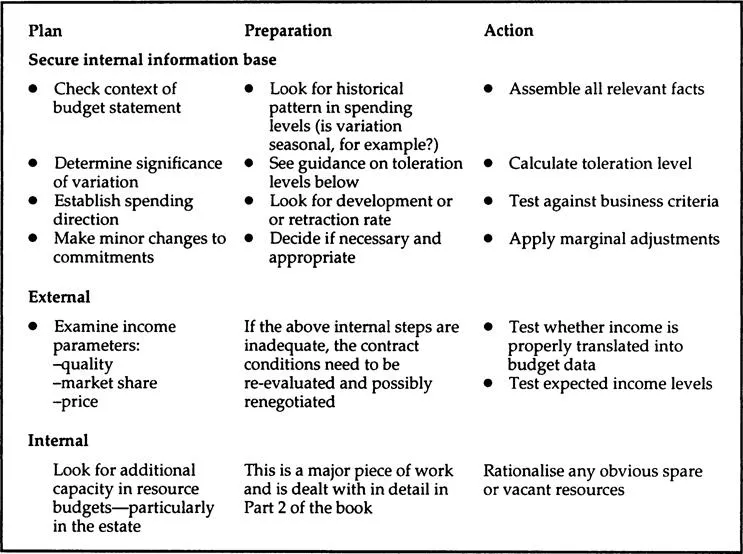
The budget manager must see whether tactical intervention is the best solution in this case or whether it is necessary to go further. The manager also needs to know if underspendings can be used or whether they are only temporary.
Significant variations
When we look at this position in terms of the year’s performance to date, it is evident that there is a consistent over-commitment in the case of hospital, housing association partnerships, and the home help budgets (see Table 1.2). However, contracts with private providers and expenditure in the community have balances remaining.
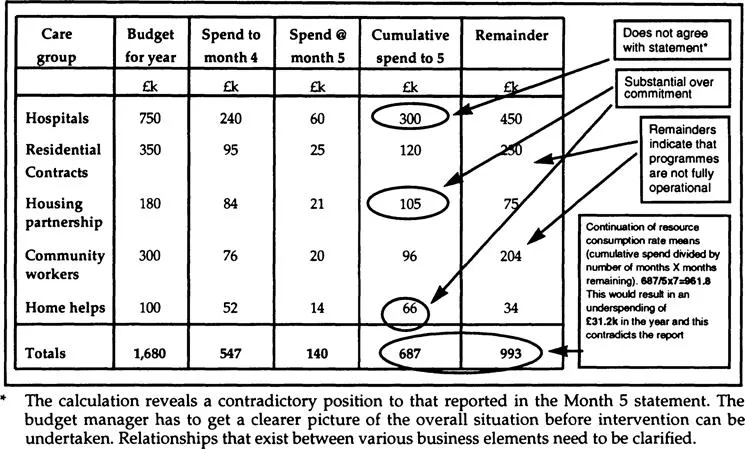 |
The budget manager must look at the business plan before any dramatic revision—especially the implementation of additional spending plans— takes place.
• In the case shown in Tables 1.2 and 1.3, the business plan reveals that the hospital portion refers to a ...
Table of contents
- Cover
- Title Page
- Copyright Page
- Dedication
- How to get the best from this book
- Content
- Table of Contents
- Part 1
- Part 2 Synopsis — operational management and tactical intervention
- Part 3 Synopsis — Developing and measuring competence
- Reading list
- Articles by the author
Trusted by 375,005 students
Access to over 1.5 million titles for a fair monthly price.
Study more efficiently using our study tools.
Frequently asked questions
Yes, you can cancel anytime from the Subscription tab in your account settings on the Perlego website. Your subscription will stay active until the end of your current billing period. Learn how to cancel your subscription
No, books cannot be downloaded as external files, such as PDFs, for use outside of Perlego. However, you can download books within the Perlego app for offline reading on mobile or tablet. Learn how to download books offline
Perlego offers two plans: Essential and Complete
- Essential is ideal for learners and professionals who enjoy exploring a wide range of subjects. Access the Essential Library with 800,000+ trusted titles and best-sellers across business, personal growth, and the humanities. Includes unlimited reading time and Standard Read Aloud voice.
- Complete: Perfect for advanced learners and researchers needing full, unrestricted access. Unlock 1.5M+ books across hundreds of subjects, including academic and specialized titles. The Complete Plan also includes advanced features like Premium Read Aloud and Research Assistant.
We are an online textbook subscription service, where you can get access to an entire online library for less than the price of a single book per month. With over 1.5 million books across 990+ topics, we’ve got you covered! Learn about our mission
Look out for the read-aloud symbol on your next book to see if you can listen to it. The read-aloud tool reads text aloud for you, highlighting the text as it is being read. You can pause it, speed it up and slow it down. Learn more about Read Aloud
Yes! You can use the Perlego app on both iOS and Android devices to read anytime, anywhere — even offline. Perfect for commutes or when you’re on the go.
Please note we cannot support devices running on iOS 13 and Android 7 or earlier. Learn more about using the app
Please note we cannot support devices running on iOS 13 and Android 7 or earlier. Learn more about using the app
Yes, you can access Business Solutions for Budget Managers in Health and Personal Social Services by William S. Bryans in PDF and/or ePUB format, as well as other popular books in Betriebswirtschaft & Buchhaltung & Budgets. We have over 1.5 million books available in our catalogue for you to explore.