- 224 pages
- English
- ePUB (mobile friendly)
- Available on iOS & Android
eBook - ePub
About this book
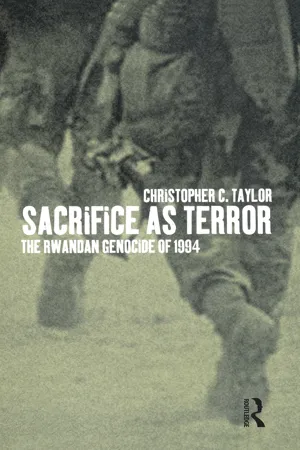
In the early months of 1994, it became clear that the government of Rwanda had not acted in good faith in signing peace accords with its adversary, the Rwandan Patriotic Front. Acts of government-sponsored violence grew more frequent. The author of this book, who at that point was conducting fieldwork in Rwanda, on several occasions found either himself or the Rwandans accompanying him threatened with, or sustaining, bodily harm. Finally, active hostilities between the antagonists escalated on April 7, 1994, just hours after the Rwandan President's plane was shot down. During the author's evacuation from Rwanda in the months following, he interviewed many survivors. This book, the outcome of the author's experiences during the conflict, is an attempt to understand the atrocities committed during the 1994 genocide in Rwanda in which nearly one million people, mostly of Tutsi ethnicity, were slaughtered in less than four months. Beyond this, the author shows that political and historical analyses, while necessary in understanding the violence, fail to explain the forms that the violence took and the degree of passion that motivated it. Instead, Rwandan ritual and practices related to the body are revelatory in this regard, as the body is the ultimate tablet upon which the dictates of the nation-state are inscribed. One rather bizarre example of this is that Hutu extremists often married or had sexual relations with Tutsi women who, according to the Hamitic hypothesis, were said to be sexually alluring. Their mixed-race offspring were not exempt from the genocide. Finally, and perhaps most importantly in light of the recent resurgence of violence, the author advances hypotheses about how the violence in Rwanda and Burundi might be transcended.
Information
CHAPTER ONE
Rwanda
Rwanda is the smallest African country south of the Sahara and possesses a superficial area roughly equal to that of the state of Maryland. Much of the surface is covered with lakes, swamps, or mountains that are too steep to farm. Rwanda is close to the equator (2s S), but high altitude keeps it temperate. Most of its population, which is 95 per cent rural, lives at altitudes between 1,500 and 2,500 m. With a population that was close to 7.5 million people before the genocide and about 6.5 million after it, including approximately 1.5 million Hutu refugees, most of whom were repatriated from Zaire (now Democratic Republic of Congo), Tanzania, and Burundi, it remains sub-Saliaran Africa's most densely populated country (over 250 inhabitants per square kilometre). Moreover, its population growth rate of over 3.5 per cent per year is one of the highest in the world. Population density in Rwanda compares to some of Japan's most populous islands, yet its average per capita GDP is one of the smallest in the world. To many observers, lack of available land contributed to the political tensions that led to the genocide (Chretien, 1997). Although far from being the whole story, there is some truth to this.
Rwandan farms are quite small, just a little over two acres on the average, whereas the typical Rwandan household consists of about nine people. Virtually all the arable land in Rwanda is under intensive cultivation. From much of the land, two crop harvests can and must be extracted per year in order for the people to survive. Subsistence crops include: plantains, sorghum, beans, maize, potatoes, sweet potatoes, manioc, wheat in some places, and rice in others. Many Rwandans also raise livestock including goats, sheep, and cattle. Cattle are the most prestigious form of livestock. Both Tutsi and Hutu own cattle where possible and the animals are exchanged in the most socially significant transactions such as marriage and patron-client ties. Cash crops are also grown in Rwanda including coffee, tea, and pyrethrum flowers (used in pyrethrin insecticides). Tea tends to be grown on large state-owned plantations, and numerous independent small farmers plant coffee. These latter are among the most poorly compensated for their product in the world (Chretien, 1997).
Not every Rwandan farm consists of only two acres; in the last several decades a rapid process of class formation and socio-economic differentiation has produced something of a rural aristocracy and a small urban bourgeoisie. Close to 17 per cent of the total number of Rwandan farms are larger than two acres and these take up about 43 per cent of Rwanda's total area of arable land, 60 per cent of the total in Kigali prefecture (Chretien, 1997: 77). Before the genocide, many of the owners of these larger farms were military officers and/or MRND party notables with commercial interests, prompting many to speak of Rwanda's élite as a 'military-merchant' class. Although some Rwandan entrepreneurs have earned their position in this élite by providing needed products and services to the Rwandan economy, most gained their status due to their proximity to the organs of state power.
More than competence, connections to the regime have given rise to a new form of pseudo-technocratic bourgeoisie and conferred prosperity upon it. Following the tips and downs of political favor, we see a rapid turnover in these bourgeois gentlemen. In three years one such high personality exercised four different functions: administrator of the pyrethrin factory in Ruhengeri, general director of the Social Fund of Rwanda, Prefect of Kibungo, and finally. Minister of Education. What pleasant diversity, what guaranty of effectiveness!
Without over-generalizing, the claim is justified that a portion of the Rwandan bourgeoisie is simply parasitic and prebendal. One must also admit that a fraction of it does re-invest some of its earnings. Many industrial ventures started out as commercial operations.
(Bezy, 1990: 51, cited from Chretien, 1997: 78, my translation)
Famines have occurred with some frequency in Rwandan history. One particularly severe famine in 1927-30 undoubtedly hastened the overthrow in 1931 of one Rwandan mwami, Yuhi Musinga, the last non-Christian Rwandan king (Cornet, 1995). More recently drought in the late 1980s coupled with a decrease in world coffee prices, combined to produce famine conditions in some areas during 1989-90. Thousands of people in south-western Rwanda fled as 'economic refugees' into neighbouring Zaire and Burundi. None of this was helped by a 'structural adjustment programme' that resulted in a sharp devaluation {40 per cent) of the Rwandan Franc (Chretien, 1997: 76). Without the massive input of food assistance during the 1990s, surely many Rwandans would have died of starvation.
During the 1970s and 1980s there were many assistance projects that aimed at increasing agricultural output and decreasing the birth rate. Some successes in achieving these goals had been realized; family planning projects, for example, had managed to bring the average number of births per woman down from close to nine to a little under six. Many other projects were operative in Rwanda in the 1970s and 1980s – so many, in fact, that Rwanda was sometimes referred to as the country with the most number of aid projects per square kilometre (Willame, 1990). These projects often did well in Rwanda because of the country's hard-working population, relatively high number of educated people, and until the mid-1980s, relatively little corruption by local standards. Other development analysts have pointed to the country's psychological and economic dependence on these projects and to the possibility that they may have been doing more long-term harm to Rwanda than good (Willame, 1990).
Early Colonial History
Until the late nineteenth century Rwanda had managed to avoid much contact with others beyond its borders. Arab slave traders for example, were unable to conduct raids on Rwandan soil because most of central and eastern Rwanda was well-organized under a centralized state ruled by a king (mwami). The fighting forces of this state, basically peasant militias with hierarchical ties to the mwami and his central court, could be rapidly mobilized to counter any external threat. For this reason, Islam, so important in neighbouring Tanzania and nearby Kenya, never gained much of a foothold in Rwanda. Only about 10 to 12 per cent of the pre-genocide population was Muslim.
As for European contact with Rwanda, it was not until the 1880s that Rwanda began to be seriously coveted by rivalrous powers in the 'scramble for Africa'. The first European colonialists to set foot in Rwanda were the Germans, who established a certain priority of claim to Rwanda and Burundi due to the fact that a German, Count von Götzen, had been the first to extensively explore the area and to sign a treaty with the Rwandan king at the time, Kigeri V Rwabugiri. But German claims to the region were contested by the British, already present in neighbouring Uganda to the north, who wanted the area as a link in their planned rail line from the Cape of Good Hope to Cairo. King Leopold of Belgium also had designs on Ruanda-Urundi due to its proximity to the Congo Free State and the possibility to extend a corridor eastward from the territory to the Indian Ocean (Louis, 1963).
These conflicting claims were settled at the Berlin Conference of 1884-85 when most of Ruanda-Urundi was awarded to Germany. England managed to retain much of the lands termed Mfumbira (adjacent to present day north-west Rwanda), although there were many people in the region who spoke Kinyarwanda. Kinyarwanda speakers also predominated on the Island of Ijwi in the middle of Lake Kivu, but the Congo Free State retained possession of it (Louis, 1963).
At the Berlin Conference the ground rules for colonialism were also established. The two main ones were 'effective occupation' and the 'civilizing mission'. A colonial power needed to demonstrate that its agents, soldiers, and missionaries, were effectively occupying the land and that they were 'civilizing' the indigenous inhabitants. At the time no one contested European anthropological assumptions, held by laymen and scholars alike, that societies could be unproblematically divided into those that were 'civilized' and those that were not. White Europeans placed themselves and all their cultural attributes at the pinnacle of civilization. Christianity constituted one of the most significant pieces in the European cultural mosaic and by sending the natives its proselytes, Europeans persuaded themselves that their interference in the lives of distant peoples was altruistic.
In the case of Rwanda, the first missionaries to accept the call were Catholic missionaries from Alsace who established their first mission in 1900. Unable to find willing candidates from Germany itself, at least at the time, the Germans decided to recruit missionaries from somewhere as close to home as possible and with some historical and cultural links to Germany. The only problem was that these priests were more often Francophone than German speaking (Linden, 1977).
Along with belief in Christ, the received wisdom of the eighteenth and nineteenth centuries associated 'civilization' with inherent biological and intellectual superiority. According to the 'Great Chain of Being' theory, northern Europeans were closer to God and the angels whereas Africans occupied a position closer to lower animals. The theory justified European domination of the planet as an inevitable corollary to the race's superior intellectual abilities. Added to the pseudo-science of the Great Chain of Being was another theologically inspired theory to explain the origin of seemingly anomalous advanced civilizational traits found south of the Sahara in central Africa. According to this theory, 'Hamite' Tutsi were responsible for bringing the rudiments of civilization to the region. Tutsi were presumed to be the remnants of a lost tribe of Israel, the descendants of Ham – Noah's son, banished to the south of the Promised Land. Following this hypothesis, descendants of Ham, being Caucasian, had an easy time conquering the less intelligent negroid peoples that they encountered in their inexorable move southward (see Chapter 2). As they moved southward the Hamites supposedly became darker skinned, though they did not lose all their Caucasian attributes.
Rwanda was destined to be the hapless focal point of these several convergent streams of thought emanating from nineteenth-century science and theology. If a state pre-existed the arrival of Europeans in Rwanda, it had to be the work of clever Hamite-Tutsi. Rwanda for the Europeans was composed of three distinct racial groups: the Hanritic Tutsi whose Caucasian affinities naturally predisposed them to rule, the Bantu Hutu whose stocky physiques naturally predisposed them to hard work, and the pygnroid Twa who, as an atavistic throwback to the ape, were a pariah race destined to disappear.
History of Ethnic Conflict
Much has been written about the two tiny central African countries of Rwanda and Burundi and, of course, one of the preferred subjects of discussion is the question of ethnicity and its effect upon political life in both countries. Before 1994, Rwanda and Burundi were characterized by a similar ethnic mix of approximately 80-85 per cent Hutu, 15-20 per cent Tutsi, and a little less than 1 per cent Twa. In sharp contrast to ethnic differentiation in other parts of Africa, where linguistic, religious, or regional differences figure prominently, Rwandan and Burundian ethnic groups share a single language and culture and are not, for the most part, regionally Concentrated in specific areas. In pre- and early colonial times, a high degree of economic specialization characterized the groups. A larger proportion of Tutsi, for example, gained their livelihood from cattle herding than Hutu, who were cultivators. Nevertheless, manv Hutu raised cattle as well as cultivating and many Tutsi raised crops as well as husbanded cattle. Only Twa neither cultivated nor herded cattle. A few were hunter-gatherers, but most were potters.
Since independence in 1962, many Twa have continued to make pots, but less difference in terms of economic activity can be observed between Tutsi and Hutu due to the diminution of pasture lands. Although there are still some Tutsi who live primarily from herding, most members of both groups cultivate the land and own cattle where this is economically feasible. Where religion is concerned, most Rwandans arc Christian, and although there are more Roman Catholics than Protestants, religious preferences do not break down neatly along ethnic lines. Differences in physiognomy among the three groups exist, but these are statistical in nature rather than indelible markers of difference. Many Tutsi are taller and thinner than Hutu and have longer and thinner appendages, whereas members of the Twa minority tend to be the shortest in stature. Physiognomy, though often used by Rwandans and Burundians as a means of ethnic discernment, is not always reliable. Many people classified in a particular ethnic group do not have the group's typical features.
When the first German colonialists arrived in Ruanda-Urundi, they noted the local use of the terms, Tutsi, Hutu, and Twa. They also perceived that in the areas with which they had the most experience, many high-status individuals came from the Tutsi group. While this perception was more accurate in the case of Rwanda, where the most influential polity was a Tutsi-led kingdom, even in Rwanda the perception of absolute Tutsi dominance was an over-simplification (Newbury, 1988). In the central Rwandan Tutsi kingdom, there were Hutu who held high positions. In areas adjacent to the centre, Hutu also held positions of responsibility even though in most instances they recognized the authority of the Rwandan king. Finally, in the most peripheral regions that were nevertheless linguistically and culturally similar in many ways to central Rwanda, Hutu polities existed that maintained their autonomy vis-à-vis the central Rwandan state (Newbury, 1988). Many of these polities referred to their ruler by the same term that was used to designate the ruler in central Rwanda, mwami (Nahimana, 1993).
Operating under the assumptions of the Euro-centric Hamitic hypothesis and following British Colonel Lugard's idea of 'indirect rule,' Germans decided to administer Ruanda-Urundi indirectly through Tutsi. Although German tutelage over Ruanda-Urundi was destined to be short-lived, it established a pattern that would come to characterize relations between Europeans and Africans and between Rwanda's two most numerous groups, Tutsi and Hutu.
In addition to favouring Tutsi over Hutu and Twa, German colonialists helped the Rwandan king extend central Rwanda's control over peripheral regions, particularly in northern and southwestern Rwanda. Although Rwandan kings had often waged military campaigns in these areas, the influence of the king and his court depended largely upon their presence. As soon as the king's soldiers headed back to central Rwanda, life would resume as before. After the arrival of the Germans, however, efforts began to definitively integrate northern Rwanda into the central state and to place Tutsi administrators there. During the early 1900s, the north was the scene of frequent violent confrontations between colonial troops allied to the central Rwandan state and local northern leaders. Many of the latter were inspired by the local traditional religion known as Nyabingi. These confrontations persisted until 1912, when the last Nyabingi leader, Ndungutse (who was a Tutsi), was killed (Lugan, 1997: 254). After his defeat, northern Rwanda became open to the in-migration of central Rwandan Tutsi associated with the Rwandan king.
Germany controlled Ruanda-Urundi for just a little over 20 years until the loss of its colonies at the end of the First World War. The League of Nations then awarded Belgium a mandate over Ruanda-Urundi. The change in colonial masters did not significantly affect relations among Rwanda's three ethnic groups, however. Tutsis continued to be favoured. Already, under the Germans, Catholic missionaries had established an administrative school at the royal capital of Nyanza. Students at this school were predominantly Tutsi. If anything, this tendency was accentuated under the Belgians –between 1932 and 1957 three-quarters of the students recruited were Tutsi (Chretien, 1997: 14).
When Belgium assumed control over Ruanda-Urundi, the policy of consolidating the central regime's hold over the north was continued. Northern Rwanda had managed over the centuries to retain a great deal of autonomy in relation to the central kingdom, thus extension of European, central Rwandan, and Tutsi control over the area during the 1920s was particularly resented. Jan Vansina refers to this period as a time when central Rwandan Tutsi 'colonized' northern Rwanda (Vansina, 1967).
After 1929, Belgian authorities further systematized indirect rule through Tutsi who had been educated at the missionary-run administrative school in Nyanza (Linden, 1977). The early Catholic missionaries educated this élite and transferred Hamitic ideology and prejudices to many of them.1 For example, the first missionary ethnographers of Rwanda such as R Pages (1933) and A de Lacger (1959) popularized Hamitic themes that had first appeared in writings by John Henning Speke, Harry Johnston, and Charles G Seligman (Prunier, 1995). Many upper-class Tutsi understood that it was to their advantage to reinforce European perceptions of Hamitic superiority and they obliged with pseudo-historical fabrications that extolled their intellectual, cultural, and military supremacy. Although the Tutsi élite were only echoing what colonialists had told them, the story of Tutsi natural superiority and predisposition to govern took on the aspect of ...
Table of contents
- Cover
- Title Page
- Copyright Page
- Contents
- Acknowledgements
- Introduction
- CHAPTER ONE Rwanda
- CHAPTER TWO The Hamitic Hypothesis in Rwanda and Burundi
- CHAPTER THREE The Cosmology of Terror
- CHAPTER FOUR The Dialectics of Hate and Desire: Tutsi Women and Hutu Extremism
- Conclusion
- Bibliography
- Index
Trusted by 375,005 students
Access to over 1.5 million titles for a fair monthly price.
Study more efficiently using our study tools.
Frequently asked questions
Yes, you can cancel anytime from the Subscription tab in your account settings on the Perlego website. Your subscription will stay active until the end of your current billing period. Learn how to cancel your subscription
No, books cannot be downloaded as external files, such as PDFs, for use outside of Perlego. However, you can download books within the Perlego app for offline reading on mobile or tablet. Learn how to download books offline
Perlego offers two plans: Essential and Complete
- Essential is ideal for learners and professionals who enjoy exploring a wide range of subjects. Access the Essential Library with 800,000+ trusted titles and best-sellers across business, personal growth, and the humanities. Includes unlimited reading time and Standard Read Aloud voice.
- Complete: Perfect for advanced learners and researchers needing full, unrestricted access. Unlock 1.5M+ books across hundreds of subjects, including academic and specialized titles. The Complete Plan also includes advanced features like Premium Read Aloud and Research Assistant.
We are an online textbook subscription service, where you can get access to an entire online library for less than the price of a single book per month. With over 1.5 million books across 990+ topics, we’ve got you covered! Learn about our mission
Look out for the read-aloud symbol on your next book to see if you can listen to it. The read-aloud tool reads text aloud for you, highlighting the text as it is being read. You can pause it, speed it up and slow it down. Learn more about Read Aloud
Yes! You can use the Perlego app on both iOS and Android devices to read anytime, anywhere — even offline. Perfect for commutes or when you’re on the go.
Please note we cannot support devices running on iOS 13 and Android 7 or earlier. Learn more about using the app
Please note we cannot support devices running on iOS 13 and Android 7 or earlier. Learn more about using the app
Yes, you can access Sacrifice as Terror by Christopher C. Taylor in PDF and/or ePUB format, as well as other popular books in Social Sciences & Anthropology. We have over 1.5 million books available in our catalogue for you to explore.