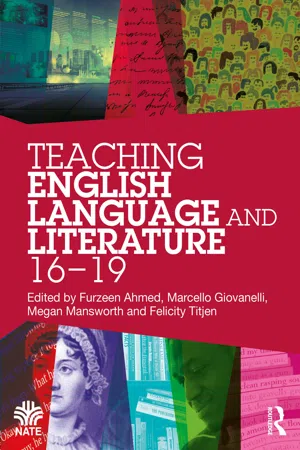
This book offers both a scholarly and practical overview of an integrated language and literature approach in the 16-19 English classroom. Providing a comprehensive overview of the identity of the subject, it outlines the pedagogical benefits of studying a unified English at post-16 and provides case studies of innovative classroom practice across a range of topics and text types.
Including contributions from practising teachers and higher education practitioners with extensive experience of the post-16 classroom and drawing on a range of literature, this book covers the teaching of topics such as:
Mind style in contemporary fiction
Comparative poetry analysis
Insights from linguistic cohesion
Criticality through creative response
Written to complement the two other Teaching English 16–19 titles in the NATE series, Teaching English Language and Literature 16–19 is the ideal companion for all practising A-level English teachers, of all levels of experience.
Every year, awarding bodies in England provide feedback to teachers in the form of an ‘Examiner’s Report’, usually put together by a senior examiner for a particular paper and authorised, published and disseminated by the awarding body. This document outlines key messages arising from the previous year’s examinations, including an overview of what candidates did well and not so well, and some strategic points for teachers to take forward into future series. The report is influential in determining how practitioners both plan for their subsequent year’s teaching and conceptualise the academic identity of the subject. In 2018, Eduqas (the English branch of WJEC) offered the following advice to teachers of their AS English Literature specification:
Feature spotting should be avoided – as well as naming of grammatical functions (i.e. ‘Austen uses the fronted adverbial’).
[…] Centres should encourage candidates to limit their use of terms taken from English Language study, as these often distract from literary analysis.
The advice offered here follows a well-established pattern of representing English in secondary and post-16 education: language and literature are effectively separated. In this instance, the compartmentalisation is such that the use of knowledge about language and linguistics is viewed as inherently bad; teachers are advised that using linguistic terminology (the point about ‘feature spotting’ aside) is bad practice and that generally language study can ‘distract’ candidates in some way from the real purpose of literary criticism. The vision of the subject being offered here has no room for an integrated English. This chapter takes this stance as a starting point and, like the remaining chapters in this volume, rejects it as false and unhelpful. In contrast it puts forward an argument for why English language and literature should exist as a discipline and set of academic practices that draw together knowledge, concepts and analytical methods from linguistic and literary study and utilise them in the service of textual production and response.
I begin by offering an overview of what I perceive as the ‘lang-lit’ problem, tracing how the compartmentalisation of the subject may be viewed as the result of historical debates about the nature and identity of English as an academic subject both in universities and in schools. At post-16, for example, English language and literature as a discrete area of study has a considerably shorter existence than both English language and, particularly, English literature as a version of English within the secondary and post-16 curricula and as a qualification offered by A-level awarding bodies. As a way of arguing for a revised conceptualisation of English language and literature, I then provide an overview of the parameters of literary linguistics or stylistics as an academic discipline together with some practical ways in which this integrated English may be developed in the classroom. The chapter ends with some reflections on what an integrated rather than a separated English might look like and how conceptualising and teaching the subject in this way may have favourable intellectual and pedagogical outcomes.
The Lang-Lit problem
A compartmentalised view of the subject has its roots in a set of arguments and debates that stretch back in both universities and in schools over many years and are often complex and multifaceted. Writing about the issue in the context of higher education, Williamson (2009) outlines how a series of heated debates regarding the relationship between language study/linguistics and literary studies played out in English universities from the 1950s onwards. Williamson traces how the shift in modern linguistics and language study in universities from philology to semantics and syntax brought with it an opportunity to re-evaluate how language and linguistics and their relationship to literary scholarship were theorised in English departments and then actualised in teaching programmes for students. For example, Williamson highlights the role played by Angus McIntosh at the University of Edinburgh who, working against firmly embedded and dichotomous versions of English as offered by Oxford (language) and Cambridge (literature), became increasingly interested in what modern linguistics could offer literary studies, even introducing what would become a seminal language paper into his department’s English literature programme (Williamson 2009: 157). Tracing the debate in fine detail over the years, Williamson highlights how one of the fundamental questions for those interested into bringing language and literature closer together in higher education was how linguistics, viewed as a scientific and objective study, could ever be integrated into literary criticism, which was largely held up to be a discipline concerned with interpretation and the subjective commitment to issues of judgement and value. She quotes David Lodge (1966: 52) who, in his Language of Fiction, had claimed:
The discipline of linguistics will never replace literary criticism, or radically change the bases of its claims to be a useful and meaningful form of human inquiry. It is the essential characteristic of modern linguistics that it claims to be a science. It is the essential characteristic of literature that it concerns values. And values are not amenable to scientific method.
According to Williamson, attempts to fully integrate language and literature, with some notable exceptions, fell apart on this fundamental issue. Indeed in universities today, a significant number of departments of English language and literature are separated. And, the discipline of linguistics may be viewed as even more removed from the study of literature so as not to appear to be connected to English at all.
In schools, similar debates occurred. In the first third of the 20th century, the study of English was largely dominated by the twin practices of grammatical analysis and composition. From the 1930s and 1940s onwards, two competing versions of English offered alternative conceptualisations of the subject with very different critical emphases. The so-called ‘Cambridge’ school had its roots in a Leavisite view of literary study with an emphasis on literature at the heart of the curriculum and a commitment to literary-critical methods and a belief in the moralising and stabilising power of exposure to literature. The ‘London’ school, which came into being through the establishment of the London Association for the Teaching of English (LATE) in 1947, had a stronger emphasis on students’ own experiences as the heart of the discipline and on the development of language as a tool both for learning and for self-awareness, although admittedly less on the study of language either as a system or as method of analysis. The setting up of the National Association for the Teaching of English (NATE) in 1963 and the subsequent ideological battle between these two schools effectively embedded a language-literature split in the subject (see Ball 1985: 60–74) that has continued ever since.
In general terms successive political, ideological and aesthetic movements, many of which were influenced by the identity of the subject in universities, positioned academic English in schools as effectively the study of English literature, reducing language study to the margins and setting up the dichotomy that still persists today. Some increased interest from academic linguists, sensitive to the kind of work being promoted by LATE shifted the focus away from the decontextualised grammar drills and exercises that had typified language work and led to the emergence of an interest in the value of descriptive linguistics in schools. For example, the highly influential Schools Council Programme in Linguistics and English Teaching, which was led by Michael Halliday and ran from 1964 to 1971, left an important legacy evident in the number of linguistically informed pedagogical materials that were produced in the 1970s (see Giovanelli 2014: 13–14). Over time, however, attempts to develop a robust and pedagogically sound programme of English language work at a national level failed due to problems around adequate teacher knowledge, suitable professional development and various successive reformulations of the National Curriculum and other statutory documents, which positioned canonical literature at the heart of the English curriculum. One such attempt was the Language in the National Curriculum (LINC) project, commissioned and funded by the Conservative government in 1989 to produce training materials for teachers but terminated just before those materials were about to be disseminated on the basis that they did not promote language work that essentially revolved around standard English and notions of correctness (see Sealey 1994; Carter 1996 for detailed discussion).
In essence, a discourse of separation of language and literature has perpetuated and become fossilised in schools. In turn, this has impacted on the ways that teachers have come to conceptualise both the subject and their own professional identities. Many English teachers join the profession because of a love of literature rather than linguistics (Ellis 2003) and it is this passion that provides a background for forging their practice and professional identity (Goodwyn 2002). In a series of interviews with teachers who had been asked to teach A-level English Language for the first time (Giovanelli 2015), I demonstrated how teachers from non-language backgrounds had developed a subject schema that viewed language work as somehow not ‘English’ (see also Watson 2012 for extended discussion), although over time the experience of being a language teacher had altered their perception of English as a subject. Carter (1988) argues that much of the difficulty in integrating language into school English arises from the positions that teachers take with respect to the identity of the subject. He distinguishes between two groups of teachers, each with a powerful subject discourse. The first, ‘Reactionaries’ (1988: 52), hold prescriptive views of language, conceptualising language as a system of rules and the teaching of what is effectively grammar as a means of promoting a discourse of correctness and a resistance to linguistic variation and change. Thus, English teaching can be conceptualised as a subject concerned with teaching those rules. The second group, ‘Romantics’ (1988: 52), occupy an equally extreme position where the study of literature and subjective response are placed at the heart of the curriculum in opposition to more knowledge-based subjects such as the sciences and other humanities (indeed Carter emphasises that for the ‘Romantic’, English has no curricular knowledge). In this conceptualisation of English, there is no space for what is viewed as an objective, formal analysis of language that denies individualism and creativity and adds little to the study of literature. Carter outlines, in contrast, how high-quality (i.e. canonical) literature is viewed as a ‘resource’ (1988: 56) from which students can draw ideas, values and models for their own writing, albeit at the expense of the marginalisation of other kinds of texts. These distinctive outlooks, arguably still in existence today, do much to perpetuate the myth of separation and particularly the status of English language: on the one hand, Reactionaries limit language work to pointless drill learning and a discourse of prescription; on the other hand, Romantic idealism privileges literature and denies a subject identity in which a body of knowledge about how language works can support an intellectual discussion of literary discourse in a much broader and inclusive sense.
The danger in viewing ‘language’ and ‘literature’ as mutually exclusive thus gives rise to a powerful discourse of opposition, which in turn has profound implications for the curriculum and for pedagogy. The historical privilege afforded to English literature has meant that it is often language work that has been marginalised or else has suffered from the introduction of policies and practices that are ideologically rather than pedagogically driven. The Key Stage 2 grammar, punctuation and spelling (GPS) tests, which are effectively a return to the kind of decontextualised grammar teaching of the 1950s, have promoted a negative discourse about language among teachers and have done little to develop a more thoughtful and progressive model of language education. Cushing (2018), for example, shows how the tests have encouraged a ‘naming of the parts’ pedagogy with little emphasis on developing students’ ability to apply that knowledge to textual analysis and therefore have limited the potential impact of primary language work within the Key Stage 3 curriculum. More generally, the removal of language study from Key Stage 4 in the last round of GCSE reform and the fact that there are hardly any connections between GCSE English Language and A-level English Language mean that there is no effectively coherent programme of language awareness from Key Stage 2 to post-16 and beyond into tertiary education.
The extent to which this separation discourse becomes embedded into teachers’ subject schema...
Table of contents
Cover
Half Title
Series Page
Title Page
Copyright Page
Table of Contents
List of illustrations
Acknowledgements
List of contributors
Introduction
1 Teaching English language and literature
2 Teaching sentence-level analysis of fictional texts
3 Teaching language methods to support analysis
4 Teaching non-literary texts
5 Teaching modal shading through recast activities
6 Teaching criticality through creative response to literature
7 Teaching characterisation and voice using The Great Gatsby
8 Teaching narrative voice in Browning’s dramatic monologues
9 Teaching point of view in Frankenstein
10 Teaching mind style in contemporary fiction
11 Teaching the context of Dracula
12 Teaching drama using discourse analysis
13 Teaching prosodics in drama texts
14 Teaching the language of poetry
15 Teaching comparative poetry analysis
16 Teaching poetry: insights from linguistic cohesion
Coda
Index
Trusted by 375,005 students
Access to over 1.5 million titles for a fair monthly price.
Study more efficiently using our study tools.
Frequently asked questions
Yes, you can cancel anytime from the Subscription tab in your account settings on the Perlego website. Your subscription will stay active until the end of your current billing period. Learn how to cancel your subscription
No, books cannot be downloaded as external files, such as PDFs, for use outside of Perlego. However, you can download books within the Perlego app for offline reading on mobile or tablet. Learn how to download books offline
Perlego offers two plans: Essential and Complete
Essential is ideal for learners and professionals who enjoy exploring a wide range of subjects. Access the Essential Library with 800,000+ trusted titles and best-sellers across business, personal growth, and the humanities. Includes unlimited reading time and Standard Read Aloud voice.
Complete: Perfect for advanced learners and researchers needing full, unrestricted access. Unlock 1.5M+ books across hundreds of subjects, including academic and specialized titles. The Complete Plan also includes advanced features like Premium Read Aloud and Research Assistant.
Both plans are available with monthly, semester, or annual billing cycles.
We are an online textbook subscription service, where you can get access to an entire online library for less than the price of a single book per month. With over 1.5 million books across 990+ topics, we’ve got you covered! Learn about our mission
Look out for the read-aloud symbol on your next book to see if you can listen to it. The read-aloud tool reads text aloud for you, highlighting the text as it is being read. You can pause it, speed it up and slow it down. Learn more about Read Aloud
Yes! You can use the Perlego app on both iOS and Android devices to read anytime, anywhere — even offline. Perfect for commutes or when you’re on the go. Please note we cannot support devices running on iOS 13 and Android 7 or earlier. Learn more about using the app
Yes, you can access Teaching English Language and Literature 16-19 by Furzeen Ahmed, Marcello Giovanelli, Megan Mansworth, Felicity Titjen, Furzeen Ahmed,Marcello Giovanelli,Megan Mansworth,Felicity Titjen in PDF and/or ePUB format, as well as other popular books in Education & Education General. We have over 1.5 million books available in our catalogue for you to explore.