Black and Asian Theatre in Britain is an unprecedented study tracing the history of 'the Other' through the ages in British theatre. The diverse and often contradictory aspects of this history are expertly drawn together to provide a detailed background to the work of African, Asian, and Caribbean diasporic companies and practitioners.
Colin Chambers examines early forms of blackface and other representations in the sixteenth century, through to the emergence of black and Asian actors, companies, and theatre groups in their own right. Thorough analysis uncovers how they led to a flourishing of black and Asian voices in theatre at the turn of the twenty-first century.
Figures and companies studied include:
Ira Aldridge
Henry Francis Downing
Paul Robeson
Errol John
Mustapha Matura
Dark and Light Theatre
The Keskidee Centre
Indian Art and Dramatic Society
Temba
Edric and Pearl Connor
Tara Arts
Yvonne Brewster
Tamasha
Talawa.
Black and Asian Theatre in Britain is an enlightening and immensely readable resource and represents a major new study of theatre history and British history as a whole.
Chapter 1 of this book is freely available as a downloadable Open Access PDF at http://www.taylorfrancis.com under a Creative Commons Attribution-Non Commercial-No Derivatives (CC-BY-NC-ND) 4.0 license.
Representation of ‘them’ – the Other – has a long history in British theatre, linked to shifting notions of who constitutes ‘us’. The portrayal of the non-white Other is a central strand of this history, a strand frequently associated with the use of the colour black. Unpicking the meanings over different historical periods of this complex, confused, and confusing tradition of representation is extremely difficult, especially as theatrical customs continually interact with extra-theatrical ones, which inevitably are always changing.
Colour was not always the chief index of difference, but its role is fundamental and deep-rooted. Blackening the face, for instance, appears to have been common in medieval village life, from poaching and protest to seasonal activities such as plough-witching and pace-egging. Although Morris dancing probably took its name from the Moors and some dancers wore blackface, whether, or in what ways, the early history of popular blackface practice is connected to people of African or Asian descent is not clear.1 Black carried several connotations: it could signify sorrow or mourning and even constant and unrequited love. The dominant meaning, however – which was not exclusive to Christianity but which Christianity did most to promote – was black as the colour of evil. The early-mid-fifteenth-century morality play, The Castle of Perseverance, features Satan as ‘Belial the blake’, but the vernacular text does not otherwise show signs of racialized intent. 2 With religious change in Britain triggered by Henry VIII, such plays were suppressed at the same time as mutual exchange with other cultures boomed through war, trade, diplomacy, and exploration. Blackface customs continued in folk culture, at court and in theatrical presentations, such as pageants, where ‘damned souls’ would have their faces blackened, or interludes, in which sin was symbolized by a blackened face.3 By the late sixteenth century, at the beginning of the modern professional playhouse tradition, black is often negative and has become firmly, though not solely, associated with the Other. Black is also a site for definitions of class and gender as well as the racialized Other. Moral attributes, both desirable and damaging, are cast onto the external Other while also being recognized as intrinsic (for example, blackness standing for sexual promiscuity). Accumulated and contradictory perceptions of what blackness signifies become ascribed to black characters who, with few exceptions, are portrayed until the twentieth century by white actors in plays by white writers written primarily for white audiences.
The theatrical use of blackface and related body decoration has to be interpreted not only in terms of social context, as part of the parade of blackness on display at a given moment in a given society (in paintings, literature, or fashion, for instance) but in terms of the complete vocabulary of theatrical signification employed at any one time, itself a highly intricate, often contradictory, and competing set of codes, inconsistently practised. The iconography of the blackface actors’ external signals – makeup, costume, gesture – is multifaceted and does not offer an unequivocal connection to race.4 Indeed, not all black roles were played in blackface. Nevertheless, blackface forms part of an increasingly racial and racist interpretation of humanity in the context of the transformation of England from a relatively minor entity, trying to establish its Protestant place in the face of European Catholic and Dutch competition, to an internationally powerful slave-trading nation in the eighteenth century and the heart of the supreme global power in the nineteenth.
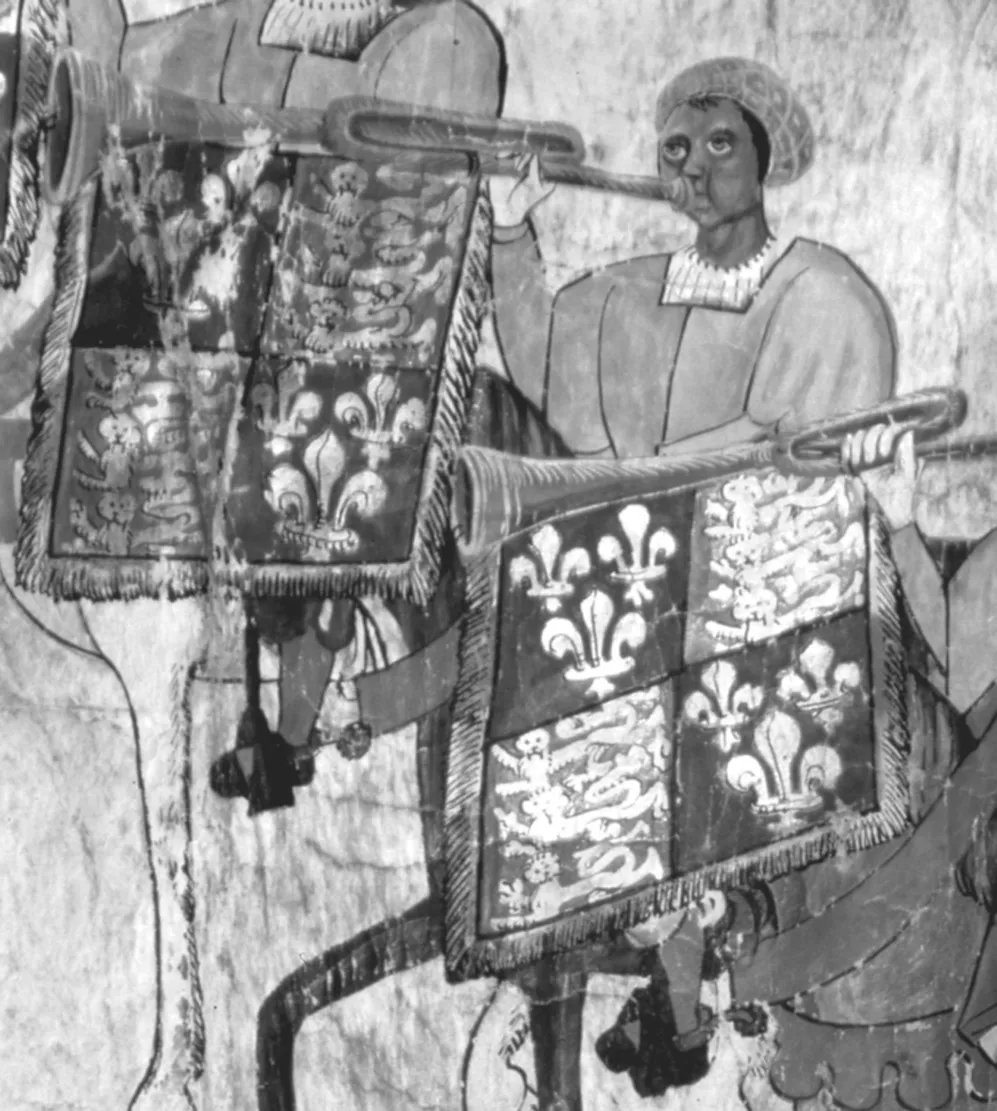
During this transformation, there was little non-white presence within drama, either as artists or audience, and what presence there was has been found mainly in musical or nonspeaking entertainments and displays. From at least the thirteenth century, there had been a European court tradition of black musicians and entertainers, which carried over into England under the Tudors, if not before. Court records show that both Henry VII and Henry VIII employed a black trumpeter, John Blanke (a.k.a. Blanc), who possibly came with Catherine of Aragon from Spain in 1501. A tapestry of him at a 1511 royal jousting tournament is regarded as one of the first images of a black person in Britain in English art. The Scottish court of Stuart King James IV employed a small number of black Africans, including a minstrel, Peter the Moor, a drummer and a choreographer, and a female, ‘Elen More’, who may have participated as the black Queen of Beauty in a tournament of the black lady and the black (or wild) knight played by the king. Queen Elizabeth I, an icon of whiteness who ordered the expulsion of ‘blackamoors’ from England twice during her reign, had black African entertainers at court and a page. Having a black page was a fashion symbol for the nobility as reflected by Shakespeare in A Midsummer Night’s Dream in the dispute between Oberon and Titania over a beautiful Indian servant boy who conjures up images of spice and barter as well as servitude. Shakespeare probably knew at least one black performer, Lucy Negro, a courtesan who took part in the 1594 Gray’s Inn Christmas revels.5 James VI of Scotland/James I of England, himself an outsider in England, employed at least one black performer. During his reign, some Asians, brought to England by way of the East India Company, joined a small number of Africans who had been arriving since the mid-sixteenth century as performers in civic and guild pageants. Such pageants had represented Moors since the early sixteenth century; mostly, it seems, but not always, they were played by whites. A mix of white and non-white performers in pageants continued through the seventeenth century when such pageants were used to laud the merits of colonialism and later of slavery itself.6
FIGURE 1.1Black musician in the procession from a Westminster tournament, 1511, thought to be John Blanke or Blanc (‘Westminster Tournament Roll’. Courtesy of The College of Arms)
The court of James I, which was said to be more outward looking than Elizabeth’s, has gained a reputation for its use of black as indicative of its love of oddity; when James’s wife, Queen Anne of Denmark, asked Ben Jonson to write her first court masque, she requested that she and her ladies appear as ‘blackamoors’.7 He obliged, and in The Masque of Blackness (1605), they abandoned the customary black masks and blackened their skin with paint to promote the virtues of female beauty, which, at the time, was represented as white. Jonson plays with notions of blackness, which here is strongly gendered with a sexual undertow. There are echoes of the proverbial expression regarding the impossibility of washing an Ethiope white, which connects to a long tradition of an Ethiopian Satan alluded to in The Castle of Perseverance. According to Andrea Stevens, Jonson’s masque was not well received because the women were not transformed back into white, possibly because no paint was available that could be removed quickly enough for the transformation to occur within the time frame of the masque.8 Jonson could only conclude his story of the River Niger’s search to change his black daughters back to their original white colour in a separate piece, The Masque of Beauty (1608). Technology seemingly had come to Jonson’s aid by the time he wrote The Gypsies Metamorphosed (1621), as the masquers, who are disguised as tawny, are cleansed before the masque is finished.
The playwrights who authored masques and pageants were busy peopling all the public and private theatres with ‘foreigners’, whether contemporary or historical, from near or far. Alongside the Irish, Scots, Welsh, Spanish, French, Italian, Scandinavian, and Jewish (the traditional bogey) can be found ancient Romans and Greeks, Moroccans, Moors, Turks, Persians, and a host of other Others. They would appear in lurid reconstructions of notable events, in fantastic adventures unfettered by the straitjacket of fact, and in metaphorical stories usefully helping to bypass censorship and punishment when their authors were addressing sensitive topical issues. Marlowe, for example, consistently looked to the Other to write about his times. In his popular renderings of the central Asian conqueror Timur the Lame, a.k.a. Tamerlaine or Tamburlaine, he writes of the European tussle between England and Spain, of the conflict between Protestant and Catholic Christianity, and of the wider battle between papal Christendom and Islam.
Representation of the Other was central to the development of drama in this innovative phase, especially in the playhouses, which themselves were novel, exotic, and dangerous. London was the dynamo of the fast-expanding economy and of the newly emerging professional theatre. Although precise figures are unavailable because many texts have been lost, the sheer volume of plays of the Elizabethan/Jacobean and first Caroline period that are known to feature the Other is remarkable. Louis Wann lists forty-seven plays from 1579 (the year of The Blacksmith’s Daughter, which portrays the treachery of the Turks) to 1642 (closure of theatres) in which at least one character from Turkey, north Africa, Malta, Arabia, Persia, and Tartary appears in the cast list.9 Turkish characters and settings figure the most, followed by North African Moors. Ottoman Sultan Suleiman I, probably the most powerful ruler of the sixteenth century, figures in at least ten plays, including a batch that retell the story of his assassination of his heir at the urging of Roxolana, one of his harem wives (but not the heir’s mother) who sought the advancement of her own sons.
At a time when the Ottoman empire was more important to England than the New World and many definitions of identity, including what it meant to be English, were unusually fluid and contradictory, terms such as Turk, Moor, blackamoor, and negro were widely applied as catch-all labels regardless of culture, faith, or geographical origin, combining and confusing peoples from Asia, Africa, and the Americas. Although geography was as much a matter of imagination as science and drama was not intended to be ethnographically authoritative, theatrical creations, nevertheless, were a means to handle actual engagements with a rapidly changing and intensely contested, multicultural world. As travellers and translators made often highly dubious information about the Other increasingly available, notions of the racialized Other inherited from the Crusades were reassembled through, and in turn were transmitted back into, trade, war, politics, and cultural exchange. The messages from the Crusades, however, were not straightforward, and nor were the new perceptions: Islam, for example, was seen as the enemy but also as a site of extraordinary knowledge, from astronomy and finance to mathematics and poetry. Though the Other was a threat, it could also be magical and wonderful, and lack of discrimination between Others did not mean they were treated the same all the time; Persians could be presented as different to the Turks, and both could be seen as enemies of Spain, whereas in The Jew of Malta (1592), in which Marlowe questions religion itself, Jews, Muslims, and Christians are all shown as corrupt. In plays that deal with conversion – political and religious apostasy was common and often enforced – the superiority of the Christian world is asserted even when Islam is allowed positive features. Yet, though conversion may offer a narrative resolution of the contest with the Other, it does not always represent a secure victory, as can be seen in the case of Shylock.10
Before the Restoration, religion remains paramount in defining the Other, and clothing, rank, and manners are more important external indices than physical attributes. Yet, though the use of colour was not always a sign of the Other or of racism, there was an accumulation of negative notions ascribed to the colour black that increasingly yoked an array of anxieties to it. Amid the plethora of stage images of the infidel Turk and the merciless Moor that link lust and irreligion to darker skins can be found deep unease concerning a range of meanings: honour, virtue, morality, sex and its progeny, religion, status, class, conquest, national identity, gender, and governance and its legitimacy.11
Though skin colour on stage may have been more a metaphor for difference rather than a description or explanation, pejorative language and imagery are, nevertheless, pervasive; Queen Isabella, for instance, is called an ‘Aethiope, Gypsie, thick lipt Blackamoor’ in The Death of Robert, Earl of Huntingdon and, in Love’s Labour’s Lost, the King and Berowne discuss love in terms of colour – ‘black is the badge of hell’. In Much Ado About Nothing, a repentant Claudio says he will marry Hero ‘were she an Ethiope’.12 The very title of John Webster’s The White Devil underlines the point that devils are assumed to be black and, when the devil appears as a dog in The Witch of Edmonton, it is black.
The stock black character was the vengeful male, the earliest significant representation of which seems to be Muly Mahamet, a defeated and malevolent usurper in George Peele’s The Battle of Alcazar (c. 1588), a part played by Edward Alleyn, one of the most celebrated actors of his day. The play draws on an account published in 1587 of a recent famous battle when Morocco defeated Portugal. Although a topical play about real people, it is presented within the conventions of the day, which can be traced back to the morality figure of Vice and the depiction of a black Satan in medieval drama. Mahamet has been seen as standing at the head of a tradition of black stage villains that can be traced through characters such as Aaron the Moor in Titus Andronicus, Eleazar in Lust’s Dominion, Mulymumen in All’s Lost by Lust and, after the Restoration, to Eleazor in Abdelazer, Zanga in The Revenge, Hassan in The Castle Spectre, and beyond into later centuries.13 Shakespeare gives Aaron, the one black villain to survive in the theatre from the Elizabethan period, a frankness that is lacking in both the Goths and the Romans. As a colonial victim, he is also given a plausible justification for his actions.14 In a barbarous world where the reaction to the Queen of the Goths having a black baby is overtly racist, Aaron refuses to kill his child when commanded. Prefiguring Shylock, he defends his skin colour and that of his son:
Is black so base a hue? –
Sweet blouse, you are a beauteous blossom, sure.15
When the child is further threatened, Aaron protects the boy, shouting at his would-be assassins:
Ye white-limed walls! Ye alehouse-painted signs!
Coal-black is better than another hue.
Degrees of colour were ...
Table of contents
Cover
Half Title
Title Page
Copyright Page
Dedication
Table of Contents
List of figures
Acknowledgements
Introduction
1 The early era
2 Aldridge and the age of minstrelsy
3 After Aldridge
4 Between the wars
5 Postwar struggles: 1940s–1960s
6 New beginnings in the 1970s
7 Asian Theatre: Tara Arts and beyond
8 ‘All a we is English’
Notes
Select bibliography
Index
Trusted by 375,005 students
Access to over 1.5 million titles for a fair monthly price.
Study more efficiently using our study tools.
Frequently asked questions
Yes, you can cancel anytime from the Subscription tab in your account settings on the Perlego website. Your subscription will stay active until the end of your current billing period. Learn how to cancel your subscription
No, books cannot be downloaded as external files, such as PDFs, for use outside of Perlego. However, you can download books within the Perlego app for offline reading on mobile or tablet. Learn how to download books offline
Perlego offers two plans: Essential and Complete
Essential is ideal for learners and professionals who enjoy exploring a wide range of subjects. Access the Essential Library with 800,000+ trusted titles and best-sellers across business, personal growth, and the humanities. Includes unlimited reading time and Standard Read Aloud voice.
Complete: Perfect for advanced learners and researchers needing full, unrestricted access. Unlock 1.5M+ books across hundreds of subjects, including academic and specialized titles. The Complete Plan also includes advanced features like Premium Read Aloud and Research Assistant.
Both plans are available with monthly, semester, or annual billing cycles.
We are an online textbook subscription service, where you can get access to an entire online library for less than the price of a single book per month. With over 1.5 million books across 990+ topics, we’ve got you covered! Learn about our mission
Look out for the read-aloud symbol on your next book to see if you can listen to it. The read-aloud tool reads text aloud for you, highlighting the text as it is being read. You can pause it, speed it up and slow it down. Learn more about Read Aloud
Yes! You can use the Perlego app on both iOS and Android devices to read anytime, anywhere — even offline. Perfect for commutes or when you’re on the go. Please note we cannot support devices running on iOS 13 and Android 7 or earlier. Learn more about using the app
Yes, you can access Black and Asian Theatre In Britain by Colin Chambers in PDF and/or ePUB format, as well as other popular books in History & Asian History. We have over 1.5 million books available in our catalogue for you to explore.