- English
- ePUB (mobile friendly)
- Available on iOS & Android
eBook - ePub
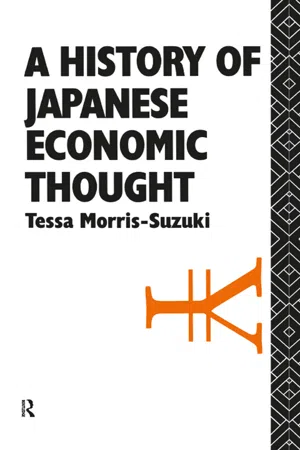
History of Japanese Economic Thought
About this book
Economics, in the modern sense of the word, was introduced into Japan in the second half of the nineteenth century. However, Japanese thinkers had already developed, during the seventeenth and eighteenth centuries, a variety of interesting approaches to issues such as the causes of inflation, the value of trade, and the role of the state in economic activity. Tessa Morris-Suzuki provides the first comprehensive English language survey of the development of economic thought in Japan. She considers how the study of neo-classical and Keynesian economics was given new impetus by Japan's 'economic miracle' while Marxist thought, particularly well established in Japan, was developing along lines that are only now beginning to be recognized by the West. She concludes with an examination of the radical rethinking of fundamental economic theory currently occuring in Japan and outlines some of the exciting new approaches which are emerging from this 'shaking of the foundations.
1
Economic thought in Tokugawa Japan
The rule of the Tokugawa shoguns (1603–1868) coincided with the age of European intellectual ferment from which economics emerged as an independent discipline. During these two-and-a-half centuries, although certain branches of Western scientific thought were assimilated and propagated by Japanese scholars, the introduction of Western philosophical, political, and economic ideas into Japan was severely restricted. At the same time, though, the evolution of an increasingly complex Japanese economy was creating some of the phenomena which had inspired the speculations of European economic thinkers from Munn to Quesnay and Adam Smith. These phenomena included the expansion of commerce, the fluctuation of prices, and the growing sophistication of the division of labour.
Because economic development in Tokugawa Japan took place in an environment of relative cultural isolation, a study of the period offers particularly fascinating insights into some of the most profound questions in the history of economic thought. How far are economic theories shaped by metaphysical, ethical, and philosophical traditions, and how far by economic circumstances? Do thinkers from diverse traditions, when confronted with the same economic problem, pose similar questions and devise similar answers? The outline of Tokugawa ideas presented in this chapter will, I think, show that although Japanese scholars’ concept of the ‘economic’ was often very different from those of modern economists, their intellectual enquiries sometimes led them along paths curiously similar to those explored by their European contemporaries.
The Economic Environment
Economics as a distinct field of study is a modern phenomenon, but economic ideas in J.S. Mill’s sense of the word – ideas about ‘the nature of wealth, including the laws of its production and distribution’ – have existed in various epochs and in many different societies.
The texts attributed to the Chinese philosopher Confucius, but probably written by his disciples in the fifth century BC, contain frequent references to prosperity and poverty. Before the third century BC Chinese philosophers of the Mohist school had developed a theory on the relationship between prices and the quantity of money, while the fourth-century Book of Mencius includes arguments on the advantages of the division of labour (Hu 1984: 13–14, 21–3). Similar discussions on economic exchange, price, and value are to be found in Indian writings of the fourth century BC, including those of Kautilya and Sūkra (Rangaswami 1934). In classical Greece, Plato and Aristotle debated, amongst other issues, the uses of money and the relative merits of communal and private property systems (Spiegel 1971: 14–30).
The common thread connecting these economic ideas is the fact that they evolved in societies with well-developed divisions of labour, complex commercial systems, thriving cities, and widespread use of money. In societies of this type, political and social relationships increasingly acquired an economic form. Prosperity and status were no longer determined purely by military might or political custom, but could be influenced by mysterious and apparently impersonal forces such as the level of prices or the scarcity of specific commodities. Philosophers and administrators who were concerned with questions of social order and justice were, therefore, more and more often forced to turn their attention to unmistakably ‘economic’ issues.
These historical considerations help to explain the vitality of economic thought in Tokugawa Japan. The Tokugawa social order was, in principle, a highly conservative system. The policies devised by the first Tokugawa shogun, Ieyasu, were designed to restrict or reverse the expansion of domestic and overseas commerce that had been occurring during the previous two centuries, and to create a society that would be not only stable, but static.
The foundations of the system rested on rice. Japan was divided into domains whose importance was measured in terms of the amount of rice they yielded, with the central area remaining under direct control of the shogun. The daimyō who ruled the domains obtained revenue mainly through the imposition of a rice tax on the peasants in their fief, and disbursed this rice as stipends to their substantial retinues of samurai officials and retainers.
Individual status was, in theory, fixed within one of four major status groups: warriors (shi), farmers (nō), artisans (kō), and merchants (shō). Excluded from this system were outcasts, who were engaged in so-called ‘unclean’ occupations such as the butchering of animals, or who had been outlawed as a punishment for crime. The functional distinction between the status groups was sharpened by the physical separation of the ruling class from the land. In earlier centuries, the aristocracy had possessed their own estates which they farmed using local peasant labour, but by the Tokugawa period they had withdrawn to castle towns, and the rice tax in effect provided their only link with agriculture. Farming, nevertheless, was recognized as the basis of national wealth. The low position of merchants on the status ladder reflected the ruling-class view that commercial activities were parasitic rather than productive.
Because of its close connections with missionary activity and foreign political influence, overseas trade was regarded by the Tokugawa shoguns as a potentially destabilizing influence. The Portuguese and other Westerners who had established commercial links with Japan were excluded, and the only channels of external trade allowed to survive after the 1630s were a small Dutch trading post on the island of Deshima (off Nagasaki) and the Ryūkyū Islands, which maintained loose political and economic ties both with China and the southern Japanese province of Satsuma.
Paradoxically, however, the very political stability of the Tokugawa system provided the conditions for economic development and this development ultimately eroded the structure of the system itself. Although there were frequent regional peasant revolts, particularly in the second half of the period, the Tokugawa age was a remarkably peaceful one by comparison with both the century it preceded and the one it followed. Prolonged peace encouraged the extension of internal trade networks and the establishment of new markets, and these developments in turn wrought gradual but significant changes in rural life. Farmers were increasingly able to purchase items such as fertilizer and firewood, which they had previously produced for themselves. Trade stimulated the exchange not only of goods but also of ideas, enabling knowledge of the best contemporary farming practices to become widely diffused, and so increasing yields. At the same time the evolution of the exchange economy encouraged farmers to specialize in the production of those goods that were best suited to the climate and soils of their region (Smith 1959: Chaps 6 and 7).
Perhaps the most spectacular symptom of the expanding exchange economy was the growth of Japanese cities. The shogun’s capital, Edo (where all daimyō were obliged to maintain a residence and spend a considerable part of their time), probably had a population of some 1.4 million by the second half of the eighteenth century, making it perhaps the largest city in the world, while the populations of Osaka and Kyoto exceeded 300,000 (Yazaki 1968: 134). Concentration of wealth in the hands of a substantially urbanized ruling class created demand for a wide variety of non-agricultural goods and services: clothing, furniture, construction services, wholesale and retail trade, inns, and theatres. The economic and social consequences of urban growth impinged directly on the personal experience of the economic thinkers of the Tokugawa era. The philosopher Ogyū Sorai, for example, reflecting on the rising price of land in the capital, could recall that
My grandfather owned a piece of land in Ise which had been cultivated for generations by his ancestors. He sold it and bought a house in Edo for only 50 ryō. I understand that the house was sold in my fathers’ time for a sum of more than 2,000 ryō.(Ogyū 1973: 327)
Fluctuations in prices, whether caused (as in this case) by the forces of supply and demand or by changes in the quantity of money, were a central concern of Tokugawa economic debates. As in medieval Europe, the increasing use of money, combined with a general lack of understanding of monetary problems on the part of the political authorities, caused repeated currency crises. The situation was compounded by the complexity of the money system in Japan, where gold, silver, and copper coins circulated side by side and were supplemented by merchants’ bills of exchange and by inconvertible paper notes issued in various domains.
Inevitably, the expansion of agricultural and handicraft production, the growth of regional specialization, rise of the cities, monetarization of the economy, and fluctuation of prices gave rise to conflict between the Tokugawa ideology of social stability and the realities of the economic world. In the cities, the theoretically rigid social hierarchy was giving way to a more fluid and ephemeral order, marvellously captured in the art and literature of the period. By the late seventeenth century, the writer Ihara Saikaku could observe that
as a rule, a well-to-do person in Osaka is not the heir to generations of wealth. He is more often some humble clerk — a ‘Kichizō’ or ‘Sansuke’ – who has a quick rise in the world and comes into money. Gradually as opportunities offer, he acquires the elements of Chinese and Japanese verse composition, kickball, archery, the koto, the flute, the drums, incense blending and the tea ceremony, and by associating with the best people he even loses his old vulgarities of speech. In life, it is training rather than birth which counts, and it is not unknown for the unwanted offspring of noble families to earn their living by hawking home-made paper flowers.(Ihara 1959: 23–4)
Discussions of economic issues in Tokugawa Japan were almost always inseparably entwined with discussions of this erosion of the hereditary social order, and, not surprisingly, the contrasting views put forward by contemporary philosophers frequently reflected their own position in the social hierarchy. The important point, however, was that social change forced the leading intellectual figures of the period to confront issues such as the economic basis of the status system and causes of the changing distribution of wealth. In this way, the frontiers of philosophical enquiry were broadened to include an increasing range of economic issues. Thomas Kuhn, in his analysis of scientific revolutions, observes that ‘discovery commences with the awareness of anomaly’ (Kuhn 1970: 52). So, in Tokugawa Japan, the anomaly between the formal rigidity and the actual fluidity of the social and economic system generated enquiry and innovation in many areas of political, economic, and ethical thought.
The Confucian Heritage
Although economic thought in Tokugawa Japan increasingly involved questioning of some aspects of philosophical tradition, it never wholly escaped the influence of that tradition. The newly emerging ideas on the economy, therefore, cannot be understood without some knowledge of their philosophical roots, particularly Confucianism, which constituted the most important of these roots. Howard Smith defines the essence of Confucius’s teaching as being
that the goal for the individual is the development of personality until the ideal of a perfect man, a true gentleman, a sage, is reached. On the other hand, his goal for society is universal order and harmony under the rule of a perfect sage.(Smith 1974: 62)
Although the emphasis on these two aspects of morality – the private and the public – varied as new schools of Confucian thought emerged and waned, the concern for ‘universal order and harmony’ meant that Confucianism could never wholly divorce itself from questions of practical politics and (as we have seen) provided some of the earliest significant contributions to economic thought. The Confucian tradition therefore offered a rich fund of ideas on which Japanese thinkers could draw as they attempted to come to terms with the economic problems of their own age.
It is also worth mentioning that Confucianism had an influence on the development of Western economic thought which has been largely ignored by historians. The French Physiocrats in particular formulated their ideas at a time when Western interest in Chinese culture was at its zenith. The Physiocratic concept of the state, for example, was influenced by the Confucian idea of li (in Japanese: ri), the principle or natural order inherent in all beings and all social systems. According to this view of the universe, the ideal state is the one which conforms most closely to its natural li, or, as the Abbé Baudeau put it,
[The] single supreme will which exercises supreme power is not, strictly speaking, a human will at all. It is just the voice of nature – the will of God. The Chinese are the only people whose philosophy seems to have got hold of this supreme truth, and they regard their Emperor as the eldest son of God.(Quoted in Gide and Rist 1913: 36)
The idea of a naturally harmonious and self-regulating order, which the ruler symbolizes but does not disturb, was conveyed via Quesnay (‘the venerable Confucius of Europe’, as a contemporary flatteringly called him) into the economic theorizing of Adam Smith. Thus the points of similarity that sometimes appear between eighteenth-century economic thought in Europe and Japan are more than pure coincidence.
The dominant form of Confucian philosophy in the early Tokugawa period was the Chu Hsi school (Shushigaku in Japanese), a complex metaphysical and ethical system that placed less emphasis on the study of the Confucian classics than on training and meditation designed to reveal the pure ri concealed within each human individual (Maruyama 1974: Chap. 2). In the eighteenth and early nineteenth centuries, however, this philosophy came to be challenged from a number of directions. On the one hand, Confucian scholars such as Ogyū Sorai and Arai Hakuseki introduced new approaches that placed greater emphasis both on the study of classical Confucian writings and on the application of ethics to practical issues of public policy. On the other, National Learning (Kokugaku) attempted to assert the superiority of Japan’s indigenous Shintō classics, the Kojiki and Nihon Shoki, while Dutch Learning (Rangaku) propagated the Western knowledge of mathematics, cartography, anatomy, and astronomy, introduced through the Dutch trading post in Nagasaki.
Although the dominance of Chu Hsi Confucianism weakened in the second half of the Tokugawa period, some fundamental Confucian ideas continued to provide the framework for economic thought even into the closing years of the era and beyond. The Confucian influence is particularly evident in the concept of economics itself. The term keizai – which in modern Japanese means ‘economy’ – already existed in Tokugawa Japan, but its meaning bore overtones far removed from twentieth-century notions of economics as the science of efficiently allocating scarce resources amongst alternative uses.
Keizai was an abbreviation of the phrase keikoku saimin (or keisei saimin), which may be roughly translated as ‘administering the nation and relieving the suffering of the people’. Dazai Shundai begins his Economic Annals (Keizai Roku), published in 1729, with the following reflections on the etymology of the term:
To govern the whole nation under heaven is keizai. It is the virtue of ruling society and relieving the sufferings of the people. Kei is wise statesmanship (keirin).… Kei literally means ‘to control a thread’. The warp of a piece of material is called kei and the woof, i. When a weaving woman makes silk cloth, she first prepares the warp… and then she weaves in the woof. Kei is also ‘management’ [or ‘construction’] (keiei).… When you construct a royal palace, you must first make a plan of the whole, and then you carry out the plan. This is kei. Sai means the virtue of salvation (saidō). This may also be read wataru, and literally means ‘to carry someone across a river to the farther bank’. … It is also the virtue of bringing relief (kyūsai), which may be read sukuu, and means ‘to relieve people of their sufferings’. Moreover, it may be interpreted as meaning ‘accomplishment’ or ‘bringing to fruition’. Therefore the term [keizai] has many meanings, but the essential point of those meanings is simply this: in short, to manage affairs and to bring these affairs to a successful conclusion.(Dazai 1972: 16)
The idea of keizai, in other words, has its origins in the Confucian world of public ethics with its paragon of the virtuous ruler. While economics in Europe, under the influence of Newtonian physics, came to present itself as a detached and objective science, keizai was a philosophical system inescapably bound up with questions of justice, law, and morality. It is entirely consistent ...
Table of contents
- Cover
- Half Title
- Title Page
- Copyright Page
- Table of Contents
- Acknowledgements
- Introduction: Japanese and Western economic thought
- 1. Economic thought in Tokugawa Japan
- 2. The introduction of Western economic thought: from the Meiji Restoration to the First World War
- 3. Economic debates in inter-war Japan
- 4. Post-war Marxian economics
- 5. Economic theory and the ‘economic miracle’
- 6. Contemporary Japanese economic thought
- Bibliography
- Index
Trusted by 375,005 students
Access to over 1.5 million titles for a fair monthly price.
Study more efficiently using our study tools.
Frequently asked questions
Yes, you can cancel anytime from the Subscription tab in your account settings on the Perlego website. Your subscription will stay active until the end of your current billing period. Learn how to cancel your subscription
No, books cannot be downloaded as external files, such as PDFs, for use outside of Perlego. However, you can download books within the Perlego app for offline reading on mobile or tablet. Learn how to download books offline
Perlego offers two plans: Essential and Complete
- Essential is ideal for learners and professionals who enjoy exploring a wide range of subjects. Access the Essential Library with 800,000+ trusted titles and best-sellers across business, personal growth, and the humanities. Includes unlimited reading time and Standard Read Aloud voice.
- Complete: Perfect for advanced learners and researchers needing full, unrestricted access. Unlock 1.5M+ books across hundreds of subjects, including academic and specialized titles. The Complete Plan also includes advanced features like Premium Read Aloud and Research Assistant.
We are an online textbook subscription service, where you can get access to an entire online library for less than the price of a single book per month. With over 1.5 million books across 990+ topics, we’ve got you covered! Learn about our mission
Look out for the read-aloud symbol on your next book to see if you can listen to it. The read-aloud tool reads text aloud for you, highlighting the text as it is being read. You can pause it, speed it up and slow it down. Learn more about Read Aloud
Yes! You can use the Perlego app on both iOS and Android devices to read anytime, anywhere — even offline. Perfect for commutes or when you’re on the go.
Please note we cannot support devices running on iOS 13 and Android 7 or earlier. Learn more about using the app
Please note we cannot support devices running on iOS 13 and Android 7 or earlier. Learn more about using the app
Yes, you can access History of Japanese Economic Thought by Tessa Morris Suzuki in PDF and/or ePUB format, as well as other popular books in Economics & Economic History. We have over 1.5 million books available in our catalogue for you to explore.