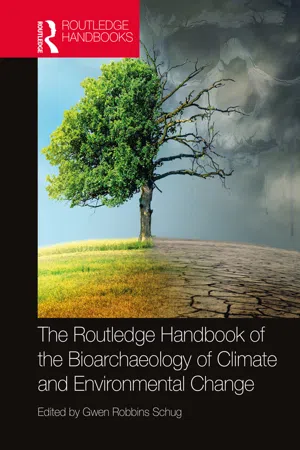
This handbook examines human responses to climatic and environmental changes in the past,and their impacts on disease patterns, nutritional status, migration, and interpersonal violence. Bioarchaeology—the study of archaeological human skeletons—provides direct evidence of the human experience of past climate and environmental changes and serves as an important complement to paleoclimate, historical, and archaeological approaches to changes we may expect with global warming.
Comprising 27 chapters from experts across a broad range of time periods and geographical regions, this book addresses hypotheses about how climate and environmental changes impact human health and well-being, factors that promote resilience, and circumstances that make migration or interpersonal violence a more likely outcome. The volume highlights the potential relevance of bioarchaeological analysis to contemporary challenges by organizing the chapters into a framework outlined by the United Nation's Sustainable Development Goals for 2030. Planning for a warmer world requires knowledge about humans as biological organisms with a deep connection to Earth's ecosystems balanced by an appreciation of how historical and socio-cultural circumstances, socioeconomic inequality, degrees of urbanization, community mobility, and social institutions play a role in shaping long-term outcomes for human communities.
Containing a wealth of nuanced perspectives about human-environmental relations, book is key reading for students of environmental archaeology, bioarchaeology, and the history of disease. By providing a longer view of contemporary challenges, it may also interest readers in public health, public policy, and planning.
A bioarchaeology of climate and environmental change
Gwen Robbins Schug
Climate change is already having an impact on global public health, human security (including food and water security), and migration flows (IPCC, 2014). Governments and non-governmental organizations are considering potential future impacts and creating plans for managing natural disasters, global warming, and associated environmental changes (DoD, 2015; EPA 2016a; b; c; d). The ability to understand global warming and predict and plan for the future relies on historical sciences. Paleoclimate science uses proxies to infer climatic and environmental fluctuations in the past, examining correlations among CO2 levels, mean global surface temperatures, ice coverage, sea-level rise, and paleoecology to develop models for prediction (Bender, 2013). Historical social sciences, including anthropology and archaeology, are also uniquely situated to contribute to these conversations based on our examinations of past human perceptions of and responses to climate and environmental change. For many decades, archaeologists and bioarchaeologists—who study human remains as a source of archaeological evidence—have been conducting scientific research on human-environmental interactions in the past and studying phenomena that will be highly valuable for contemporary planning and policymaking. Our scholarship addresses the socio-cultural-political dimensions of climate change over the last 12,000 years. Our data allow for nuanced interpretations of short-term strategies and long-term trajectories of human responses to environmental change.
The 27 chapters in this volume demonstrate there are no grand narratives in the arc of human history; however, these chapters do demonstrate a historical perspective on four major challenges facing contemporary human communities. Anthropogenic climate and environmental changes are occurring at a scale and a magnitude unprecedented in human history and they are already a significant threat to health and well-being. However, it is critical we recognize humans are biological organisms, enmeshed within an ecological system and completely interdependent on other species across the Kingdoms of life. Global warming is accompanied by the sixth mass extinction, which threatens the maintenance of life on Earth. We are also in the midst of an epidemiological transition, where modernity has brought sedentism, poor diets, obesity, and a rise in morbidity due to degenerative conditions. Unfortunately, we are also facing powerful challenges from emerging and re-emerging infectious diseases as we increasingly disturb wild spaces, interact with other species in detrimental new ways, and have mis-used antibiotic therapies. Bioarchaeological research as it is presented in this volume addresses hypotheses about every one of these current challenges and provides a deep-time perspective on human-environmental relations that is critically relevant to planning for a warmer world.
Although this has been a major area of research in our discipline, particularly since the 1970s, anthropology has, unfortunately, been conspicuously absent at the human security, policy, planning, and management tables (see Robbins Schug et al., 2019, for discussion). This volume brings together a sampling of bioarchaeologists working on the biocultural effects of human-environmental interactions, framing their research within global sustainable development goals. Sustainable development—creating the capacity to meet the needs of future generations while remaining mindful of the needs of the current human population—is at the core of creating a strategy for coping with global climate change and as such the United Nations (UN) has defined 17 major goals for global sustainable development as part of their policy agenda (Figure 1.1). These goals—outlined in the 2030 Agenda for Sustainable Development (https://sustainabledevelopment.un.org/)—were adopted by all of the United Nations member states in 2015. Here they are being used to organize the bioarchaeological research presented in the following chapters with the goal of demonstrating bioarchaeology’s relevance to issues of contemporary concern and potentially making this work accessible and useful to policymakers and people from other disciplines, as well as to students who are interested in pursuing these questions in their future research.
Figure 1.1The UN’s 17 Sustainable Development Goals (SDGs).
It is important to note from the outset that anthropological perspectives on sustainable development involve more than looking at global relations or making plans for coping with climate change. In anthropology, the concept of “sustainable development” includes a demand to also consider colonial histories and attitudes, territories of extraction and exploitation, and situated struggles over Indigenous sovereignty; anthropologists recognize the establishment of private property, disaster capitalism, and national borders as barriers for human mobility and adaptation; and we cannot escape from a consideration of the way history has defined global priorities for development, and the so-called “landscapes of power” (e.g., Powell, 2018). In archaeology and bioarchaeology, we take an approach that is both evolutionary and also deeply biocultural; we recognize that what, in other species, would be considered biological characteristics—what is food, who is a suitable mate, or who is related to us—are for humans deeply embedded in culture and history, to an extent that culture, history, and biology cannot be distinguished in human populations.
Bioarchaeologists have a lot to say about concepts and consequences inherent to the UN’s sustainable development goals. Our research makes particularly important contributions to understanding human-environmental relations from a deep-time, cross-cultural perspective as we have defined a suite of diverse challenges to human “health” in the face of climate and environmental changes over the past 12,000 years. As the reader will see in the following chapters, bioarchaeological research is already contributing important insights on human health in the context of climate and environmental change in the following areas: occupational health hazards, air quality, and infectious pathogen susceptibility in the face of climate and environmental changes. Our research demonstrates how pandemics move through communities in the absence of modern medicine: we have access to data about differential susceptibility, the effects on the body in different socio-cultural circumstances, and the long-term, evolutionary outcomes of catastrophic mortality. We specifically include the role of socio-economic inequality in constraining responses to and shaping the effects of environmental “crisis.” We see climate crisis and pandemics as a space for socio-cultural change in the past. Our work addresses concepts of “vulnerability” particularly regarding environmental migration, culture contact, colonialism, violence, and “civilizational collapse.” In our field, we have re-defined resilience by examining its relationship to diversity, flexibility, adaptability, and also the suffering that often accompanies survival through difficult circumstances. Our research considers the bodily impacts of life in diverse landscapes, entanglement with other species, health impacts of dietary change, famine, and other forms of resource stress. In other words, we already have insights on the UN’s sustainable development goals and how these ideas have run like threads through human history.
The UN’s 17 goals for sustainable development (Figure 1.1) represent a framework for planning for global climate change but they also represent an avenue for thinking about climate and environmental change in the past, for creating a bioarchaeology of human-environmental interactions and climate change that will have far-reaching impacts within and beyond academia. Specifically, chapters in this volume address the following sustainable development goals: good health and well-being (goal 3); socioeconomic and gender equality (goals 5 and 10), including the effects of poverty and hunger (goals 1 and 2); peace, justice and strong institutions (goal 16); and life on land (goal 15). The chapters have been arranged within sections entitled accordingly.
As the reader will find in the detailed descriptions below, almost every chapter in this volume addresses the goal of good health and well-being for women, infants and children and for communities facing climate and environmental change; however, this UN development goal is most strongly focused in the first section of this book, which explicitly examines maternal-infant mortality, infectious disease risk (particularly tuberculosis, malaria, and neglected tropical diseases), respiratory disease and other occupational health hazards. Good health and well-being cannot be separated from goals related to socioeconomic and gender equality, poverty, and hunger and these topics form the basis for the second section of this volume. The third section of this volume is deeply concerned with goal 16 (peace, justice, and strong institutions) as well as “life on land” (goal 15), which concerns our ability to live sustainably and in healthy relationships with other species on this planet. Each of these sections will outline the issues raised by these sustainable development goals, as framed by the UN, and will orient the reader to ways that bioarchaeological data address these issues.
Goal 3: Good health and well-being
Half of the human population alive today does not have access to adequate medical and health services. Maternal, infant, and child mortality is still a major challenge for life expectancy rates around the world. Air pollution, inadequate food and water sanitation, and other challenges of living in modern urban communities lead to occupational and mental health risks. Emerging and re-emerging infectious diseases—particularly tuberculosis, malaria, neglected tropical diseases, and insect-borne diseases—all represent major challenges for a warming world with increasing frequency and severity of natural disasters combined with over-population, over-crowding, millions living in impoverished conditions, and increasing antibiotic resistance. Many diseases that we thought to be a thing of the past are re-emerging as potent problems. Environmental degradation, capitalism, and global poverty bring us into contact with environments and other animals in ways that promote emerging infections. These issues are tackled in section one of this volume.
In Chapter 2, Charlotte Roberts presents an overview of the concept of the “epidemiological transition” and argues that these should be referred to as “phases” because the word “transition” suggests a progressive order that is not appropriate in all contexts. Roberts defines our current condition, the “third epidemiological phase,” as a period when morbidity and mortality are increasingly due to emerging infections, re-emerging infectious diseases, and antibiotic resistance. In the context of over-population and rising social inequality, climate and environmental change play an increasingly strong role in shaping this phenomenon, with global warming, natural disasters, deforestation, and other human-caused environmental changes presenting the biggest challenges to human health in the coming century—exposing human populations to new zoonotic diseases, altering patterns of disease transmission, exacerbating conditions that lead to antibiotic resistance, increasing pollution, and exposure to contaminated food and water. Roberts emphasizes the value of paleopathology as a tool for understanding human-pathogen co-evolution, epidemiological phases, and biocultural aspects of health in the face of changing environments in the past. She uses research on maxillary sinusitis in the past to illustrate how a historical perspective is useful for developing a fuller understanding of contemporary public health challenges. Finally, she provides some examples of how paleopathologists can bring our work into non-academic contexts to educate the public and members of the Global Health and Development community.
In Chapter 3, Molly K. Zuckerman and Ashley C. Dafoe provide an overview of health and disease in the context of climate and environmental change over the past 10,000 years, describing bioarchaeological insights on these issues from the published literature spanning the past decade. Some work has been done on infectious diseases but for the limited number of studies conducted thus far, the primary impacts of climate and environmental change have been in the areas of interpersonal violence and subsistence transitions—food shortages and famines, dietary change and insufficiency that has led to signs of developmental disturbance and declines in adult stature, undernutrition and micronutrient deficiencies, rising infant mortality and measures of fertility—which have had particularly large effects on adult women, infants, and children in past populations. Highlighting published case studies from several bioarchaeologists, some of whom are also contributors to this volume—Elizabeth Berger, Sharon DeWitte, Ryan Harrod, Britney Kyle, Kelly Knudson, Deb Martin, Laurie Reitsema, Gwen Robbins Schug, Chris Stojanowski, and Hui Wang—Zuckerman and Dafoe convincingly argue that a useful theoretical framework for turning these case studies into a comprehensive but nuanced understanding of past patterns might be found in a model known as risk pathway thinking, which organizes the effects of climate change into direct, indirect, and tertiary impacts but maintains recognition of how political economy shapes vulnerability.
Chapters 4 through 8 take us through examples of periods in the human past where climatic and environmental changes likely contributed to changing patterns in human health and disease. These chapters consider the record of climate and environmental changes, the skeletal evidence for health, biocultural stress, and disease, and the possibility that there are important interactions between human health and the environment that are more than just coincidence. “Health” is difficult to address using human skeletal material and the term is here used to refer to a variety of traces on the human skeleton that mark periods where (1) homeostasis was disrupted to a degree significant enough to impact bones and teeth, (2) when inflammation and infection left generalized marks on the bones, or (3) specific micronutrient deficiencies and diseases can be identified by pathognomic signs on bones or teeth. It is important to recognize that, typically, signs of “stress” or pathophysiological disruption will be found in “healthy” populations; in other words, it is normal to have dental caries, degenerative joint disease, and even mild inflammation or infection in what we would otherwise consider a “healthy” human population (Klaus, 2014). Furthermore, as many chapters in this volume describe, sometimes “healthy” individuals have more signs of “stress” in the skeleton because they survive these stressful events; whereas “unhealthy” individuals, who are more frail, will express fewer signs of “stress” in the skeleton because they died before the skeleton was impacted (DeWitte and Stojanowski, 2015; Reitsema and McIlvaine, 2014; Temple and Goodman, 2014; Wood et al., 1992). If we were to define health as “complete physical, mental, and social well-being” then the health of past populations cannot fully be assessed from human skeletal remains. Rather, these chapters explore the presence and prevalence of micronutrient deficiencies, signs of malnutrition, disruptions to growth and development as expressed in bones and teeth, and specific infectious diseases to create a nuanced view of how certain dimensions of human health are affected by climate and environmental changes but in recognition that, while the human skeleton is the most direct source of evidence on these questions, these data have their limits and they cannot tell the entire story.
Several of these chapters (4 through 7) are focused on climate-induced resource stress in four arid regions of the world—the Atacama Desert, the steppes and desert biomes of the Hexi Corridor in Northwest China, Medieval Iceland, and the Nile Valley in Egypt. These chapters consider human communities living in ecosystems that are often considered marginal environments for human habitation but, importantly, the authors focus on how human biocultural adaptations make these landscapes habitable, the character of resilience, and how human health impacts are part of the phenomenon of resilience, particularly for women, infants, and children. It is difficult to make predictions about how the arid regions of the globe will be affected by climate change and what specific environmental changes will result; climate feedbacks involving rainfall, temperature, CO2, and ecosystem effects are complicated but there is a consensus that arid and semi-arid regions will be among the most responsive ecosystems to climate change (see, for example, chapters by Snoddy and colleagues; Berger and Wang; Martin and Harrod; Pilloud and colleagues; Torres-Rouff; Juengst; Lieverse; Gregoricka; Schneider and colleagues; and Hrivnyak and Eng). This unpredictability and the promise of substantial impacts mean that looking to the past is a particularly important tool for making predictions about how climate and culture change can be inter-related, how “local biologies” might be impacted by the specific challenges of living in different global regions, and the relative long-term success of different short-term strategies employed by human populations living in these changing environments.
In Chapter 4, Anne Marie E. Snoddy, Charlotte L. King, and colleagues investigate human biocultural adaptations to resource stress and environmental instability in human populations that occupied that Atacama Desert from 3500 to 1500 years ago. This hyper-arid region represents a challenge for human occupation because of frequent extreme weather events and unpredictable food resource availability—for both terrestrial and marine foods. These authors set up a context for human habitation using paleoenvironmental reconstructions that include evidence for a variety of challenges, the most salient being an increasing frequency of El Niño/Southern Oscillation (ENSO) events in what was already a marginal environment. The authors hypothesized that this increase in ENSO events may have contributed to “micro-famines,” dietary changes, and, ultimately, to impacts on human health across the Archaic to Formative Period transition. Their bioarchaeological analysis—combining isotopic evidence of changing dietary strategy and paleopathological evidence of nutritional sufficiency—of 187 skeletal, mummified, and partially mummified remains demonstrates that ENSO events affected fisheries and human food choices in times of cyclical or periodic resource scar...
Table of contents
Cover
Half Title
Title Page
Copyright Page
Dedication
Contents
List of figures
List of tables
Notes on contributors
Acknowledgments
1 A bioarchaeology of climate and environmental change
Part I Good health and well-being
Part II Socioeconomic and gender equality, no poverty or hunger
Part III Peace, justice, and strong institutions
Part IV Life on land
Index
Trusted by 375,005 students
Access to over 1.5 million titles for a fair monthly price.
Study more efficiently using our study tools.
Frequently asked questions
Yes, you can cancel anytime from the Subscription tab in your account settings on the Perlego website. Your subscription will stay active until the end of your current billing period. Learn how to cancel your subscription
No, books cannot be downloaded as external files, such as PDFs, for use outside of Perlego. However, you can download books within the Perlego app for offline reading on mobile or tablet. Learn how to download books offline
Perlego offers two plans: Essential and Complete
Essential is ideal for learners and professionals who enjoy exploring a wide range of subjects. Access the Essential Library with 800,000+ trusted titles and best-sellers across business, personal growth, and the humanities. Includes unlimited reading time and Standard Read Aloud voice.
Complete: Perfect for advanced learners and researchers needing full, unrestricted access. Unlock 1.5M+ books across hundreds of subjects, including academic and specialized titles. The Complete Plan also includes advanced features like Premium Read Aloud and Research Assistant.
Both plans are available with monthly, semester, or annual billing cycles.
We are an online textbook subscription service, where you can get access to an entire online library for less than the price of a single book per month. With over 1.5 million books across 990+ topics, we’ve got you covered! Learn about our mission
Look out for the read-aloud symbol on your next book to see if you can listen to it. The read-aloud tool reads text aloud for you, highlighting the text as it is being read. You can pause it, speed it up and slow it down. Learn more about Read Aloud
Yes! You can use the Perlego app on both iOS and Android devices to read anytime, anywhere — even offline. Perfect for commutes or when you’re on the go. Please note we cannot support devices running on iOS 13 and Android 7 or earlier. Learn more about using the app
Yes, you can access The Routledge Handbook of the Bioarchaeology of Climate and Environmental Change by Gwen Robbins Schug in PDF and/or ePUB format, as well as other popular books in Social Sciences & Global Warming & Climate Change. We have over 1.5 million books available in our catalogue for you to explore.