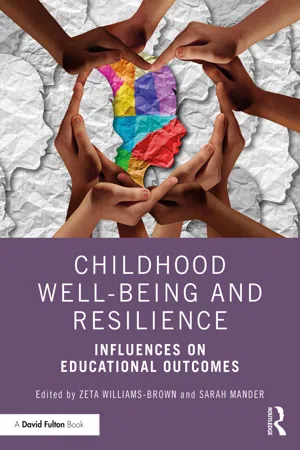
This book examines the ways in which well-being affects educational outcomes. Using an ecological approach, the book defines what we mean by well-being and resilience in education and how this relates to policy and children and young people's rights. The book considers strategies utilised by the education, health, voluntary and private sectors which promote well-being and resilience for children and young people from the early years to adulthood. This book also explores societal factors such as poverty and family well-being.
Childhood Well-being and Resilience goes on to provide examples of practice interventions inside and outside the classroom. It represents a sea change in professional approaches to well-being and resilience as protective factors against poor mental health. It includes chapters on key topics such as:
The concept of child well-being, resilience and the rights of the child
Peer interaction and well-being
Social media and mental health
Well-being and outdoor learning
Mindfulness for young children
International policy and child well-being
This book supports professionals to increase their knowledge, establish a skill set and build their confidence which can enable children and young people to develop good levels of well-being and to improve their resilience. Including reflective questions and case studies, Childhood Well-being and Resilience is essential reading for undergraduate students studying Early Childhood Studies, Education Studies, Teaching Awards and Family and Community Studies.
Section 1 Defining well-being and resilience in education
1 Understanding the concept of child well-being
Domains, dimensions and discourses
Alyson Lewis
Introduction
This chapter examines the complex concept of well-being and aims to broaden and extend your understanding of this concept. Developing your knowledge and understanding of well-being is important particularly when there is a fast growing interest in education (McLaughlin, 2008). Mayr and Ulich (1999, p. 230) claim that well-being is “a complex physical and psychological state and disposition”. Whereas Chambers (2014; cited in White and Abeyasekera, 2014, p. xi) suggests that “what people seek and value as wellbeing is subjective and varies by person, gender, age, relationships, status, place, culture and more”. Morrow and Mayall (2009) suggest that well-being is the new term that politicians and educationalists use instead of children’s ‘welfare’. They also hypothesise that well-being shares the same meaning as ‘welfare’ across countries (Morrow and Mayall, 2009). Statham and Chase (2010, p. 6) argue that in general “there is still limited agreement on what the constituent components of child wellbeing are, or how they should be weighted in terms of importance or priority”. This chapter demonstrates that well-being is understood and communicated in various ways, which can lead to confusion and uncertainty about its nature (Coleman, 2009). Therefore, the chapter is organised by first, explaining the complexity in defining well-being; second, exploring the various domains (also known as types of well-being); third, discussing the subjective and objective dimensions and, finally, explaining well-being discourses which are rooted in disciplines such as philosophy, psychology and economics.
This chapter aims to provide clarity about the nature of well-being and explores a claim by Raghavan and Alexandrova (2015) who state that a theory of child well-being does not currently exist because long-standing discourses, such as those within philosophy, were not originally written with children in mind. Ultimately, the chapter encourages you to think about whether a theory of child well-being is needed.
The complexity in defining well-being
Many different interpretations of well-being exist and La Placa et al. (2013) state that due to its inherent complexity, it is difficult to reach a simple definition. Mayr and Ulich (1999) suggest that well-being is difficult to define because there are numerous domains (types of well-being) that inter-relate. Similarly, Statham and Chase (2010) claim that well-being is difficult to narrow down to one simple definition because there are subjective and objective ways of understanding the concept. Nonetheless, the New Economics Foundation (2009, p. 7) defines well-being as a concept that emerges in relation to “a dynamic interaction of different factors”. Dodge et al., draw upon Reber’s (1995) definition from psychology and explain in more detail that well-being is a state of being stable. They suggest that
Stable wellbeing is when individuals have the psychological, social and physical resources they need to meet a particular psychological, social and/or physical challenge. When individuals have more challenges than resources, the see-saw dips, along with their well-being and vice-versa.
Arguably, well-being is difficult to define because it is often conflated (mixed or merged together) with other concepts, such as ‘happiness’, ‘life satisfaction’, ‘quality of life’, ‘emotional literacy’, ‘emotional intelligence’ and ‘positive mental health’ to name but a few (Pollard and Lee, 2003; McLaughlin, 2008; Statham and Chase, 2010; Mashford-Scott et al., 2012). However, Coleman (2009, p. 283) asserts, “well-being is not quite the same as happiness”. According to Morrow and Mayall (2009, p. 221), defining well-being is ‘conceptually muddy’ because it is conflated with other concepts.
The argument that well-being is conflated with other concepts and used synonymously supports Ereaut and Whiting’s (2008) claim that well-being is socially and culturally constructed and does not have a fixed meaning. Also, this argument highlights that the concept is vague and ambiguous and can have many different meanings. Coleman (2009) suggests that when there are differences between how well-being is understood, it is very difficult to measure and operationalise. Therefore, it can be problematic, particularly for schools, to show that well-being has improved or changed.
Another complexity associated with defining well-being is a grammatical and semantic one. Well-being is considered a noun, but there are many different types of nouns, for example, there are common nouns, abstract nouns, concrete nouns, collective nouns and so on. As you read the following sections about domains and dimensions, you should start to notice that grammar and semantics play an important role in the meaning of well-being. I have chosen to present well-being with the hyphen for the main reason that I see well and being as representing my understanding of the concept. For example, well relates to a range of domains and being relates to existence and focuses on the philosophical aspect of the concept which is often neglected in discussions about well-being. You will notice in this chapter that wellbeing is sometimes written without the hyphen and this reflects the original quotes. Ereaut and Whiting (2008) state that wellbeing will become the norm as e-mail became email.
Individual/group task
Consider what well-being means to you?
How would you define well-being?
Does well-being have the same meaning for different age groups?
Well-being domains
Various well-being domains also known as types are used to describe well-being, which help to provide some clarity about its meaning. For example, adjectives are often used, such as ‘emotional’ well-being, ‘social’ well-being, ‘physical’ well-being, ‘economic’ well-being to name but a few. In 2003, Pollard and Lee (2003) conducted a systematic review of well-being and identified five domains, namely
physical,
psychological,
cognitive,
social and
economic well-being.
In 2009, Fauth and Thompson (2009) identified four domains, namely
physical well-being,
mental health,
emotional and social well-being,
cognitive and language development and school performance, and
beliefs.
Then in 2010, Statham and Chase (2010) identified three domains, namely
emotional,
physical and
social well-being.
The Office for National Statistics (ONS) devised a framework for measuring well-being, which includes ten domains applicable to all age groups (ONS, 2015), but it highlights that measurement tools vary for the age groups (ONS, 2014). Therefore, many domains exist and there is no consensus.
In terms of well-being domains and policy which relate to children and young people, there is usually more focus on emotional and physical well-being and mental health and well-being. As a nation, Wales is interesting because it has recently introduced two well-being Acts, namely the Social Services and Well-being (Wales) Act 2014 and the Well-being of Future Generations (Wales) Act 2015. Both Acts focus on people having a say about what matters to them, and they focus on the present and future lives of all citizens. However, on closer scrutiny of policy documents in Wales that relate to children and young people, social well-being is often omitted. This omission is important because the nature of social well-being incorporates a range of social skills but specifically pro-social behaviour (Fauth and Thompson, 2009). According to Eisenberg (2003), pro-social behaviour is an important aspect of positive development, and if social well-being is not explicitly communicated in policy this suggests that a widespread negative view towards children may still exist (Haworth and Hart, 2007). Therefore, it is paramount that adults listen authentically to children and young people and value their contributions despite implicit messages in policy.
A dominant health and well-being and physical well-being focus in education-related policy supports Clack’s (2012) argument that schools are being targeted to tackle health inequalities and various other societal ills. Others explain that the emotional domain is usually privileged in education-related policy because there are “powerful links in the human mind between emotion and cognition” (Whitebread, 2012, p. 28). Moreover, Craft et al. (2008) claim that “positive emotional states are necessary for most transferable learning, playfulness, discovery and invention” (p. 127).
Individual/group task
Are certain domains more dominant than others in your setting or placement? What domains are evident in the following policy documents relating to children and young people within the United Kingdom?
(1) Department for Education. 2019. Keeping children safe in education: statutory guidance for schools and colleges. London: Department for Education.
(2) Department for Education. 2018. Working together to safeguard children: a guide to inter-agency working to safeguard and promote the welfare of children. London: Department for Education.
(3) Department for Education. 2018. Mental health and wellbeing provision in schools Review of published policies and information. London: Department for Education.
(4) Department of Health. 2017. Co-operating to safeguard children and young people in Northern Ireland. Northern Ireland: Department of Health.
(5) Scottish Government. 2017. Getting it right for every child (GIRFEC). Scotland: Scottish Government.
(6) Welsh Government. 2013. Building a brighter future: early years and childcare plan. Cardiff: Welsh Government.
Subjective and objective dimensions of well-being
The two overarching dimensions of well-being, which are commonly associated with the concept, are the subjective and objective kind. For example, the subjective dimension perceives well-being as an abstract noun, whereas the objective dimension perceives well-being as a concrete noun, as in something you can see or hear. The subjective dimension tends to have an unfixed meaning and thought to be difficult to measure, whereas the objective dimension tends to have a fixed meaning and thought to be measurable (Ereaut and Whiting, 2008). Gasper (2010) suggests that nouns (in this case well-being) are typically reified which means making an abstract concept more concrete. He further argues that well-being is not a “definite single thing, or just two things – ‘subjective well-being’ and ‘objective well-being’ – or any number of things” (p. 352).
Since 2005, The Children’s Society has been researching young people’s subjective well-being and describe subjective well-being “as a positive state of mind in which a person feels good about life as a whole and its constituent parts, such as their relationships with others, the environments that they inhabit and how they see themselves” (The Children’s Society, 2018, p. 9). UNICEF also reports on subjective and objective well-being and use objective indicators such as poverty rates, infant mortality rates, low birth weight, immunisation rates, the Programme for International Student Assessment (PISA) results and the number of children enrolled in pre-school to report on well-being (UNICEF, 2013). These measures are known as proxy indicators and are used when you cannot measure exactly what you want or need. For example, when you cannot measure someone’s subjective well-being, proxy indicators can be helpful. The aim should be to include objective and subjective data, which provide a comprehensive picture of well-being (McLellan and Steward, 2015).
According to Mashford-Scott et al. (2012), professionals working with younger children acknowledge both dimensions. Although they suggest the objective dimension is a more dominant perspective because “it serves to quantify wellbeing; making it more measurable” (Mashford-Scott et al., 2012, p. 239). The objective dimension is associated with a child demonstrating positive and negative beha...
Table of contents
Cover
Half Title
Title Page
Copyright Page
Dedication
Table of Contents
List of abbreviations
List of contributors
Introduction
Section 1 Defining well-being and resilience in education
Section 2 The role of children and young people in their own well-being and resilience
Section 3 Examples of practice interventions that support children and young people’s well-being and resilience
Section 4 Societal and cultural influences upon children’s and young people’s well-being and resilience
Conclusion
List of support organisations
Index
Trusted by 375,005 students
Access to over 1.5 million titles for a fair monthly price.
Study more efficiently using our study tools.
Frequently asked questions
Yes, you can cancel anytime from the Subscription tab in your account settings on the Perlego website. Your subscription will stay active until the end of your current billing period. Learn how to cancel your subscription
No, books cannot be downloaded as external files, such as PDFs, for use outside of Perlego. However, you can download books within the Perlego app for offline reading on mobile or tablet. Learn how to download books offline
Perlego offers two plans: Essential and Complete
Essential is ideal for learners and professionals who enjoy exploring a wide range of subjects. Access the Essential Library with 800,000+ trusted titles and best-sellers across business, personal growth, and the humanities. Includes unlimited reading time and Standard Read Aloud voice.
Complete: Perfect for advanced learners and researchers needing full, unrestricted access. Unlock 1.5M+ books across hundreds of subjects, including academic and specialized titles. The Complete Plan also includes advanced features like Premium Read Aloud and Research Assistant.
Both plans are available with monthly, semester, or annual billing cycles.
We are an online textbook subscription service, where you can get access to an entire online library for less than the price of a single book per month. With over 1.5 million books across 990+ topics, we’ve got you covered! Learn about our mission
Look out for the read-aloud symbol on your next book to see if you can listen to it. The read-aloud tool reads text aloud for you, highlighting the text as it is being read. You can pause it, speed it up and slow it down. Learn more about Read Aloud
Yes! You can use the Perlego app on both iOS and Android devices to read anytime, anywhere — even offline. Perfect for commutes or when you’re on the go. Please note we cannot support devices running on iOS 13 and Android 7 or earlier. Learn more about using the app
Yes, you can access Childhood Well-being and Resilience by Zeta Williams-Brown, Sarah Mander, Zeta Williams-Brown,Sarah Mander in PDF and/or ePUB format, as well as other popular books in Pedagogía & Educación infantil. We have over 1.5 million books available in our catalogue for you to explore.