This interdisciplinary volume discusses the division of the early modern material world into the important legal, economic, and personal categories of mobile and immobile property, possession, and the rights to usufruct.
The chapters describe and compare different modes of acquisition and intergenerational transfer via law and custom. The varying perspectives, including cultural history, legal history, social and economic history, philosophy, and law, allow for a more nuanced understanding of the links between the movability of an object and the gender of the person who owned, possessed, or used it. Case studies and examples come from a wide geographical range, including Norway, England, Scotland, the Holy Roman Empire, Italy, Tyrol, the Ottoman Empire, Greece, Romania, and the European colonies in Brazil and Jamaica. By covering both urban and rural areas and exploring all social groups, from ruling elites to the lower strata of society, the chapters offer fresh insight into the division of mobile and immobile property that socially and economically posed disadvantages for women.
By exploring a broad scope of topics, including landownership, marriage contracts, slaveholding, and the dowry, this book is an essential resource for both researchers and students of women's history, social and economic history, and material culture.
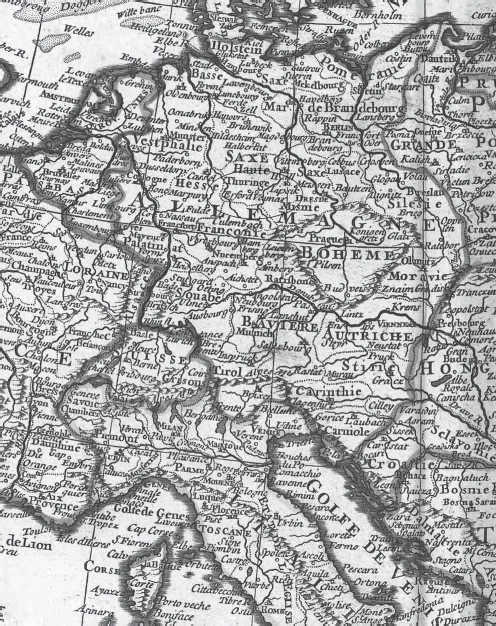
FIGURE 1.1 Early modern Germany, Guillaume de L’Isle, Philippe Buache, Carte d’Europe, 1769 (detail).
Source: Library of Congress Geography and Map Division, Washington, D.C., U.S.A., public domain, G5700 1724. L5 TIL, http://hdl.loc.gov/loc.gmd/g5700.ct000045 (15.02.2020, 12:45 CET).
1 GENDER, LAW, AND MATERIAL CULTURE
Annette Caroline Cremer
I. The tooth of a hippo as gendered item?
In 1716, Countess Auguste Dorothea of Schwarzburg (1666–1751), member of the high nobility and widow of the late ruler over a small earldom in today’s Thuringia, Germany, appeared as litigant before the Reichshofrat (Aulic Council), the Supreme Court of the Holy Roman Empire in Vienna. The premature death of her husband, Count Anton Günther II (1653–1716), had left her without issue. Now, as a childless widow she had to fight for her dowry against the interests of the agnate heirs. Auguste claimed housing and financial support that she was entitled to according to the marriage contract from 1684. To that extent, the case seems rather ordinary. But she also claimed specific items from the residency the couple had inhabited, among them items from the collection in the cabinet of curiosities, such as a petrified piece of wood “since it resembled a jewel”; a camera obscura and microscope “since they contained a mirror”; a papyrus with Chinese letters declared “a historical book, made for the perusal of women”; and a Roman oil lamp that “looked like a portable chandelier”. Finally, she claimed the tooth of a hippo and argued ex negative that “there was no proof that it had stemmed from a male animal”.1 It is not the items she claims for herself, but the way she argues that leaves us slightly puzzled. I want to use this curious example of a court case as a point of departure to explain the connexions between the keywords and concepts that form the core of this volume – namely, gender, law, and material culture.
Auguste’s claims were informed by early modern Saxonian law and contemporary ideas in respect to the ordering of things as part of the male or female sphere of the material world. Objects that were legally considered part of the female sphere were called Gerade, which stemmed from a Middle High German term meaning “utensils” or “tools”. The Gerade can be traced back to the thirteenth century as a part of female property.2 In force in northern parts of the Holy Roman Empire, it stayed in use for several hundred years, until the middle of the nineteenth century, exceeding the introduction of the General Prussian Law in 1794. Paragraph 206 of the Prussian Law still states that within marriage, apart from wedding gifts and property secured by a premarital contract, subject to the wife’s assets were only those objects “which, by their very nature, are dedicated to the use of women”, emphasising their habitual use.3 Comprehensive descriptions of what were considered items of the Gerade appear as entries in mid-eighteenth- to mid-nineteenth-century German encyclopaedias.4 The rules of the Gerade were also included in the popular handbook Frauenzimmer-Lexicon (Curious Women’s Dictionary), first published in 1715 and intended “for women’s usage and entertainment”. The book included a detailed description of the specific items that counted as part of the Gerade in conjunction with topics such as the history of famous women and medical treatment and recipes.5 The Gerade, so it seems, was part of a common pattern of agency and a matter of regular debate among women. Exact knowledge of what was to be considered part of it was key.
TABLE 1.1 Items of the Gerade understood as “female” objects as defined in Johann Heinrich Zedler’s Universal Lexicon (1735) and Johann Georg Krünitz’s Oekonomische Encyklopädie (1779).
• CLOTHING from wool, linen, and silk, including underwear, sleeping gown, and trousers
• RIBBONS, bonnets, gloves, stockings, shoes, and buckles that go with them as well as fans and veils
• CHESTS and coffers with lids
• All BOXES and cases in which female property was stored, and then if only the widow had the keys to them, but not inside walls and only if inside the cases were less general heritage pieces than Gerade pieces, according to their value
• Squeezing MACHINE for tablecloths and other textiles
• THREAD but not from wool
• Unused SILK and embroidery
• All harvested LINEN and FLAX but not hemp
• MIXED TEXTILES, including cotton and linen textiles
• BEDS and mattresses on which she herself, the children, and the servants have slept or those used for travel, as long as she had the keys to them, but not those used for guests
• Any CUSHIONS in daily use
• Any LINENS used as bedcovers, tablecloths, handkerchiefs, towels, aprons, scarfs, or sleeves
• All CURTAINS, carpets, and tapestries used daily by the wife
• Any FEATHERS
• BATHING towels, basin, and cauldron, but not the bathtub
• All blankets, SADDLE for horse-riding
• All CHANDELIERS and candleholders made of silver, tin, brass, or crystal that are not tied to the wall even if the name of the husband was imprinted on them, including the objects on which they stand (gueridons), but not large chandeliers hanging from the walls or ceilings or those that were bought by the husband for special occasions and not for daily usage
• Washing CAULDRON “within the wall or freely standing”
• All JEWELLERY
• Small IMAGES of emperors, kings, electors, and so on
• WATCHES when used as part of female attire
• Little POTS with balsam and RINGS, but not the signet ring unless adorned with gemstones
• SOAP in vessels
• All BOOKS the woman has read, together with the furniture they are stored in or set on (repository or table)
• All “items that belong to female work”: SPINNING WHEELS, lace pillows, all items connected to weaving, sewing, and knitting, including scissors
• MIRRORS in daily use but not those in the salon or bought for special decoration by the husband
• All SHEEP of female sex, all geese and ducks
• The horse-drawn CARRIAGE used by the wife, but without the horses
The Gerade was defined as a set of objects that was considered female property and was to be extracted from the estate before the general Saxon laws of distribution in hereditary succession applied. Traditionally, what was to be divided in accordance with its rule consisted in part of tools habitually used and all movable objects controlled by females and necessary for household chores. It also included such items that women had produced as well as all textiles in the house, clothing, mattresses, jewellery, mirrors, and chandeliers and also portraits of female family members and, in general, the female share of livestock. The Gerade varied in its details in accordance with local ordinances and depended on the social status of the persons concerned.6 The reason for the invention of the Gerade, so contemporaries argued, was the fact that daughters were excluded from their natural heritage by the sons since they did not benefit from the male form of the Gerade, called Hergewedde, which referred to male clothing, tools, and weapons handed down from father to son or next male heir. By contrast, the Gerade generally excluded sons, but with a telling exception: Sons who had become clergymen were also entitled to claim their share of the Gerade.7 While the male form (Hergewedde), which implied compulsory armed service, fell out of use in the seventeenth and eighteenth centuries, the Gerade stayed in use. Clearly, not all objects of the material world had a specific “gender”; nonetheless, parts of the material world were obviously understood as “female” or “male”. The gender category was defined by its visual characteristics (portraits of women), sex (female livestock), control (lock and key), homemade character, or object in daily use.
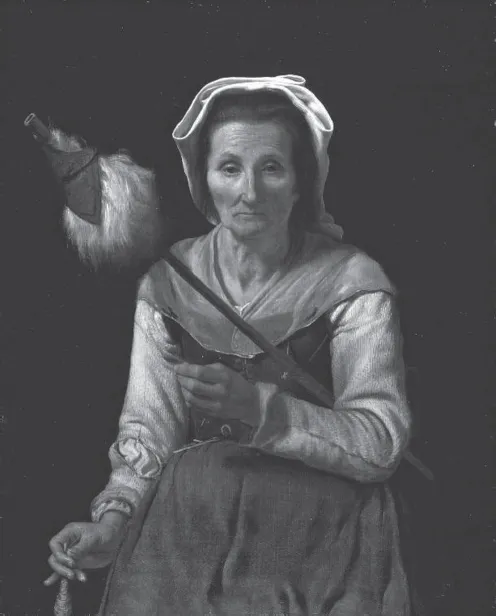
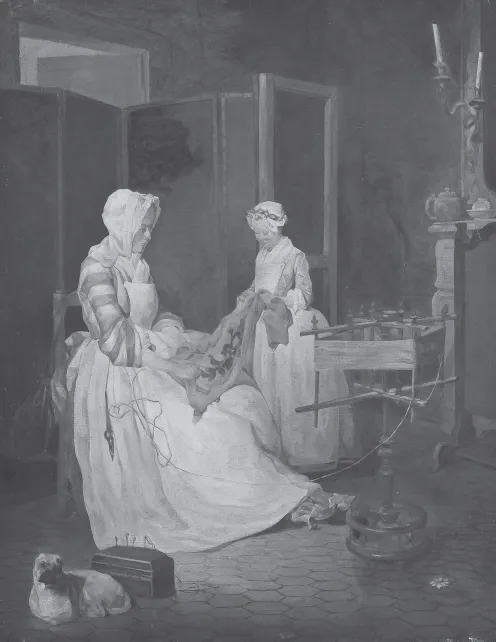
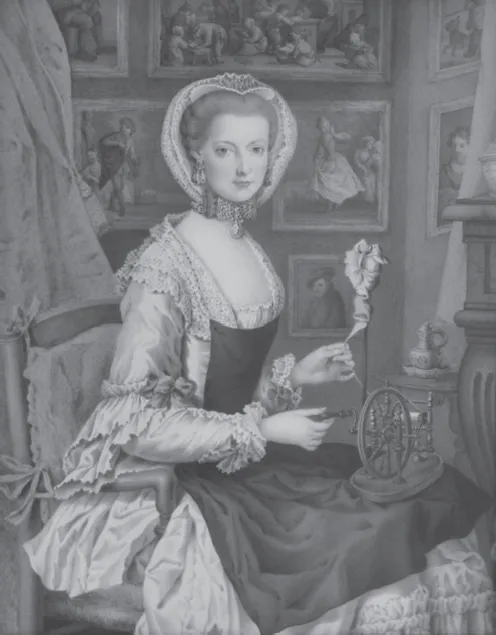
Early modern Europe had clear associations between men, women, and objects. The object types that functioned almost as an icon of the female gender role in all social groups were the spindle and distaff. The allegorical connotation of the spindle and distaff operated in three ways: First, as an expression of the clearly gendered household chore of spinning, the objects as such, because of their repetitive usage by women, were “gendered” as female. Second, as spinning formed the economic basis of many women in the pre-industrial home production of textiles, it stood for the industriousness of and capacity for self-subsistence of its owner. Third, it turned into a symbol of female virtue, so much so that even the Habsburg princess Marie Christine depicted herself using it. The spindle and distaff were objects integral to every household and can be traced from the lowest to the highest social levels (see Figures 1.2–1.4). They also appear in several fairy tales as attributes of female virtuousness and diligence, such as Old Mother Frost or Rumpelstiltskin by the Brothers Grimm. In early modern Germany, the spindle and distaff were, without any doubt, part of the gendered pre-inheritance of the Gerade.
FIGURE 1.2 Michael Sweerts, An Old Woman Spinning, 1646–1648.
Still, to reflect on the “gender” of an object seems irritating, as objects as such are neither male nor female. It is their connotation – an applied meaning that derives from a repetitive usage in a certain way and by a certain group of people – that ascribes to things a gender. A stomacher in the eighteenth century was clearly part of a woman’s attire and was thus coded as a “female” object. A stomacher worn by a man on stage in Shakespearean England, where women as artists were forbidden, was still a female garment and a costume, indicating that the actor wearing it represented a female character. A man wearing a stomacher in the twenty-first century is playfully criticising the binary division of humans’ biological sex and either represents a deconstruction of the visual code for male/female or states an appropriation of “femininity”. The meaning of a “gendered” object clearly depends on its precise contexts of usage.
FIGURE 1.4 German: Marie Christine von Habsburg-Lothringen: Erzherzogin Marie Christine im weißen Kleid. Gouache; English: Archduchess Marie Christine of Austria (1742–1798), daughter of Franz I, Stephan of Lorraine, Holy Roman Emperor, and Maria Theresia, Empress of Austria and Hungary, spouse of Albert, Prince of Saxony (1738–1822). Self-portrait. c. 1765. Marie Christine of Austria.
The early modern material world was classified not only by its alleged gender but also by a second category in respect to its movability:
[T]hings are by the law … distributed into two kinds; things real, and things personal. Things real are such as are permanent, fixed and immoveable, which cannot be carried out of their place; as lands and tenements; things personal are goods, money, and all other moveables; which may attend the owner’s person wherever he thinks proper to go.8
General as well as legal understanding categorised objects under two rubrics, seemingly in respect to their intrinsic properties, as mirrored by the citation of William Blackstone. This basic division followed an alleged “nature of an object”9 and defined objects as either immobile (“real”) or movable – terms still partly reflected in our modern language (German Immobilie for “real estate” or the French biens meubles). The German legal dictionary documents the us...
Table of contents
Cover
Half Title
Title
Copyright
Contents
List of figures
List of tables
List of contributors
Acknowledgements
Part I Introduction: men, women, property, law, and custom
Part II Gifts, symbolic values, and strategies
Part III Women’s access to immobile property
Part IV Women, law, and property in colonial contexts
Part V Women and property in transitory zones
Part VI Synthesis
Index of objects
Index
Trusted by 375,005 students
Access to over 1.5 million titles for a fair monthly price.
Study more efficiently using our study tools.
Frequently asked questions
Yes, you can cancel anytime from the Subscription tab in your account settings on the Perlego website. Your subscription will stay active until the end of your current billing period. Learn how to cancel your subscription
No, books cannot be downloaded as external files, such as PDFs, for use outside of Perlego. However, you can download books within the Perlego app for offline reading on mobile or tablet. Learn how to download books offline
Perlego offers two plans: Essential and Complete
Essential is ideal for learners and professionals who enjoy exploring a wide range of subjects. Access the Essential Library with 800,000+ trusted titles and best-sellers across business, personal growth, and the humanities. Includes unlimited reading time and Standard Read Aloud voice.
Complete: Perfect for advanced learners and researchers needing full, unrestricted access. Unlock 1.5M+ books across hundreds of subjects, including academic and specialized titles. The Complete Plan also includes advanced features like Premium Read Aloud and Research Assistant.
Both plans are available with monthly, semester, or annual billing cycles.
We are an online textbook subscription service, where you can get access to an entire online library for less than the price of a single book per month. With over 1.5 million books across 990+ topics, we’ve got you covered! Learn about our mission
Look out for the read-aloud symbol on your next book to see if you can listen to it. The read-aloud tool reads text aloud for you, highlighting the text as it is being read. You can pause it, speed it up and slow it down. Learn more about Read Aloud
Yes! You can use the Perlego app on both iOS and Android devices to read anytime, anywhere — even offline. Perfect for commutes or when you’re on the go. Please note we cannot support devices running on iOS 13 and Android 7 or earlier. Learn more about using the app
Yes, you can access Gender, Law and Material Culture by Annette Cremer, Annette Caroline Cremer,Annette Cremer, Annette Caroline Cremer in PDF and/or ePUB format, as well as other popular books in History & Social History. We have over 1.5 million books available in our catalogue for you to explore.