- 272 pages
- English
- ePUB (mobile friendly)
- Available on iOS & Android
eBook - ePub
About this book
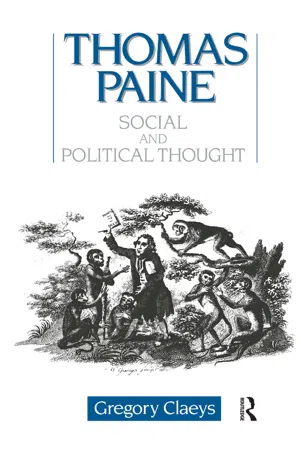
This book investigates Thomas Paine's social and political thought in both its British and American moments. It examines the ways in which Paine's ideas were understood. The book restores him to the position his contemporaries accorded him, that of an important writer on politics and society.
Information
1
‘Apostle of liberty’: the life of Thomas Paine
Like nearly everything else associated with him, the retailing of Paine’s life has been contentious. After the Rights of Man appeared, the British government for £500 commissioned a slanderous ‘biography’ of Paine from one ‘Francis Oldys’, a Tory refugee from Maryland and clerk at the Board of Trade and Plantations named George Chalmers. This reached eleven editions within two years, in the process growing (ever more fictionally) from 25 to over 150 pages, and was abstracted, embellished and widely reprinted.1 In the late 1790s similarly hostile works appeared by, among others, William Cobbett, then a leading anti-Jacobin but soon to convert to radicalism himself. Early in the new century an apostate radical headed in the opposite direction, James Cheetham (‘Cheat ‘Em’ to Paine’s disciples), added another vituperative account. But the Painites retaliated as early as 1793 with brief Impartial Memoirs of Paine and after 1815 several more substantial biographies appeared. Since then Paine’s character has been assailed and defended many times, his vices greatly exaggerated by his enemies, his virtues trumpeted loudly by his friends. Settling the true facts about several events in Paine’s life (his own autobiography having disappeared) remained important until many decades after his death, the last great point of contention being Paine’s supposed death-bed reversion to orthodox Christianity.2
Thomas Paine was born in the small Suffolk market town of Thetford (which today honours him with a statue and the Rights of Man public house) on 29 January 1737, the son of a small Quaker farmer and stay- (or corset-support) maker. Politically the town was in the pocket of a prominent Whig magnate, the Duke of Grafton, who nominated the two local MPs. The Lent Assizes for the Eastern Circuit were also held there and Paine doubtless witnessed the barbarous penalties meted out to those who defied the law. Raised as a Quaker on his father’s side, indeed, Paine was particularly aware of the cruelty of many punishments and frequent use of the death penalty, for the sect was in the forefront of opposition to both and, while later comments reveal that he found the Quaker life dull and colourless, he remained fond of the ‘exceedingly good moral education’ it demanded. At his mother’s instructions Paine was confirmed in the Church of England. But he was puzzled by a sermon on redemption read to him by a relative, doubting that God would allow his own son to be killed when ‘a man would be hanged who did such a thing’ and remaining convinced of God’s greater benevolence.3
Despite an aptitude for science and mathematics, Paine was withdrawn from school by his father at the age of 13 to learn the stay-making business, and remained at this task for some five years. Having already conceived a desire to see America, however, he doubtless found the trade constricting. More attractive, too, was the naval life a schoolmaster had regaled him with, and at 17 Paine slipped away to join the Terrible (its captain’s name was Death), a privateer engaged against French traders.4 His father rescued him before the vessel sailed, however, and in its next engagement it lost nearly nine-tenths of its crew. It was not the first time fortune would smile upon Paine. Though in 1756 he apparently joined another privateer, the King of Prussia, Paine returned to stay-manufacturing first in London, then Dover, and finally at Sandwich in Kent, where he married in the autumn of 1759, and possibly also acted briefly as a Methodist lay preacher. But his business was unsuccessful and in the following year his wife died. Soon after Paine decided to become an exciseman. For a time he examined brewers’ casks at Grantham and in mid-1764 was appointed to observe smugglers at Alford. Ill-paid, and probably also immersed in his own scientific studies, Paine like many of his colleagues neglected to examine fully all of the goods brought into local warehouses. For passing some without inspection he was discharged in August 1765.
Paine now travelled for a time and, though he sued successfully and was reinstated as an exciseman, no suitable post was available for him. He taught English briefly in London, again apparently preaching, and may even have considered becoming an Anglican minister. He also attended scientific lectures at the Royal Society (later telling a friend that he had ‘seldom passed five minutes of my life, however circumstanced, in which I did not acquire some knowledge’). Finally an excise post came open and after a brief period in Cornwall Paine went to Lewes, Sussex in early 1768, where he boarded with a Quaker tobacconist. This was an extremely important period in his life. He seems to have been involved in local charitable work. He began to be interested in politics, composing an election song for a local Whig candidate for the respectable sum of three guineas. Soon, too, by one account, he began to move away from Whiggism, prompted in the first instance by the none too seditious comment by a friend, over a glass of punch after a game of bowls, that Frederick, King of Prussia was ‘the right sort of man for a king, for he has a deal of the devil in him’, which led Paine to wonder ‘if a system of government did not exist that did not require a devil’. He also began his career as a pamphleteer here. His first work, The Case of the Officers of the Excise (1772), detailed the low wages and arduous duties of excisemen, the temptations to dishonesty this incited and the consequent dangers for revenue collection. Paine’s talents as a writer were already evident: ‘The rich, in ease and affluence, may think I have drawn an unnatural portrait’, he proclaimed, adding, ‘but could they descend to the cold regions of want, the circle of polar poverty, they would find their opinions changing with the climate.’ Paine was also active in a local debating society, the White Hart Evening Club, where he became known as a convivial conversationalist with a taste for oysters and wine. Here, Paine’s comrades elected him ‘General of the Headstrong War’ for his ‘perserverance in a good cause and obstinacy in a bad one’, as a radical Quaker friend, Thomas ‘Clio’ Rickman later put it.5 His only pronounced vice, in fact, seems to have been a predilection towards vanity.
Paine married again in 1771, this time a young Quaker girl, and spent much of the next few years preparing petitions favouring higher excisemen’s salaries, a task his colleagues had deputed him for. He also operated a tobacco mill and small grocery shop for a time, but was hard hit when he lost his excise post again in April 1774 (though Chalmers’s later accusation that he had been selling smuggled tobacco was groundless). Forced to sell his possessions in order to meet his creditors’ claims, Paine separated from his wife (whom he later helped to support) a few months later and never remarried.6 Returning to London, he followed the ‘Wilkes and Liberty’ campaign with great interest. He now became acquainted with the writer Oliver Goldsmith and also Benjamin Franklin, whose electrical experiments he admired and to whom he made the famous retort, when Franklin stated, ‘Where liberty is, there is my country,’ ‘Where liberty is not, there is my country.’ Franklin saw much promise in Paine and encouraged him to leave for the American colonies, where there was greater scope for his talents.
Soon taking this fateful advice, Paine reached Philadelphia in December 1774 after nine weeks’ voyage, having barely survived an outbreak of shipboard typhus. Originally seeking to open a girls’ school, he instead with Franklin’s assistance became editor of a small paper, the Pennsylvania Magazine, or American Museum. To this and other Philadelphia journals he contributed, among other pieces, a defence of modern authors and institutions against the ancient, an important antislavery essay at a time (March 1775) when such views were uncommon, and articles condemning duelling, British policy in India, the use of titles and cruelty to animals. He also helped to draft a bill incorporating the American Philosophical Society. As colonial independence neared, he had already begun to establish that vigorous and independent style of radicalism which would become his trademark. But this was not sufficient to earn a living and poor pay soon forced him to leave the paper.7
Paine did not initially favour the violent separation of the colonies from Britain. But when the British fired upon a demonstration at Lexington in April 1775, and certainly by late 1775, or barely a year after his arrival, he concluded that independence was inevitable. The cause of separation became soon and long associated with his name and the force of his arguments. The pattern of Paine’s political career, as we will see, was already laid: what others hesitantly and often reluctantly felt, he stated unequivocally and in a language all could comprehend.
Much of the autumn of 1775 was devoted to writing Common Sense, which ‘burst from the press with an effect which has rarely been produced by types and paper in any age or country’, as his friend Dr Benjamin Rush put it. None the less Paine’s authorship remained unknown at first, partly because he had resided only briefly in the colonies and did not want this to prejudice his readers. Franklin, in fact, was widely believed to have written the piece, though when a loyalist lady denounced him for using the phrase ‘the royal brute of Britain’ to describe George III, Franklin denied that he would have so dishonoured the animal world. Despite the success of Common Sense, Paine gained nothing from it, since he paid the costs of publication (about £40) himself, and further donated the copyright to the colonists’ struggle. It was to set a pattern for his entire career, for Paine was usually too proud and too idealistic to accept money for doing what he did best, and was consequently rarely well off.8
As the cause of independence gathered steam, Paine assailed vacillating public opinion in Pennsylvania and New York, and warned against accepting prospective English peace proposals. Closely associated with Jefferson for a time, he endeavoured to have an anti-slavery clause inserted into the Declaration of Independence, but it was withdrawn after objections by Georgia, South Carolina and various northern slave suppliers. Meanwhile Paine joined the army. By September he was an aide-de-camp to General Nathaniel Greene with the rank of brigade major and accompanied the Continental Army during its retreat to Newark. Here he began to compose the first of his Crisis articles, which did much to raise the colonists’ flagging spirits in the face of an apparently hopeless plight.
In early 1777 Paine served as part of a delegation to secure neutrality from some Pennsylvania Indians and in April became secretary to the newly created Committee of Foreign Affairs of the Congress. Philadelphia fell to the British in September and Paine again returned to the field, following Washington to Valley Forge and seeing action on several occasions. He was rarely far from political controversy, however. First he defended at length the Pennsylvania constitution framed by Franklin, which was under assault by opponents of popular government. In late 1778 Paine became involved in a major scandal which made him many political adversaries when he denounced an American envoy to France, Silas Deane, for purportedly defrauding Congress by charging for supplies which Paine felt were a gift. Paine inadvertently undermined his own position, however, by indiscreetly disclosing secret information about France’s aid to America at a time of its supposed neutrality. The French envoy was compelled to protest and Paine to defend himself. A fierce debate occupied nearly a week of congressional business in early 1779 and one of Paine’s enemies, with whom he would have much to do in the future, Gouverneur Morris, even urged his dismissal on the grounds of his humble social origins alone.9 Congress refused to discharge him, but Paine resigned his post anyway in the belief that his case would not be fairly heard. Refusing a large bribe from the French ambassador, who hoped to gain the services of his pen for France, he instead became a clerk in the offices of a local lawyer, and in September 1779 complained that he could not even afford to hire, much less to buy, his own horse.
To raise funds Paine now proposed to bring out a collected edition of his writings as well as to commence a history of the revolution which, unlike accounts of ancient wars he knew, would provoke ‘moral reflection’. Lacking support for such projects, Paine reminded the government of Pennsylvania of its debts to him. Its assembly accordingly elected him Clerk in November 1779, and in his first day of office Paine probably assisted in introducing an anti-slavery act which passed the following March. But his attention remained focused on the war. The Continental Army was again sinking fast in the winter of 1780 and the new republic was in desperate financial straits. Paine began a subscription fund with $500 of his own money and eventually £300,000 was raised. With two new pamphlets in the spring of 1780, Paine also found his popularity returning, and on 4 July 1780 he was granted the degree of Master of Arts by the newly reconstituted University of Pennsylvania. Later that year he proposed that Congress send him on a secret mission to England to further the American cause by appearing to be an Englishman returning from the colonies certain of American victory.
Resolved to write his history, none the less, and still hoping for congressional support, Paine resigned his clerkship to the Pennsylvania Assembly in November 1780. Before he could commence work, however, one Colonel John Laurens, who had been appointed by Congress to sail for France in search of loans, persuaded Paine to accompany him as his secretary. Paine found himself widely known and respected in France, and their mission was highly successful, 6 million livres being secured with Franklin’s help. Returning to Boston in late summer, Paine found he would receive no recompense for the expenses of his trip. In the autumn he appealed to Washington to aid his straitened circumstances. The general, basking in his victory over Cornwallis at Yorktown, agreed that Paine’s services to the cause had been essential and arranged for $800 annually to be granted him in return for writing on behalf of the nation, particularly in support of higher state contributions to the national government and an extension of the powers of Congress. A similar sum was to be paid him by the Secretary of Foreign Affairs. By late 1783 Paine had also accepted money from France in gratitude for his militantly anti-British attitude, though these were of course causes which he supported himself. In the coming months Paine wrote warning of overconfidence as negotiations continued and he restrained Washington from hanging a British officer in reprisal for the unwarranted British execution of an American officer. He also tried again to persuade some recalcitrant states to fund the army even as its victory seemed certain. But such efforts had little effect beyond making Paine himself seem a mere agent of the Congress.
Soon after this, Paine moved to Bordentown, New Jersey to be near a Quaker friend, Colonel Joseph Kirkbride. Virtually impoverished after sinking his money into a small house, he continued to hope for congressional relief. Washington recommended that Paine be appointed historiographer to the new nation. But Paine’s views favouring a strong national sovereignty over the states evidently deflected congressional sympathy for this proposal. In 1784, however, the State of New York granted him a 277-acre farm with a large house at New Rochelle which had been confiscated from an exiled loyalist. The Virginia legislature attempted a similar grant, but it failed to pass. Pennsylvania granted him £500. Finally Congress, trying to avoid resuscitating the Deane affair again, granted him $3,000, reduced from an original proposal of $6,000. This did not cover Paine’s expenses in France, but at least he now enjoyed considerable independence.
During the next several years Paine worked on his favourite scientific project, the construction of the first large single-arch iron bridge.10 The Pennsylvania Assembly expressed interest in the design, but Paine decided first to visit his mother in England, with a stop in France to seek support for his project as well as for the cause of peace with England. At Paris in the summer of 1787 he was widely fêted, and much attention was bestowed upon his bridge model. At Thetford he found his mother in comfort, stayed with her for several months, perhaps attending a local Quaker meeting house, and settling upon her a respectable allowance. While in Britain he also wrote against the prosp...
Table of contents
- Cover
- Half Title
- Title Page
- Copyright Page
- Dedication
- Table of Contents
- Acknowledgements
- Chronology
- Introduction The age of Paine
- 1 ‘Apostle of liberty’: the life of Thomas Paine
- 2 ‘The cause of all mankind’: Paine and the American revolution
- 3 Republicanism contested: Burke’s Reflections (1790) and the Rights of Man (1791-92)
- 4 Paine’s achievement
- 5 A great awakening: the birth of the Revolutionary Party
- 6 Inequality vindicated: the government party
- 7 Revolution in heaven: The Age of Reason (1794-95)
- 8 Revolution in civilization: Agrarian Justice (1797)
- Conclusion Political saint: the legend of Thomas Paine
- Bibliography
- Index
Trusted by 375,005 students
Access to over 1.5 million titles for a fair monthly price.
Study more efficiently using our study tools.
Frequently asked questions
Yes, you can cancel anytime from the Subscription tab in your account settings on the Perlego website. Your subscription will stay active until the end of your current billing period. Learn how to cancel your subscription
No, books cannot be downloaded as external files, such as PDFs, for use outside of Perlego. However, you can download books within the Perlego app for offline reading on mobile or tablet. Learn how to download books offline
Perlego offers two plans: Essential and Complete
- Essential is ideal for learners and professionals who enjoy exploring a wide range of subjects. Access the Essential Library with 800,000+ trusted titles and best-sellers across business, personal growth, and the humanities. Includes unlimited reading time and Standard Read Aloud voice.
- Complete: Perfect for advanced learners and researchers needing full, unrestricted access. Unlock 1.5M+ books across hundreds of subjects, including academic and specialized titles. The Complete Plan also includes advanced features like Premium Read Aloud and Research Assistant.
We are an online textbook subscription service, where you can get access to an entire online library for less than the price of a single book per month. With over 1.5 million books across 990+ topics, we’ve got you covered! Learn about our mission
Look out for the read-aloud symbol on your next book to see if you can listen to it. The read-aloud tool reads text aloud for you, highlighting the text as it is being read. You can pause it, speed it up and slow it down. Learn more about Read Aloud
Yes! You can use the Perlego app on both iOS and Android devices to read anytime, anywhere — even offline. Perfect for commutes or when you’re on the go.
Please note we cannot support devices running on iOS 13 and Android 7 or earlier. Learn more about using the app
Please note we cannot support devices running on iOS 13 and Android 7 or earlier. Learn more about using the app
Yes, you can access Thomas Paine by Gregory Claeys in PDF and/or ePUB format, as well as other popular books in Politics & International Relations & Political Biographies. We have over 1.5 million books available in our catalogue for you to explore.