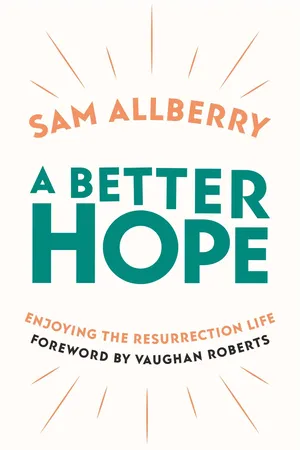
Hope is far bigger than wishful thinking. Biblical hope is something certain and firm, that keeps us going when life is tough and inexplicable, and when the bottom drops out of our world. Hope transforms everything. Hope lifts the pressure off us - turns our eyes to a bigger picture.For the Christian, the Resurrection means that we have real, genuine hope in this life, and beyond, for eternity. We are trusting in Christ, not ourselves, and he is the gateway to lasting hope, peace and joy. We have a better hope.In this short, conversational book Sam Allberry invites us to consider what the Bible says about this better hope. The gospel persuades us to base our lives on something secure, not flimsy, something lasting, not temporary. Millions have done so and have never regretted it.Discover how the Resurrection offers you a better hope.This e-book extracted from the 2010 volume Lifted.
- English
- ePUB (mobile friendly)
- Available on iOS & Android
eBook - ePub
About this book
Information
Topic
Theology & ReligionSubtopic
ChristianityHope
‘Hope’ for dummies . . .
I was hoping – hoping quite hard, as it happens. The first two-thirds of the flight had gone smoothly. I’d befriended the old lady in the seat next to me and was munching my way through her bag of sweets. But it all came to an abrupt halt when the aircraft made a sudden lurch to the left, as if the pilot was making a handbrake turn. Severe turbulence followed, and lasted till virtually the end of the flight. It felt as though the plane was advancing solely by means of some unseen force repeatedly drop-kicking it across the Atlantic skies. And so I sat there, hands gripping each armrest, hoping – really hoping – that the plane would just hurry up and get down onto the ground. Preferably all of it at the same time.
I think we often get hope wrong. We normally speak of hope as something we do: I hope it doesn’t rain tomorrow, hope the meeting goes well, and hope this cold clears up. Hopes in these cases can be significant or insignificant – anything from how someone might respond to a marriage proposal to the weekend sports results. But they’re pretty much always uncertain. We don’t control the things we hope for. I have no power over weather, health, aviation or what side of bed my football team decide to get out of. This kind of hope is another way of describing wishful thinking. It’s about things we want, but might not necessarily get. It’s fraught with the risk of disappointment and so we ‘try not to get our hopes up’. There’s every chance it’s not going to turn out the way we hoped.
The Bible speaks of hope as something we have. It is about looking forward to something that is certain. I have the hope of eternity with Christ. We still don’t control the thing for which we have hope, but God does and has promised eternity to us. There is no degree of risk or disappointment. This hope cannot be frustrated by anyone. Unlike all our other expressions of hope, this is hope that won’t disappoint us (as Paul says in Romans 5:5). It is guaranteed by God himself and bears his signature: the resurrection of Jesus from the dead.
This sort of hope makes living possible, for it gives us a future. Part of what makes us human is the ability to consider the future. We can’t help but be conscious of it. And we need to be. We need to have a future which is, to some extent, sorted out. We need to have hope.
Hope and humanness
To be without hope is one of the hardest experiences in life. A moment’s reflection bears this out. It has been said by those who survived the horrors of the Soviet labour camps in the mid-twentieth century that there were really only two kinds of people imprisoned there: those who had hope, and those who did not. It was the difference between those who could keep going, and those who couldn’t. If you take away a person’s hope, you take away his or her life. We need to know we have a future to head towards.
This can often be difficult for those heading into middle age. By this stage of life it can become painfully clear what we are actually going to be able to achieve. Realism kicks in. We dream in youth but wake in midlife. A middle-aged man recently said to me, ‘By your forties life is pretty much where it’s going to be.’ The midlife crunch is epitomized by Billy Crystal’s character Mitch in the classic 1990s movie City Slickers. Mitch sums up the despair of a forty-something by asking his boss one day, ‘Have you ever had that feeling that this is the best I’m ever gonna do, this is the best I’m ever gonna feel . . . and it ain’t that great?’ (His boss, familiar with where all this has come from, sighs in response, ‘Happy Birthday, Mitch’.)
By mid-life our options are more limited. It becomes clear that many of our cherished dreams may not materialize in the way we’d always imagined – dreams about family, security, advancement, money, popularity. Where we’ve got to by this stage pretty much indicates where we’ll ever get to. ‘Where we’re at, is where we’re at. And that’s it’, as I heard one forty-something put it. No wonder they say middle age is the hardest stage of life. It is when hope is doused in the cold water of reality.
A new kind of hope
Christians, by definition, are people of hope. Hope that has the fingerprints and guarantee of God all over it. It all has to do with the resurrection: ‘Praise be to the God and Father of our Lord Jesus Christ! In his great mercy he has given us new birth into a living hope through the resurrection of Jesus Christ from the dead’ (1 Peter 1:3).
We can see why this hope is so different. It is not based on my circumstances and prospects. It comes through Jesus’ resurrection, and is therefore independent of those things. For this reason, it is a living hope. It has a life of its own that can endure even the worst experiences of life in this world. It is grounded in what God has done in raising Jesus from the dead. It is hope that is totally contingent on a particular event. And because that event has happened our hope is secure. Not wishful-thinking hope, but guaranteed hope.
We need to see how this is so, how Peter is able to connect the resurrection of Jesus two millennia ago with a future hope for Christians today. It’s a connection we need to get right, and yet the early Christians got it terribly wrong in two ways, and we need to learn from their mistakes.
Mistake 1: ‘The resurrection has already taken place’
This, we’re told, is the teaching of Hymenaeus and Philetus, two names that wreak havoc not just on the spellchecker but on the Christian faith as well. Paul discusses them – and others like them – in 2 Timothy:
Their teaching will spread like gangrene. Among them are Hymenaeus and Philetus, who have wandered away from the truth. They say that the resurrection has already taken place, and they destroy the faith of some.
(2 Timothy 2:17–18)
According to their teaching the resurrection has already happened: not just that the resurrection of Jesus has happened (which Paul has affirmed many times), but that the whole resurrection ‘package’ is now done. In other words, Jesus’ resurrection was the end of what God is up to, and not the beginning. There is nothing more to come. This ide...
Table of contents
- Foreword
- Hope
Trusted by 375,005 students
Access to over 1.5 million titles for a fair monthly price.
Study more efficiently using our study tools.
Frequently asked questions
Yes, you can cancel anytime from the Subscription tab in your account settings on the Perlego website. Your subscription will stay active until the end of your current billing period. Learn how to cancel your subscription
No, books cannot be downloaded as external files, such as PDFs, for use outside of Perlego. However, you can download books within the Perlego app for offline reading on mobile or tablet. Learn how to download books offline
Perlego offers two plans: Essential and Complete
- Essential is ideal for learners and professionals who enjoy exploring a wide range of subjects. Access the Essential Library with 800,000+ trusted titles and best-sellers across business, personal growth, and the humanities. Includes unlimited reading time and Standard Read Aloud voice.
- Complete: Perfect for advanced learners and researchers needing full, unrestricted access. Unlock 1.5M+ books across hundreds of subjects, including academic and specialized titles. The Complete Plan also includes advanced features like Premium Read Aloud and Research Assistant.
We are an online textbook subscription service, where you can get access to an entire online library for less than the price of a single book per month. With over 1.5 million books across 990+ topics, we’ve got you covered! Learn about our mission
Look out for the read-aloud symbol on your next book to see if you can listen to it. The read-aloud tool reads text aloud for you, highlighting the text as it is being read. You can pause it, speed it up and slow it down. Learn more about Read Aloud
Yes! You can use the Perlego app on both iOS and Android devices to read anytime, anywhere — even offline. Perfect for commutes or when you’re on the go.
Please note we cannot support devices running on iOS 13 and Android 7 or earlier. Learn more about using the app
Please note we cannot support devices running on iOS 13 and Android 7 or earlier. Learn more about using the app
Yes, you can access A Better Hope by Sam Allberry in PDF and/or ePUB format, as well as other popular books in Theology & Religion & Christianity. We have over 1.5 million books available in our catalogue for you to explore.