Based on the latest text of the NIV, this updated commentary reflects the most current scholarship.
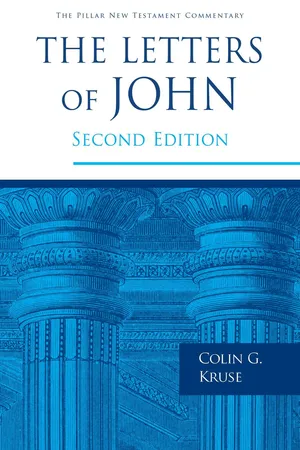
This updated and revised Pillar commentary seeks to clearly explain the meaning of John's letters to teachers, pastors, and general readers looking for a reliable and trusted resource for personal study. Colin Kruse introduces the important issues involved in interpreting the Johannine letters, gives verse-by-verse comments, and provides extensive discussion of John's major theological themes, including the real humanity of Christ, atonement, the role of the Spirit, Christian assurance, the meaning of koinonia, Christian love, and eternal life. Designed both for serious students and for general readers of the Bible, the Pillar New Testament Commentary volumes seek to make clear the meaning of the text of Scripture as we have it. The scholars writing these volumes interact with the most important, informed contemporary debate yet avoid undue technical detail. Their ideal is a blend of rigorous exegesis and exposition, scholarship and pastoral sensitivity, with an eye alert both to biblical theology and to the contemporary relevance of the Bible.
- English
- ePUB (mobile friendly)
- Available on iOS & Android
eBook - ePub
The Letters of John
About this book
Trusted by 375,005 students
Access to over 1.5 million titles for a fair monthly price.
Study more efficiently using our study tools.
Information
Topic
Theology & ReligionSubtopic
Biblical CommentaryOutline of 1 John
1:1–4 – A preface concerning the Word of life
1:5–2:2 – Claims to know God tested by attitudes to sin
2:3–11 – Claims to know God tested by obedience
2:12–17 – Affirmation and exhortation for believers
2:18–27 – Warnings against being deceived by the secessionists
2:28–3:10 – Distinguishing the children of God from the children of the devil
3:11–24 – The gospel demand to love one another and confidence in prayer
4:1–6 – Testing the “spirits”
4:7–5:4a – Claims to love God tested by love for fellow believers
5:4b–12 – Accepting God’s testimony and eternal life
5:13–21 – Concluding reassurances and exhortations
Commentary on 1 John
A Preface Concerning the Word of Life (1:1–4)
As a circular letter, 1 John lacks the normal opening greeting that identifies the author and recipients. It opens directly with a prologue that reminds them of the message they heard when they first became Christians. This message rested on the firsthand testimony of those who saw, heard, and even touched with their hands the Word of life, the Lord Jesus Christ. It is on this testimony, the author says, that the readers’ fellowship with him and their fellowship with God are based.
1 That which was from the beginning, which we have heard, which we have seen with our eyes, which we have looked at and our hands have touched—this we proclaim concerning the Word of life. 2 The life appeared; we have seen it and testify to it, and we proclaim to you the eternal life, which was with the Father and has appeared to us. 3 We proclaim to you what we have seen and heard, so that you also may have fellowship with us. And our fellowship is with the Father and with his Son, Jesus Christ. 4 We write this to make our joy complete.
1:1 This “Word of life” is described first of all as “that which was from the beginning” (ho ēn ap’ archēs). Modern-day readers of the NT can hardly avoid seeing here an allusion to teaching found in the prologue of the Fourth Gospel: “In the beginning was the Word” (en archē ēn ho logos). In the context of the prologue of John’s Gospel, “the beginning” means the time before the creation of the world. In the context of the opening verses of 1 John, “the beginning” has a different meaning. The expression “that which was from the beginning” functions as one of a series of relative clauses descriptive of the “Word of life,” which the passage, as it unfolds, makes quite clear refers to the Word of life incarnate in Jesus Christ. The net result is that when the author describes the Word of life as “that which was from the beginning,” he is in fact speaking primarily of the Word of life incarnate in Jesus Christ, not the Word existing with God prior to the foundation of the world.1 Nevertheless, the echoes of the prologue of the Gospel found in this statement may imply an identity between the Word of life incarnate in Jesus Christ and the one whom the Fourth Gospel speaks of as being with God in the beginning before the foundation of the world.2
Second, the Word of life is described as that “which we have heard.” It is sometimes suggested that this does not imply a firsthand hearing of Jesus’s preaching by the author, but only a hearing of the message of Jesus handed down by others. Taken on its own, “we have heard” could mean this.3 However, the immediate context of the expression in 1:1 makes it clear that an actual firsthand hearing of the proclamation of Jesus is implied. What was heard is associated with what was seen with the eyes and touched with the hands, expressions which, as we shall see, imply firsthand sense perception. This is in line with the statement in v. 5 where the author speaks of “the message we have heard from him.”
Third, the Word of life is described as that “which we have seen with our eyes” (ho heōrakamen tois ophthalmois hēmōn). This expression, found only here in the NT, is used to reinforce the claim that the proclamation of the Word of life comes from one who is an eyewitness.4 This is supported by the fact that all but one of the ninety-one uses of expressions combining forms of the verb “to see” and the words “with the eyes” in the LXX imply sense perception—that is, a direct personal acquaintance with the object said to have been seen.
Fourth, the Word of life is described as that “which we have looked at” (ho etheasametha). The verb theaomai is used twenty-two times in the NT. The nineteen uses outside 1 John all denote unambiguously a physical seeing with the human eye. One of the three uses in 1 John (4:12: “no one has ever seen God”) also relates unambiguously to seeing with the human eye. There is little reason, therefore, to think that the other two uses in 1 John, found here in 1:1 and in 4:14 (in both places the author claims to be among those who saw the Word of life/the Son), should be understood in any way other than actual physical seeing with the human eye.
There does not appear to be any notable difference in meaning between the verb “to see” (horaō) and the verb “to look at” (theaomai) used here in v. 1, but the different tenses used in each case represent different emphases by the author: the perfect (in the case of “we have seen with our eyes”) focuses attention on the status of the author as one of the eyewitnesses, and the aorist (in the case of “we have looked at”) simply narrates the seeing itself.
Fifth, the Word of life is described as something that “our hands have touched” (hai cheires hēmōn epsēlaphēsan). The expression “to touch with the hands” is found only here in the NT, but the verb “to touch” (psēlaphaō) occurs in three other places: in Luke 24:39 and Heb 12:18, where it denotes a physical touching (with the hands), and in Acts 17:27, where it has the metaphorical sense of feeling after God (something made clear by the context). The verb is found fifteen times in the LXX, where it is used predominantly to denote actual touching (with the hands). In the present context it is clear that the author is using the verb to mean actual touching with the hands. By doing so, he claims that his proclamation rests on the experience of not only seeing but also having touched with his own hands the Word of life.
It is clear from the foregoing that when the author says, “this we proclaim5 concerning the Word of life,”6 he has in mind something much more than a spoken message.7 He proclaims the Word of life that he has heard, seen, and touched. As will become clear in what follows, he proclaims a message that has been embodied in a person—the person of Jesus Christ.
Excursus 1: A Note on the Language of Sense Perception
Brown includes a lengthy discussion of the identification of the “we” in 1:1, and in particular a discussion of the question of whether the “we” were eyewitnesses of the Word of life.8 Brown, who argues that the “we” were not eyewitnesses but a “School of tradition bearers,” appeals to a number of ancient texts to illustrate how the language of sense perception could be used where sense perception was not involved.9 It is important to review this evidence, and so the texts to which he appeals are reproduced below together with a brief comment on their significance.
It was not his [Agricola’s] fate to see the Senate-house besieged, the Senate surrounded by armed men, and in the same reign of terror so many consulars butchered, the flight and exile of so many honorable women. Mettius Carus was still rated at one victory only; Messalinus’ rasping voice was confined to the Alban citadel; Baebius Massa was still as before, on trial. A little while and our hands it was which dragged Helvidus to his dungeon; it was we who were (put to shame) by the look which Mauricus and Rusticus gave, we who were soaked by the innocent blood of Senecio. Nero after all withdrew his eyes, nor contemplated the crimes he authorised. (Tacitus, Agricola 45)
In this text the speakers do use metaphor when they say “our hands it was which dragged Helvidus to his dungeon” and “we . . . were soaked by the innocent blood of Senecio.” Nevertheless, the speakers are still acknowledging they, unlike Agricola, were eyewitnesses of the terrible events they narrate. This text, then, is the testimony of eyewitnesses and provides no precedent for interpreting 1 John 1:1 otherwise.
We ourselves heard this voice that came from heaven when we were with him on the sacred mountain. (2 Pet 1:18)
In this text the author claims to have actually heard the voice from heaven that spoke to the disciples on the Mount of Transfiguration. The only way the implied claim to be an eyewitness here can be denied is to regard 2 Peter as pseudonymous. If it is not pseudonymous, this text also provides no precedent for interpreting 1 John 1:1 as the voice of the “Johannine school” and not the voice of an eyewitness.
Now I beseech you all to obey the word of righteousness, and to endure with all the endurance which you also saw before your eyes, not only in the blessed Ignatius, and Zosimus, and Rufus, but also in others among yourselves, and in Paul himself, and in the other Apostles. (Polycarp, To the Philippians 9.1)
Here Polycarp urges the Philippians to follow the examples of obedience to the word of righteousness (probably meaning the instructions given to them about facing persecution and martyrdom) that they “saw before their eyes” in the endurance of people they knew—that is, the endurance of Ignatius, Zosimus, Rufus, and others among themselves. Clearly Polycarp was referring to their actual observance of the sufferings of these people. He goes on to cite the example of Paul and the other apostles, whose sufferings the readers had probably not witnessed, and they would know that Polycarp was speaking metaphorically at this point. This text does then speak about genuine eyewitness experience, and where it speaks metaphorically, the meaning would be obvious. The text provides no precedent for interpreting 1 John 1:1 m...
Table of contents
- List of Excursuses
- Editor’s Preface
- Author’s Preface
- Abbreviations
- Bibliography
- Introduction
- Outline of 1 John
- Commentary on 1 John
- Outline of 2 John
- Commentary on 2 John
- Outline of 3 John
- Commentary on 3 John
- Appendix: Biblical and Extrabiblical References to Cain
- Search items for subjects
- Search items for modern authors
- Search items for Scripture references
- Search items for extrabiblical literature
- Notes
Frequently asked questions
Yes, you can cancel anytime from the Subscription tab in your account settings on the Perlego website. Your subscription will stay active until the end of your current billing period. Learn how to cancel your subscription
No, books cannot be downloaded as external files, such as PDFs, for use outside of Perlego. However, you can download books within the Perlego app for offline reading on mobile or tablet. Learn how to download books offline
Perlego offers two plans: Essential and Complete
- Essential is ideal for learners and professionals who enjoy exploring a wide range of subjects. Access the Essential Library with 800,000+ trusted titles and best-sellers across business, personal growth, and the humanities. Includes unlimited reading time and Standard Read Aloud voice.
- Complete: Perfect for advanced learners and researchers needing full, unrestricted access. Unlock 1.5M+ books across hundreds of subjects, including academic and specialized titles. The Complete Plan also includes advanced features like Premium Read Aloud and Research Assistant.
We are an online textbook subscription service, where you can get access to an entire online library for less than the price of a single book per month. With over 1.5 million books across 990+ topics, we’ve got you covered! Learn about our mission
Look out for the read-aloud symbol on your next book to see if you can listen to it. The read-aloud tool reads text aloud for you, highlighting the text as it is being read. You can pause it, speed it up and slow it down. Learn more about Read Aloud
Yes! You can use the Perlego app on both iOS and Android devices to read anytime, anywhere — even offline. Perfect for commutes or when you’re on the go.
Please note we cannot support devices running on iOS 13 and Android 7 or earlier. Learn more about using the app
Please note we cannot support devices running on iOS 13 and Android 7 or earlier. Learn more about using the app
Yes, you can access The Letters of John by Colin G Kruse in PDF and/or ePUB format, as well as other popular books in Theology & Religion & Biblical Commentary. We have over 1.5 million books available in our catalogue for you to explore.