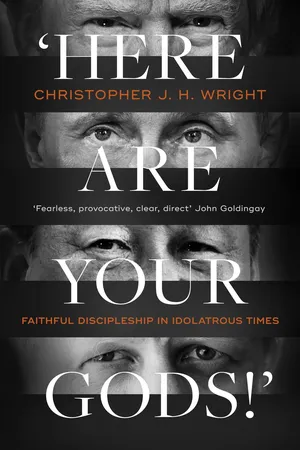
How should Christians be faithful disciples in the political turbulence of Trump and Brexit?Christopher J H Wright unpacks the Biblical theme of idolatry and connects it to discipleship in today's world. As Christians, we desperately need to name and expose the false gods and idols that we are tempted to bow down to - 'Here are your gods!'The Bible challenges the idols of political power and nationalism. The Biblical story is filled with hope that the kingdom of God will ultimately triumph over all human empires. How then should we live as followers of Jesus, the Messiah, Saviour, Lord and King?Part One is adapted from chapter 5 of Wright's The Mission of God, 'The Living God Confronts Idolatry'. Parts Two and Three bring the Bible to bear on contemporary politics in the UK and USA, and for all Christians seeking to make sense of the changing world we live in.
- English
- ePUB (mobile friendly)
- Available on iOS & Android
eBook - ePub
About this book
Information
Topic
Theology & ReligionSubtopic
ReligionPart one
The Lord God and Other Gods in the Bible
Monotheism and mission. Two vast words that you will not actually find in the Bible, yet they embrace massive biblical teaching: that there is only one true living God, the God revealed as Yahweh in the Old Testament and incarnated in Jesus of Nazareth in the New; and that this God revealed in the Bible is on mission, that is to say, he is working out his own sovereign plan and purpose for the whole creation through the whole of human history and calls his whole redeemed people to participate with him in that mission.
Each of these words, monotheism and mission, is inseparably tied to the other.
Biblical monotheism is necessarily missional. That is because the one true living God of the biblical revelation wills to be known and worshiped throughout his whole creation and by all the nations of humanity. That divine will to be known constitutes and generates the mission of God, through biblical history and to the end of human history.
And biblical mission is necessarily monotheistic. That is because God’s people are commissioned to call people of all nations to the worship of this one living Creator and Redeemer God, and to join all creation in giving this one God the praise and glory that is due to him alone.1
What about all the other gods that populate the pages of the Bible and surround us still today in many forms? In the four chapters of part one we will examine how the Bible handles the phenomenon of human beings worshiping many alleged deities other than the God of Israel. What exactly are they? What should be a missional response to this phenomenon? What should we be doing in relation to idols and gods?
It has long seemed to me that the biblical category of idolatry—when it is even considered at all—is often handled or dismissed with shallow understanding and simplistic responses. Yet surely it is a fundamental, though negative, aspect of a fully biblical and missional account of biblical monotheism. For that reason, we should make an effort to grapple with how the Bible handles the subject, as a vital part of authentic and sensitive Christian mission.
CHAPTER ONE
The Paradox of the Gods
Are the “other gods” that we read about in the Bible something or nothing?
A statue is real enough. A carved or molten image has three-dimensional existence in the real world. But what about the god or gods those images supposedly represent? Are they real? Do they exist? Are they something or nothing? What did Israel believe about the gods in relation to its own God, Yahweh?
That last question has vexed the minds of Old Testament theologians for many decades. With monotheism defined, in the generic categories of human religion, as the belief that only one divine entity exists, along with the consequent denial of the existence of any other deities whatsoever, the search was on for the process by which and the time by when Israel could be said to have achieved monotheism in that sense. Clearly Israelites expressed their commitment to Yahweh in some very exclusive terms. But did that mean that Israelites categorically denied the existence of the other gods whom they were forbidden to worship?
The classic answer given within the guild of Old Testament scholarship has been the evolutionary or developmental one summarized, repackaged, and reissued by Robert Gnuse.1 With variations as to the precise dating of the transitions, this view reconstructs the religious history of Israel as proceeding from (1) polytheism (as conceded in Josh 24:14), through (2) henotheism (or mono-Yahwism, the demand for exclusive worship of Yahweh by Israel, while accepting the existence of the gods of other nations), to (3) true monotheism (the explicit denial of the existence of any other gods than Yahweh) as a final and fairly late conclusion of the process.
According to some scholars, the first and second stages span most of the Old Testament history of Israel. That is, they argue, originally Israelite religion was virtually indistinguishable from Canaanite religion. Then for centuries the major drive within Israel was merely to get Israel to be loyal to its national covenant with Yahweh and not “go after other gods.” The other gods that they might be tempted to go after were clearly presumed to exist. Yair Hoffman, for example, argues that even in the Deuteronomic traditions, the characteristic phrase ʾĕlōhîm ăḥērîm, “other gods,” presumes, rather than denies, their existence as gods. “The phrase . . . although reflecting some idea of otherness, does not certify that these deities were considered an utterly different essence from the God of Israel. . . . They are other gods since they are not ours.”2 Finally, only in the late exile (to which Is 40–55 is assigned), did anyone in Israel say in so many words that no other god than Yahweh even existed.3 Only at that final stage was it envisaged that the category of deity was a house with one sole and exclusive occupant—Yahweh.
On this view, the answer to our question about whether, in the religion of Israel, other gods actually existed depends on the point in the chronological development of Israel at which the question is asked. Suppose you could have approached an Israelite and asked, “Do you believe that there are other gods as well as Yahweh?” For a long period, the answer you would have received (according to the critical consensus) would have been, “Of course. There are many gods. Yahweh is one of the gods and a very powerful one, so we’re rather glad he’s our god.” Then, when the more exclusive ideas of a national covenant were introduced and emphasized by the prophets and the reforming Deuteronomistic party, the answer would have been, “Yes, other nations have their own gods, but Yahweh is the only God that Israel must worship, or we will face the consequences of his anger.” That view clashed with a more liberal, popular polytheism for a long time. Finally, however, with the triumph of the “official” Yahwistic party in the late exilic and postexilic period, the answer eventually would have been a firm, “No, Yahweh alone is ‘the God,’ and other gods have no real existence at all. All so-called gods are actually nonentities.”
Such a neat linear view, however, is almost certainly just that—too neat. It is far too simple to put the question (or its answer) in a simple binary form: Do other gods exist, or do they not exist? Are they something or nothing? The issue is more complex and depends on the predicate of such questions (that is to say, to what does the word god refer to?). What needs to be added to the question is “Do other gods exist within the same order of existence that Yahweh does?” “Are they the same ‘thing’ as Yahweh is [the same divine ‘something’]? Or are they not what Yahweh is [‘no-thing,’ i.e., no-divine-thing]?”
Now, we can tell from reading multiple Old Testament texts that the essence of Israelite monotheism lies in what Israel affirmed dynamically about Yahweh (namely, that Yahweh alone is the universal Creator, the sovereign Ruler of all histories, the Judge of all nations, and the Savior of people from all nations who turn to him), not primarily in what it denied about other gods. Nevertheless, what the Old Testament affirms about Yahweh has unavoidable negative consequences for whatever may be claimed about other gods. Commenting particularly on Deuteronomy, and disputing Nathan MacDonald’s argument that the book does not deny the existence of other gods (and is therefore not formally monotheistic, in terms of the Enlightenment categories that MacDonald rightly rejects as irrelevant and damaging in Old Testament study), Richard Bauckham makes the following carefully nuanced point (the references are to Deuteronomy):
What Israel is able to recognize about Yahweh, from his acts for Israel, that distinguishes Yahweh from the gods of the nations is that he is “the God” or “the god of gods.” This means primarily that he has unrivalled power throughout the cosmos. The earth, the heavens and the heaven of heavens belong to him (10:14). By contrast, the gods of the nations are impotent nonentities, who cannot protect and deliver even their own peoples. This is the message of the song of Moses (see especially 32:37‑39). The need to distinguish among “the gods” between the one who is supreme (Yahweh) and the others who are not just subordinate but powerless, creates, on the one hand, the usages “the God” and “the god of gods,” and, on the other hand, the contemptuous “non-god” (32:17: לא אלה and 32:21: לא אל), and “their mere puffs of air” (32:21: הבליהם). Though called gods, the other gods do not really deserve the term, because they are not effective divinities acting with power in the world. Yahweh alone is the God with supreme power . . . (32:39). . . . It is not enough to observe that Deuteronomy does not deny the existence of other gods. We should also recognize that, once we do attend to the ontological implications that MacDonald admits Deuteronomy’s “doctrine of God” must have, this theology is driving an ontological division through the midst of the old category “gods” such that Yahweh appears in a class of his own.4
So, coming back to the question, are the gods something or nothing? If the question is asked in relation to Yahweh, the answer has to be nothing. Nothing whatsoever compares with Yahweh or stands in the same category as he does. Yahweh is not one of a generic category—“the gods.” Yahweh alone is the God, in what Bauckham calls “transcendent uniqueness.”5 With reference to Yair Hoffman’s point above: while it may be true to say that the phrase “other gods” does not by itself imply that “these deities were considered an utterly different essence from the God of Israel,” nevertheless what is said about Yahweh makes it categorically clear that he is of an utterly different essence from them. “Yahweh, he is the God; there is no other beside him” (Deut 4:35, my translation).
But if the question is asked in relation to those who worship the other gods—whether the nations who claimed them as th...
Table of contents
- Preface
- Part one
- CHAPTER ONE
- CHAPTER TWO
- CHAPTER THREE
- CHAPTER FOUR
- Part two
- CHAPTER FIVE
- CHAPTER SIX
- Part three
- CHAPTER SEVEN
- CHAPTER EIGHT
- Epilogue
- Search items for Scripture references
- Notes
Trusted by 375,005 students
Access to over 1.5 million titles for a fair monthly price.
Study more efficiently using our study tools.
Frequently asked questions
Yes, you can cancel anytime from the Subscription tab in your account settings on the Perlego website. Your subscription will stay active until the end of your current billing period. Learn how to cancel your subscription
No, books cannot be downloaded as external files, such as PDFs, for use outside of Perlego. However, you can download books within the Perlego app for offline reading on mobile or tablet. Learn how to download books offline
Perlego offers two plans: Essential and Complete
- Essential is ideal for learners and professionals who enjoy exploring a wide range of subjects. Access the Essential Library with 800,000+ trusted titles and best-sellers across business, personal growth, and the humanities. Includes unlimited reading time and Standard Read Aloud voice.
- Complete: Perfect for advanced learners and researchers needing full, unrestricted access. Unlock 1.5M+ books across hundreds of subjects, including academic and specialized titles. The Complete Plan also includes advanced features like Premium Read Aloud and Research Assistant.
We are an online textbook subscription service, where you can get access to an entire online library for less than the price of a single book per month. With over 1.5 million books across 990+ topics, we’ve got you covered! Learn about our mission
Look out for the read-aloud symbol on your next book to see if you can listen to it. The read-aloud tool reads text aloud for you, highlighting the text as it is being read. You can pause it, speed it up and slow it down. Learn more about Read Aloud
Yes! You can use the Perlego app on both iOS and Android devices to read anytime, anywhere — even offline. Perfect for commutes or when you’re on the go.
Please note we cannot support devices running on iOS 13 and Android 7 or earlier. Learn more about using the app
Please note we cannot support devices running on iOS 13 and Android 7 or earlier. Learn more about using the app
Yes, you can access Here Are Your Gods!' by Christopher J H Wright in PDF and/or ePUB format, as well as other popular books in Theology & Religion & Religion. We have over 1.5 million books available in our catalogue for you to explore.