eBook - ePub
Advances in Grid-Connected Photovoltaic Power Conversion Systems
- 213 pages
- English
- ePUB (mobile friendly)
- Available on iOS & Android
eBook - ePub
Advances in Grid-Connected Photovoltaic Power Conversion Systems
About this book
Advances in Grid-Connected Photovoltaic Power Conversion Systems addresses the technological challenges of fluctuating and unreliable power supply in grid-connected photovoltaic (PV) systems to help students, researchers, and engineers work toward more PV installations in the grid to make society more sustainable and reliable while complying with grid regulations. The authors combine their extensive knowledge and experience in this book to address both the basics of the power electronic converter technology and the advances of such practical electric power conversion systems.
This book includes extensive, step-by-step practical application examples to assist students and engineers to better understand the role of power electronics in modern PV applications and solve the practical issues in grid-connected PV systems.
- Offers a step-by-step modeling approach to solving the practical issues and technological challenges in grid-connected PV systems
- Provides practical application examples to assist the reader to better understand the role of power electronics in modern PV applications
- Extends to the most modern technologies for grid-friendly PV systems
Information
Topic
Physical SciencesSubtopic
Energy1
Introduction
Abstract
A high expectation of renewable power generation based on the solar photovoltaic (PV) technology has been set worldwide. To enable a smooth integration of PV systems in the grid and also a smooth shift of energy paradigms, strategies should thus be developed. In this chapter, the background is presented. As the power electronic converters are the key of the energy conversion, this chapter briefly discusses the state-of-the-art PV systems and the general configurations. A flow of this book is also presented. More importantly, the reasons for advancing the PV technologies are discussed.
Keywords
Photovoltaic systems; Power electronic converters; Advanced control strategies; Grid integration; Smart PV systems; Grid support; Ancillary service; Power electronic-based power systems
1.1 Background
The foreseen deficiency of fossil fuel-based energy sources and also the still high consumption demand of energy in the modern society for industrialization and manufacturing have been the major driving forces to seek for and develop clean and renewable alternatives. There is also an urgent need to solve the global environmental concern, that is, to reduce the emission of carbon dioxide (CO2) [1], [2]. Among various renewable technologies (not including the hydropower), the wind and solar PV energy are the most commercially implemented and widely adopted in today's energy paradigms across the globe [2]. However, the massive integration and exploitation of renewables form a more mixed and distributed power grid or network, as demonstrated in Fig. 1.1. Therefore, many attempts have been made to better integrate various renewable energy sources of intermittency. Nonetheless, it can be anticipated that more energy systems will be employed to solve the potential energy crisis, although the incentive schemes are becoming not very attractive. This is yet benefited from the advances in power electronic systems and the improvement of energy storage technologies [3]–[5].

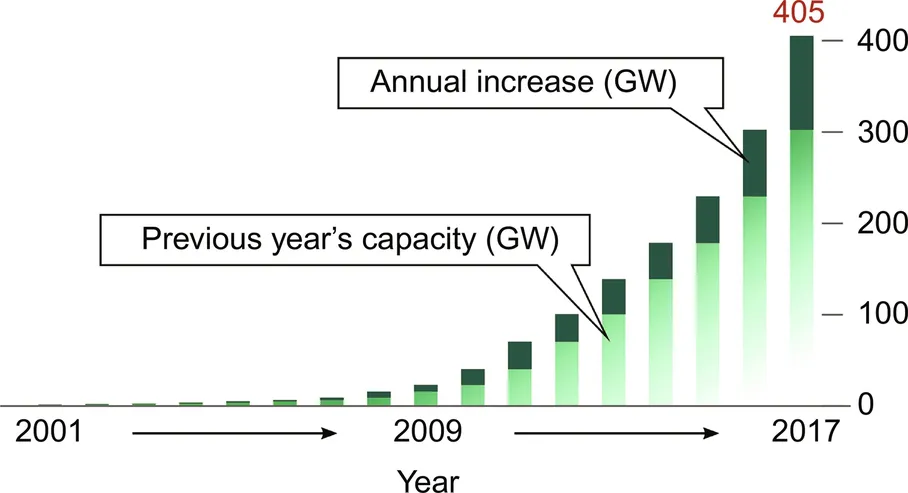
For instance, it has been recorded that the global cumulative PV capacity is now more than 400 GW [6], as shown in Fig. 1.2. This strong market is in part shared by European countries, such as Germany, Spain, and Italy, where there are rich solar resources. China and Japan are leading the market in Asia with the corresponding total installed capacity reaching 78 and 43 GW, respectively, by 2016 [7]. Even so, as aforementioned, driven by a common target of lowering cost of energy and also increasing the competiveness in most countries, electricity generation from PV systems will take a major share in the very near future [8]. Recent reports clearly indicate this trend, where many countries have set ambitious goals for the next few decades to accept highly penetrated PV systems as a part of their renewable energy systems. For example, the European Commission has set renewable energy policies for 2020 and 2030, in which it is expected that 12% of the European electricity demand will be supplied by PV systems by 2020. Even Denmark, which has quite limited sunshine in the winter, is also reshaping its future renewable energy structure, where it is targeted at 100% renewable energy in electricity and heating by 2035 [9]. Moreover, Japan has targeted 200 GW of PV capacity by 2050 [10]. Thus, it can be seen that there are increasingly worldwide expectations for energy production by means of solar (PV) energy systems, although challenging issues are also associated with. In addition, solar PV also opens the possibilities to increase the energy accessibility in poverty regions or remote areas by developing off-grid systems, where a further cost reduction is the major focus [11]. The technical implementation barriers should also be properly addressed in such applications.
As discussed at the beginning, the negative side of the high penetration level of PV systems is that it imposes challenging issues for distributed system operators (DSO) and end consumers. The impact may also be seen in the high-level system (e.g., the transmission system) in terms of mutual interactions. More specifically, the availability, quality, and reliability of the entire electric grid may be challenged, since it makes the electric networks more decentralized, uncontrollable, and heterogeneous [5], [12], [13]. This leads to discussions of appropriate adoption and effective integration of PV power systems into the grid. At the same time, grid regulations are continuously updated to enhance the integration and cater for more PV capacity in distributed grids. On the other hand, it does call for an emerging development of not only advanced control strategies but also innovative converter configurations tailored for specific applications.
Currently, the active grid requirements are applied mostly to three-phase systems connected to medium-voltage and/or high-voltage (MV/HV) grids considering the grid stability [14]. In contrast, for low-voltage systems, the demands have been specially focused on islanding protection and energy maximization, and there are not so many demands on the fault-handling capability [15]–[18]. This may also induce instability of the entire grid as the PV systems may contribute a large amount of short-circuit power when the penetration degree is high enough [14], [19]–[21]. Therefore, it is essential to assess the impact of power-converter-based PV systems on the grid, not only considering three-phase high-power systems, in such a way to develop advanced control strategies to further enable an increasing penetration of cost-effective PV systems. For the individual power generation unit, there are certain basic requirements [22], related to active power output, frequency control dependent on active power, power quality, and voltage stability, which should also be fulfilled, when it is connected to the grid. Selective demands at different levels for a grid-connected PV system are summarized in Table 1.1. Notably, those requirements are being updated continuously, as discussed above, and also make the PV conversion systems multifunctional, that is, the grid-connected PV systems not only are generating units but also are active in the distributed networks by providing ancillary services [23], [24].
Table 1.1
| Voltage level | Requirements |
|---|---|
| Transmission level (EHV, HV) | Response to faults, grid stability (voltage and frequency), power quality, reactive power, etc. |
| Distribution level (HV, MV) | Local stability (voltage and frequency), power flow, P/Q provision to HV, inertia provision, etc. |
| Converter system level (LV) | Voltage rise, fault ride through (V and/or f), antiislanding, efficiency, cost, reliability, power controllability, power factor, monitoring and safety, communication, temperature management, etc. |
| Generator level (PV modules) | Power optimization, efficiency, cost, safety, panel monitoring and diagnosis, etc. |
EHV, extra high voltage; HV, high voltage; LV, low voltage, and MV, medium voltage.
It is worth mentioning that efficiency, cost, and reliability are highly concerned in PV systems at the converter system and generator levels, as listed in Table 1.1, since they are closely tied with the cost of PV energy [25]. According to the SunShot Initiative [26], [27], the cost of PV systems should be continuously decreased, as summarized in Fig. 1.3, which shows that a significant reduction by more than 50% in the cost of PV systems has been achieved in the past 7 years and a further reduction of more than 50% is demanded by 2030. The ambitious targets require much more efforts by means of (1) the exploration of new emerging power devices (e.g., silicon-carbide and gallium-nitride power semiconductors) and applications in PV systems, (2) the development of new topologies, and (3) advancements in the control strategies to enable multiple functionalities of PV systems. In all, the demand of high-penetration PV systems with high reliability and high efficiency but lower cost is s...
Table of contents
- Cover image
- Title page
- Table of Contents
- Copyright
- Preface
- 1: Introduction
- 2: Power electronic technologies for PV systems
- 3: PV system modeling, monitoring, and diagnosis
- 4: Control of PV systems under normal grid conditions
- 5: Advanced control of PV systems under anomaly grid conditions
- 6: Flexible active power control of PV systems
- 7: Conclusion and outlook
- Index
Trusted by 375,005 students
Access to over 1.5 million titles for a fair monthly price.
Study more efficiently using our study tools.
Frequently asked questions
Yes, you can cancel anytime from the Subscription tab in your account settings on the Perlego website. Your subscription will stay active until the end of your current billing period. Learn how to cancel your subscription
No, books cannot be downloaded as external files, such as PDFs, for use outside of Perlego. However, you can download books within the Perlego app for offline reading on mobile or tablet. Learn how to download books offline
We are an online textbook subscription service, where you can get access to an entire online library for less than the price of a single book per month. With over 1.5 million books across 990+ topics, we’ve got you covered! Learn about our mission
Look out for the read-aloud symbol on your next book to see if you can listen to it. The read-aloud tool reads text aloud for you, highlighting the text as it is being read. You can pause it, speed it up and slow it down. Learn more about Read Aloud
Yes! You can use the Perlego app on both iOS and Android devices to read anytime, anywhere — even offline. Perfect for commutes or when you’re on the go.
Please note we cannot support devices running on iOS 13 and Android 7 or earlier. Learn more about using the app
Please note we cannot support devices running on iOS 13 and Android 7 or earlier. Learn more about using the app
Yes, you can access Advances in Grid-Connected Photovoltaic Power Conversion Systems by Yongheng Yang,Katherine A. Kim,Frede Blaabjerg,Ariya Sangwongwanich in PDF and/or ePUB format, as well as other popular books in Physical Sciences & Energy. We have over 1.5 million books available in our catalogue for you to explore.