eBook - ePub
Probability and Mechanics of Ship Collision and Grounding
- 387 pages
- English
- ePUB (mobile friendly)
- Available on iOS & Android
eBook - ePub
Probability and Mechanics of Ship Collision and Grounding
About this book
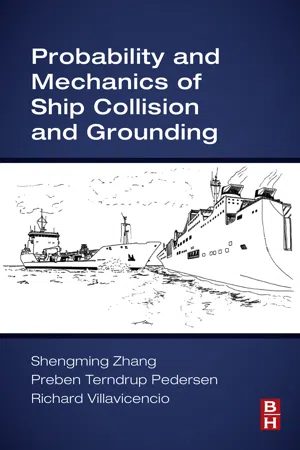
Probability and Mechanics of Ship Collision and Grounding provides simplified analytical procedures for ship collision and grounding assessments, including probabilistic methods, an estimation of the energy released during collisions, and a prediction of the extent of damage on involved structures. An additional chapter is dedicated to current finite element analysis techniques that are used for estimating structural damage during ship collisions. The book encapsulates reliable and fast analysis methods for collision and grounding assessment, presenting tactics that have been extensively validated with experimental and numerical results. In addition, all described analysis methods include realistic calculation examples to provide confidence in their use.
- Provides mathematical expressions for the determination of probability of ship grounding events, ship to ship collisions and ship collisions against fixed and floating offshore installations, i.e., offshore wind parks and bridges over navigational channels
- Provides analytical solutions to calculate the energy released for crushing in ship collision scenarios and loading on ship bottoms in grounding events
- Reviews damage theorems and materials modellings and presents simplified analytical methods to determine the structural damage of ship and offshore structures in ship collisions and grounding
- Provides calculation examples for each analysis method
Information
1
Probability of ship collision and grounding
Abstract
To quantify the risk involved in ship traffic, rational evaluation procedures for collision and grounding accidents have to be applied. This implies that probabilities and the inherent consequences have to be analysed and assessed. This chapter presents mathematically based methods for the evaluation of the probability of ship–ship collisions, ship collisions against offshore installations, ship collisions against bridges, and ship grounding events due to human navigational errors and technical errors. The procedures have been developed for risk assessments associated with new ship types, new navigational routes, environmental risk from collisions, and grounding events in specific geographical areas and for risk evaluation of offshore structures and bridges. These procedures also allow analysis of the effect of different risk control options such as new navigational equipment.
Keywords
Probability of ship–ship collisions; Risk acceptance criteria; Human navigational errors; Rudder failure; Engine blackout; Probability of ship collisions with offshore structures; Probability of ship collisions with bridges; Critical meeting situations; Heinrich factor; Probability of grounding events
1.1 Introduction
Every year, ship–ship collisions, ship collisions to offshore structures and bridges, and grounding events cause the loss of lives, economic losses, damages to the environment, and other unwanted events. It is important that the design and operation of a ship or an offshore installation meet risk levels that can be estimated to be so low that risks are of little concern to users and third parties. On the other hand, the required risk levels should still allow construction and operation of the maritime structure at feasible cost levels. Therefore, one of the many performance goals during the design phase of ships and offshore structures should be to ensure that serious accidents and service disruptions are low enough to be acceptable to all stakeholders, that is, owners, the public, and those responsible for public safety. To demonstrate such safety levels, risk analyses have to be performed.
Risk evaluation procedures are based on an estimation of the probability of the considered hazard followed by an estimate of the consequences.
The probability of the occurrence of collision and grounding events can be estimated from historical data, expert opinions, and predictive calculations. Historical data can in some highly trafficked navigational areas provide realistic figures. However, these data are difficult to use for future predictions since they are relevant to ship structures constructed in the past that differ from those used today and they do not take into account new operational procedures and new n...
Table of contents
- Cover image
- Title page
- Table of Contents
- Copyright
- Preface
- 1: Probability of ship collision and grounding
- 2: External dynamics of ship collisions and grounding
- 3: Internal mechanics of ship collision and grounding
- 4: Damaged material volume method
- 5: Collision damage assessment by nonlinear finite element simulations
- Index
Trusted by 375,005 students
Access to over 1.5 million titles for a fair monthly price.
Study more efficiently using our study tools.
Frequently asked questions
Yes, you can cancel anytime from the Subscription tab in your account settings on the Perlego website. Your subscription will stay active until the end of your current billing period. Learn how to cancel your subscription
No, books cannot be downloaded as external files, such as PDFs, for use outside of Perlego. However, you can download books within the Perlego app for offline reading on mobile or tablet. Learn how to download books offline
Perlego offers two plans: Essential and Complete
- Essential is ideal for learners and professionals who enjoy exploring a wide range of subjects. Access the Essential Library with 800,000+ trusted titles and best-sellers across business, personal growth, and the humanities. Includes unlimited reading time and Standard Read Aloud voice.
- Complete: Perfect for advanced learners and researchers needing full, unrestricted access. Unlock 1.5M+ books across hundreds of subjects, including academic and specialized titles. The Complete Plan also includes advanced features like Premium Read Aloud and Research Assistant.
We are an online textbook subscription service, where you can get access to an entire online library for less than the price of a single book per month. With over 1.5 million books across 990+ topics, we’ve got you covered! Learn about our mission
Look out for the read-aloud symbol on your next book to see if you can listen to it. The read-aloud tool reads text aloud for you, highlighting the text as it is being read. You can pause it, speed it up and slow it down. Learn more about Read Aloud
Yes! You can use the Perlego app on both iOS and Android devices to read anytime, anywhere — even offline. Perfect for commutes or when you’re on the go.
Please note we cannot support devices running on iOS 13 and Android 7 or earlier. Learn more about using the app
Please note we cannot support devices running on iOS 13 and Android 7 or earlier. Learn more about using the app
Yes, you can access Probability and Mechanics of Ship Collision and Grounding by Shengming Zhang,Preben Terndrup Pedersen,Richard Villavicencio in PDF and/or ePUB format, as well as other popular books in Technology & Engineering & Biotechnology. We have over 1.5 million books available in our catalogue for you to explore.