eBook - ePub
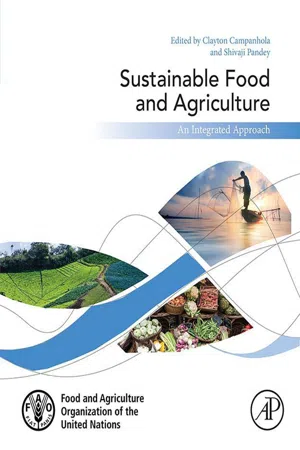
Sustainable Food and Agriculture
An Integrated Approach
- 594 pages
- English
- ePUB (mobile friendly)
- Available on iOS & Android
eBook - ePub
About this book
Sustainable Food and Agriculture: An Integrated Approach is the first book to look at the imminent threats to sustainable food security through a cross-sectoral lens. As the world faces food supply challenges posed by the declining growth rate of agricultural productivity, accelerated deterioration of quantity and quality of natural resources that underpin agricultural production, climate change, and hunger, poverty and malnutrition, a multi-faced understanding is key to identifying practical solutions. This book gives stakeholders a common vision, concept and methods that are based on proven and widely agreed strategies for continuous improvement in sustainability at different scales.
While information on policies and technologies that would enhance productivity and sustainability of individual agricultural sectors is available to some extent, literature is practically devoid of information and experiences for countries and communities considering a comprehensive approach (cross-sectoral policies, strategies and technologies) to SFA. This book is the first effort to fill this gap, providing information on proven options for enhancing productivity, profitability, equity and environmental sustainability of individual sectors and, in addition, how to identify opportunities and actions for exploiting cross-sectoral synergies.
- Provides proven options of integrated technologies and policies, helping new programs identify appropriate existing programs
- Presents mechanisms/tools for balancing trade-offs and proposes indicators to facilitate decision-making and progress measurement
- Positions a comprehensive and informed review of issues in one place for effective education, comparison and evaluation
Information
Section I
Food and Agriculture at a Crossroads
Outline
Section I. Food and Agriculture at a Crossroads
Lead Authors
Rob Vos and Shenggen Fan (International Food Policy Research Institute (IFPRI), Washington, DC, United States)
Chapter 1
Food and Agricultural Systems at a Crossroads
An Overview
Abstract
Food systems need to change fundamentally to become sustainable. Amid great plenty, billions of people still face pervasive poverty, gross inequalities, joblessness, environmental degradation, disease, and deprivation. Much of humanity’s progress has come at a considerable cost to the environment. The impacts of climate change are already being felt, and—if left unabated—will intensify considerably in the years ahead. Globally integrated production processes have brought many benefits. However, challenges in regulating those processes highlight the need to steer them toward more equitable and sustainable outcomes. Such challenges raise concerns regarding the feasibility of achieving the sustainable development goal of ending hunger and all forms of malnutrition, while making agriculture and food systems sustainable (SDG2). This chapter provides a brief overview of these challenges as addressed in greater detail in subsequent chapters.
Keywords
Food security; agriculture; climate change; sustainability; food systems; nutrition
1.1 The State of Global Food and Agriculture
Over the past century, enormous progress has been made in improving human welfare worldwide. Societies have changed radically thanks to quantum leaps in technology, rapid urbanization, and innovations in production systems. Yet, conditions today are a far cry from the world “free of fear and want” envisioned by the founders of the United Nations. Amid great plenty, billions of people still face pervasive poverty, gross inequalities, joblessness, environmental degradation, disease, and deprivation. Much of humanity’s progress has come at a considerable cost to the environment. The impacts of climate change are already being felt and—if left unabated—will intensify considerably in the years ahead. While globally integrated production processes have brought many benefits, challenges in regulating those processes highlight the need to steer them toward more equitable and sustainable outcomes.
Such challenges raise concerns regarding the feasibility of achieving the sustainable development goal (SDG) of ending hunger and all forms of malnutrition while making agriculture and food systems sustainable (SDG2). Are today’s food and agricultural systems capable of meeting the needs of a global population that is projected to reach almost 10 billion by mid-century? Can we achieve the required production increases, even if this implies adding pressure to already dwindling land and water resources, specifically within the context of climate change?
As these challenges are strongly interrelated, addressing them in order to achieve SDG2 and other related SDGs will require a systems approach to food and agriculture. While still critical, agricultural development alone will not be enough to secure adequate food availability and stave off hunger and famine. Food systems at large will need to be sustainable in order to address multiple development challenges.
Section I of this volume contains eight chapters addressing key questions regarding the sustainability of food and agriculture systems across various dimensions. The assessments coincide in the view that current trends and policy efforts will inadequately address these challenges, seriously jeopardizing prospects of achieving SDG2. Significant, transformative changes in agriculture and food systems need to occur to achieve a world without hunger and malnutrition and to protect the natural resource base required for feeding present and future generations.
1.2 Food and Agriculture at a Crossroads: Challenges and Opportunities
Global Trends and Challenges to Food and Agriculture Into the 21st Century
Rob Vos and Lorenzo Giovanni Bellù review some of the key global trends and challenges facing agriculture and food systems through the 21st century (Chapter 2: Global Trends and Challenges to Food and Agriculture Into the 21st Century). They start by addressing the core question of whether today’s agriculture and food systems are capable of meeting the needs of a global population that is projected to reach almost 10 billion by mid-century and that may peak at more than 11 billion by the end of the century. They project that global food demand will increase by 50% between 2012 and 2050. During the preceding four decades, food production more than tripled, to the extent that current systems are likely capable of producing enough food. Moving forward, the challenges will be both different and more complicated.
With accelerating urbanization and continued income growth, especially in emerging economies, dietary preferences are shifting rapidly toward increased demand for more resource-intensive food, such as animal-sourced foods, fruits and vegetables, and processed foods. Satisfying this rising and changing demand through the currently prevalent farming and food processing systems will likely put added pressure on already scarce land, soil, and water resources and further degrade the quality of these resources. Some regions, especially tropical zones, already suffer from the adverse impacts of climate change. If left unabated, climate change will significantly slow agricultural productivity growth in the coming decades. Changing dietary patterns and food systems is a double-edged sword in terms of nutritional outcomes. They have facilitated the intake of more diversified diets and improved the nutritional status of many. However, at the same time, the increased consumption of animal-sourced food and the often too salty and sugary processed foods has given rise to the spread of overweight and obesity, which in turn are associated with a rising prevalence of noncommunicable diseases. Additionally, the ease of access to low-nutrient processed foods has also led to a further spread of people suffering from micronutrient deficiencies. Consequently, as Vos and Bellù show, ending hunger and all forms of malnutrition by 2030 (and not even by 2050) will be nothing but an elusive target if current trends continue. Hence, they argue, transformative changes to agriculture and food systems are urgently needed to feed the world sustainably.
The Demographics of Rural Poverty and Sustainable Agriculture and Rural Transformations
Population, income, and urban growth have been key drivers underlying many of the changes in food and agricultural systems and will continue to pose challenges to the sustainability of these systems for decades to come. Chapter 3, Demographic Change, Agriculture, and Rural Poverty, by James Thurlow, Paul Dorosh, and Ben Davies dwells further on these drivers to spell out key challenges for employment and poverty reduction in those regions where much of the demographic dynamics will appear: South Asia and, in particular, sub-Saharan Africa. These regions have lagged in the structural transformation of their economies and as a result will feel the weight of demographic pressures threatening future economic and social progress. Structural transformation entails workers leaving less-productive agriculture and moving to more productive industries, often in urban centers. Population growth slows with development, leading to greater dependence on capital and technology rather than on labor. This was East Asia’s successful pathway. Sub-Saharan Africa is also transforming, but far less than other regions and with its own distinctive features. Africa is urbanizing...
Table of contents
- Cover image
- Title page
- Table of Contents
- Copyright
- List of Contributors
- Foreword
- Preface
- Acknowledgments
- Acronyms
- Section I: Food and Agriculture at a Crossroads
- Section II: Current Approaches to Sustainable Food and Agriculture
- Section III: Understanding Sustainable Agri-Food Systems
- Section IV: Operationalizing Sustainable Food and Agriculture Systems
- Section V: Innovations, Policies, Investments, and Institutions for Sustainable Food and Agriculture Systems – And the Way Forward
- Author Index
- Subject Index
Trusted by 375,005 students
Access to over 1.5 million titles for a fair monthly price.
Study more efficiently using our study tools.
Frequently asked questions
Yes, you can cancel anytime from the Subscription tab in your account settings on the Perlego website. Your subscription will stay active until the end of your current billing period. Learn how to cancel your subscription
No, books cannot be downloaded as external files, such as PDFs, for use outside of Perlego. However, you can download books within the Perlego app for offline reading on mobile or tablet. Learn how to download books offline
We are an online textbook subscription service, where you can get access to an entire online library for less than the price of a single book per month. With over 1.5 million books across 990+ topics, we’ve got you covered! Learn about our mission
Look out for the read-aloud symbol on your next book to see if you can listen to it. The read-aloud tool reads text aloud for you, highlighting the text as it is being read. You can pause it, speed it up and slow it down. Learn more about Read Aloud
Yes! You can use the Perlego app on both iOS and Android devices to read anytime, anywhere — even offline. Perfect for commutes or when you’re on the go.
Please note we cannot support devices running on iOS 13 and Android 7 or earlier. Learn more about using the app
Please note we cannot support devices running on iOS 13 and Android 7 or earlier. Learn more about using the app
Yes, you can access Sustainable Food and Agriculture by Clayton Campanhola,Shivaji Pandey in PDF and/or ePUB format, as well as other popular books in Biological Sciences & Science General. We have over 1.5 million books available in our catalogue for you to explore.