eBook - ePub
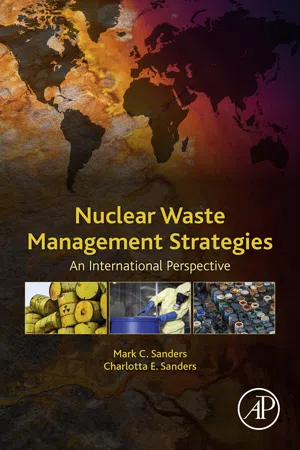
Nuclear Waste Management Strategies
An International Perspective
- 226 pages
- English
- ePUB (mobile friendly)
- Available on iOS & Android
eBook - ePub
Nuclear Waste Management Strategies
An International Perspective
About this book
Nuclear Waste Management Strategies: An International Perspective presents worldwide insights into nuclear waste management strategies from a technical engineering perspective, with consideration for important legal aspects. It provides a one-stop, comprehensive analysis of both historical and up-to-date nuclear waste management strategies, while consulting important legal aspects of decision-making and implementation processes. With case studies from around the world, this book provides a unique understanding of nuclear waste management technologies and methods available, ensuring that researchers and engineering professionals are equipped with the right knowledge to design, build, implement and improve their own waste management strategies.
This book will benefit those researching and learning in the nuclear energy sector, especially those specializing in nuclear waste management strategies, as well as technical and legal communities within nuclear and environmental areas. It is also a valuable resource for lawmakers and regulatory bodies concerned with nuclear policy and waste management.
- Provides a one-stop location for reference material on nuclear waste management strategies from around the world
- Focuses on the associated technical engineering elements of planning for, and implementing, waste management strategies
- Includes real-life examples from Europe, North America, South America, Asia, the Middle East and Africa
Information
Chapter 1
Introduction
Abstract
The management of spent nuclear fuel and nuclear wastes demands a strategy to provide for the safe, secure, and permanent disposal of radioactive material from power generation, defense uses, and other activities. Nation states have taken different paths to nuclear waste management and are at various stages of the development of a nuclear waste management strategy. A strategy may include developing a geological repository, nuclear fuel reprocessing, interim storage, as well as discussions of the creation of a multinational storage facility. This book explores the many options to nuclear waste management, as well as the political/societal barriers and legal frameworks from both an international and local perspective.
Keywords
History; Legal system; Nuclear waste management; Political System
Nuclear power generation, it is often argued, provides a stable, efficient and secure means of power generation while remaining nearly carbon neutral (Svenne, 2012), and therefore should be part of the overall energy mix in the global effort to combat a warming climate. While the veracity of the statement is not widely in dispute—dependent on one’s political persuasion and “environmental” philosophy—despite the radiological events at Fukushima, this central idea has given impetus for growth in the popularity of nuclear power in certain corners of the globe, especially among certain Asian nation states, such as China and India (Truelove and Greenberg, 2013). Nuclear power generation has the ability to provide constancy in the energy program of a nation state as demand for raw materials, such as oil and natural gas, continue to grow, which has brought “nuclear energy very firmly back onto the political agenda” (Tromans, 2009) of many nation states around the globe. For both developed and developing nuclear power generating States, a major dilemma is the closing of the nuclear fuel cycle by successfully managing any created nuclear waste, generally in a long-term geologic disposal facility for high-level waste. As Tromans suggests, the track of nuclear waste management programs in many of these States has commonly not “been a happy one” (Tromans, 2009).
The overall concept of the book is to take the reader on a journey thru some of the complexities surrounding different aspects of a nuclear waste management program, as well as present the strategies and options being looked into, used, or desired by a plethora of nation states. Nuclear waste management programs are constantly in flux due to technological requirements, political decisions, and economic impacts. Thus, to consider nuclear waste management programs from an international perspective is not the easiest of tasks. It is, therefore, envisioned that this book will undergo revisions, as new information and concepts appear. For now, our main purpose and intent is to provide a starting point for the student or professional starting their initial foray into the nuclear waste management voyage. This book is based on two research papers, published in 2016 and January 2019 (Sanders and Sanders, 2016a, 2019). Therefore, the reader will find areas of overlap with these papers, but also additions and more expansive discussion, which the limitations of amount of written pages is not possible for the template of a research article. Footnotes have been limited, where possible, for ease of typesetting and publication.
1.1 Background
In 1957, during the initial development phase of the modern nuclear power generating industry, it was commented that “We need not be awed by nuclear science. The operations of a steam laundry are exceedingly more intricate and the economic operation of a steam laundry is a whole lot more perplexing” (42 Mass., 1957). In the 60 or so years since this statement was made, the use of by-products of “splitting the atom” is now even more widespread given nuclear applications in research, industry, medicine and even agriculture. However, as Ausness noted in 1979, even before the accidents at Chernobyl (1986) and Fukushima (2011), “Public awareness of the serious problems associated with nuclear power has grown, and consequently, many people are now deeply concerned about the dangers of nuclear power” (Ausness, 1979). Such acute public awareness is manifested through both civil and uncivil discourse, including: (1) engagement in open public meetings; (2) use of the judicial system through court action, usually with a basis of objection on environmental and safety concerns; and‚ (3) acts of civil disobedience generally observed at nuclear sites, especially with regard to the transport of nuclear waste, with anti-nuclear protesters blocking shipping routes leading to clashes with police and/or security forces.
Though nuclear power generation is taking on a new significance as a base-load low carbon source of energy in the global fight against climate change, the political decisions associated with nuclear power programs, and more notably with nuclear waste management programs, can be fraught with political and social peril for the policy-maker. Therefore, the political decision to include a nuclear power generating and nuclear waste management program in the energy mix has to be undertaken and presented in a manner consistent with a nation’s legal customs and traditions, as well as a connection to its past to assure that these programs are firmly rooted in the legal traditions and culture of that particular nation state (FORATOM, 2012).
As further discussed in Chapter 4, it is the prerogative of the State to determine its nuclear waste management program in accordance with the decision-making processes within the State. It is in this right, so enshrined within the Joint Convention (IAEA, 1997), that gives variance to the nuclear waste management strategies among the Contracting Parties. Thus, given the political predilection of a State, it must be assumed that some State’s decision making processes “will not be as democratic as others, so that decisions to site a repository will probably be in the hands of elite with vested interests” (Marshall, 2005). Though this is certainly a matter of taste, it cannot be assumed that such decisions will not have equal weight of law or be less/more correct choices given the similar obligations inherent to the Contracting Parties to the Joint Convention.
In fact, the Swedish historian and author Geijer in the early 1800s would argue that as “human history is a chain of connections of people and ideas through the ages of time,” it is the decision making processes promulgated in harmony with the legal traditions and culture of the State that ensures a sense of stability between the bonds that link these connections, as sudden large chasms should not appear between each link of this chain. Based on this model, each new action, decision, or discovery should therefore occur at a slow and steady pace in its progression. To achieve this sought after “stability,” an incremental or step-by-step approach is therefore required.
The origins leading to the discovery of atomic fission (pre-World War II) have a linkage to past discoveries in the preceding centuries. A particular problem in “stability through linkage” arose chiefly due to how the current use of atomic fission for peaceful purposes in energy production (post-World War II) came to fruition because of and through the discoveries occurring while in the darkness of secrecy for developing the atom bomb under the auspices of the Manhattan project. The sudden thrust of atomic fission on the conscious of humanity in August 1945 with the dropping of the atom bomb did not allow this new force to achieve a “stability through linkage” in mankind’s history chain. Instead, there appears to be a metaphorical gap in this period of history. It lies in stark contrast to Geijer’s “stability through linkage” proposition. Therefore, there exists a need to provide stability in the sustainability model for nuclear power generation, and more importantly, with issues surrounding nuclear waste management.
Though it would appear at first glance a high hurdle to overcome, the need for a nuclear waste management strategy (though a relatively “new” phenomenon in relation to human history up to this present time) in actuality springs from the natural progression of historical events that arose through the scientific discoveries during the preceding centuries. In addition, though nuclear law is a relatively new area of law, it too stems from centuries of law making precedent and theory. Therefore, it is possible to jump the hurdles that seem to beset nuclear waste management programs and the dilemma faced.
1.2 The non-dilemma, dilemma?
In discussing the nuclear waste “dilemma” one must be careful to understand the root cause of the concerns that are hindering the progression of choosing a path to resolving the nuclear waste management question. Is there in actuality a nuclear waste management “dilemma”? The answer to the question is based on which perspective logical reasoning is being applied. On one side of the coin, there are challenges to the technical requirements of a long-term geologic storage facility. On the flip side, is the social/political decision-making processes which determine the ability for proceeding with solving these technical challenges. An argument can be made that nuclear waste management concerns are primarily a social/political dilemma and not so much of a technical/scientific argument.
According to the poet, Robert Frost, the simplest reference to a d...
Table of contents
- Cover image
- Title page
- Table of Contents
- Copyright
- Chapter 1: Introduction
- Chapter 2: Nuclear waste characterization
- Chapter 3: Waste management techniques
- Chapter 4: International nuclear waste management framework
- Chapter 5: Nuclear liability
- Chapter 6: Smorgasbord: An international overview of nation states
- Chapter 7: Conclusion
- Index
Trusted by 375,005 students
Access to over 1.5 million titles for a fair monthly price.
Study more efficiently using our study tools.
Frequently asked questions
Yes, you can cancel anytime from the Subscription tab in your account settings on the Perlego website. Your subscription will stay active until the end of your current billing period. Learn how to cancel your subscription
No, books cannot be downloaded as external files, such as PDFs, for use outside of Perlego. However, you can download books within the Perlego app for offline reading on mobile or tablet. Learn how to download books offline
Perlego offers two plans: Essential and Complete
- Essential is ideal for learners and professionals who enjoy exploring a wide range of subjects. Access the Essential Library with 800,000+ trusted titles and best-sellers across business, personal growth, and the humanities. Includes unlimited reading time and Standard Read Aloud voice.
- Complete: Perfect for advanced learners and researchers needing full, unrestricted access. Unlock 1.5M+ books across hundreds of subjects, including academic and specialized titles. The Complete Plan also includes advanced features like Premium Read Aloud and Research Assistant.
We are an online textbook subscription service, where you can get access to an entire online library for less than the price of a single book per month. With over 1.5 million books across 990+ topics, we’ve got you covered! Learn about our mission
Look out for the read-aloud symbol on your next book to see if you can listen to it. The read-aloud tool reads text aloud for you, highlighting the text as it is being read. You can pause it, speed it up and slow it down. Learn more about Read Aloud
Yes! You can use the Perlego app on both iOS and Android devices to read anytime, anywhere — even offline. Perfect for commutes or when you’re on the go.
Please note we cannot support devices running on iOS 13 and Android 7 or earlier. Learn more about using the app
Please note we cannot support devices running on iOS 13 and Android 7 or earlier. Learn more about using the app
Yes, you can access Nuclear Waste Management Strategies by Mark H. Sanders,Charlotta E. Sanders in PDF and/or ePUB format, as well as other popular books in Technology & Engineering & Energy. We have over 1.5 million books available in our catalogue for you to explore.