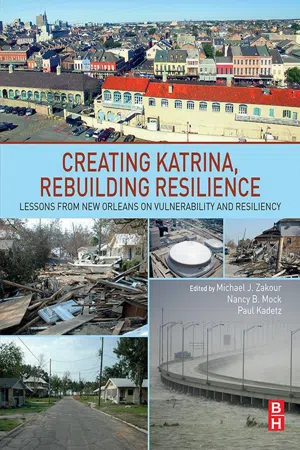
eBook - ePub
Creating Katrina, Rebuilding Resilience
Lessons from New Orleans on Vulnerability and Resiliency
- 420 pages
- English
- ePUB (mobile friendly)
- Available on iOS & Android
eBook - ePub
Creating Katrina, Rebuilding Resilience
Lessons from New Orleans on Vulnerability and Resiliency
About this book
Creating Katrina, Rebuilding Resilience: Lessons from New Orleans on Vulnerability and Resiliency presents a unique, integrative understanding of Hurricane Katrina in the New Orleans area, and the progression to disaster vulnerability as well as resilience pathways. The book integrates the understanding of vulnerability and resiliency by examining the relationships among these two concepts and theories.
The disaster knowledge of diverse disciplines and professions is brought together in this book, with authors from social work, public health, community organizing, sociology, political science, public administration, psychology, anthropology, geography and the study of religion. The editors offer both expert and an insider perspectives on Katrina because they have lived in New Orleans and experienced Katrina and the recovery. An improved understanding of the recovery and reconstruction phases of disaster is also presented, and these disaster stages have been the least examined in the disaster and emergency management literature.
- Integrates multiple disciplines to study the long-term recovery of the worst non-terrorist disaster in U.S. history
- Provides a local perspective, with at least one co-contributor for each chapter living in New Orleans
- Examines vulnerability and resilience theory and application
Information
Part I
Introduction and Theoretical Framework
Outline
Chapter 1
Editors’ introduction
The voices of the barefoot scholars
Michael J. Zakour1, Nancy B. Mock2 and Paul Kadetz3, 1West Virginia University, Morgantown, WV, United States, 2Tulane University, New Orleans, LA, United States, 3Drew University, Madison, NJ, United States
Abstract
This book will examine one of the worst disasters in the history of the United States. Hurricane Katrina resulted in the near-total destruction of a major US metropolitan area (Knabb, Rhome, & Brown 2005), with over 1500 deaths in New Orleans (alone) in the immediate impact period (Osofsy et al., 2009). Eighty percent of the city's area and built structures were flooded (Cigler, 2007). The disaster in the wake of Hurricane Katrina, in August 2005, will be examined through an historical perspective with the goal of clarifying how vulnerability and resilience interacted to affect the postdisaster recovery and sustainability of New Orleans and coastal Louisiana. The years after Katrina offer many lessons concerning the growing vulnerability associated with sea-level rise and climate extremes. The examination of the precursors and sequelae of Hurricane Katrina through a complex systems lens, with a strong emphasis on local knowledge and capacity, offers important lessons for urban and coastal regions. We develop the theoretical and conceptual framing for this volume, including the concept of structural violence. Finally, we provide a brief overview of the book chapters.
Keywords
Hurricane Katrina; New Orleans; barefoot scholars; disaster; recovery; sea level rise; vulnerability; resilience
This book examines one of the most devastating, deadly, and costly disasters in the history of the United States. Hurricane Katrina resulted in the near-total destruction of a major US metropolitan area (Knabb, Rhome, & Brown, 2005), with over 1500 deaths in New Orleans alone in the immediate impact period (Osofsky, Osofsky, Kronenberg, Brennan, & Hansel, 2009) and nearly 4000 more deaths in its wake (Stephens et al., 2007). Eighty percent of the city’s area and built structures were flooded (Cigler, 2007). The disaster in the wake of Hurricane Katrina, in August 2005, is examined in this volume through an historical perspective with the goal of providing more clarity of how vulnerability and resilience interacted to affect the postdisaster recovery trajectory, as well as the sustainability of New Orleans and coastal Louisiana. Studying the (ongoing) recovery from Hurricane Katrina via a long-term analysis provides important new insights, theories, and knowledge pertinent to postdisaster recovery and resilience studies. Ongoing disaster vulnerability and resilience are often best understood by studying recovery and reconstruction. Sustainability is only evident over longer periods of time. Post-Katrina recovery has slowly progressed, yet after more than 12 years it is still not completed. Some have called the years after Katrina, “a failed recovery” (Adams, 2013). Failed recovery and reconstruction is actually a “second disaster,” which can lead to as much misery and uncertainty as the original disaster.
The decade following Katrina offers many lessons concerning the growing risks associated with sea-level rise, climate extremes, wetland loss, coastal development, river delta subsidence, and long-term levee management. These growing risks represent a movement toward greater vulnerability. Globally progressing risks challenge group resilience and sustainable human development that are needed to mitigate new hazards. The examination of the precursors and sequelae of Hurricane Katrina through a complex systems lens, with a strong emphasis on local knowledge and capacity, offers important lessons for urban and coastal regions globally, particularly given the ongoing outcomes of climate change. In this introductory chapter we develop the theoretical and conceptual framing for this volume. We then describe how these concepts and theories apply to the Katrina event. Finally, we provide a brief overview of this volume's chapters.
Classifying Disasters
Disasters are the socially constructed human reactions to natural, geological, or meteorological events (Echterling & Wylie, 2013). According to Noji (2005), the human-influenced components of disasters can be classified as technological or complex humanitarian emergencies. Following Noji, we distinguish between natural and human-caused hazards. Hurricane Katrina would most accurately be considered a human-caused hazard. Although the Katrina event has often been classified as a natural disaster, the politics of this designation and the shirking from human accountability is problematic. The actual source of the city’s flooding lies in the structural failure of the levees, worsened by the subsiding coastline, rising sea levels, collapse of the emergency management system, and associated technological disasters, such as the Murphy Oil spill in St. Bernard Parish. All of these causes of flooding were outcomes of human decisions (for a full discussion, see Chapter 6).
The wetlands surrounding New Orleans serve as a last line of defense from a storm surge, yet 2000 of coastal Louisiana’s original 7000 square miles of wetlands have been lost (Freudenburg, Gramling, Laska, & Erikson, 2009). This loss is due, in part, to the environmental damage caused by offshore oil drilling, urban and rural development, and the building of navigation canals and other transportation projects (Bullard & Wright, 2009). Because these fresh-water marshes are at sea level, the increasing rate of sea level rise in the 21st century threatens to destroy additional areas of Louisiana’s wetlands.
September 2017 marked the busiest month of Atlantic Ocean hurricanes on record, commencing with Hurricane Harvey that devastated parts of Texas (particularly Houston) and followed in rapid succession by two category five Hurricanes. Irma wreaked havoc in the Caribbean and Florida, and Maria caused further damage throughout the Caribbean, especially to Puerto Rico and the U.S. Virgin Islands. And this only covers recent weather-based disasters that affected the United States and its territories. Current disaster recovery must consider the uncertainty introduced by climate change, particularly for urban settlements on river deltas throughout the world, for it is not clear how rapidly sea levels will rise, or how prevalent or severe weather extremes will become in the future. Furthermore, “Effective risk reduction and adaptation strategies [need to] consider the dynamics of vulnerability and exposure and their linkages with socioeconomic processes, sustainable development, and climate change” (IPCC, 2014, p. 25).
The combined disaster of Hurricane Katrina and the floods that followed was produced by a situation in which both basic priorities that ensured safe infrastructure prior to the storm and effective humanitarian-oriented relief programs after the storm were largely absent (Adams, 2013). The current political milieu in the United States, embracing climate change denial, renders the ongoing lessons from this disaster even more imperative as we brace for more frequent and damaging climate events (see the epilogue of this volume for a fuller discussion). The United States is at an urgent crossroads in climate change policies and interventions. Climate change has already begun to demonstrate markedly negative impacts throughout the world, particularly for the well-being of marginalized populations. Increased risks are especially salient for ethnic and racial minorities in both rural and urban areas in the United States (IPCC, 2014). In New Orleans and Southeast Louisiana, marginalized communities were both disproportionately harmed by Hurricane Katrina and were largely excluded from the recovery process. African-Americans, women, the poor, and other marginalized populations were most impacted by the flooding of New Orleans. Pre-hurricane vulnerabilities limited the participation of many in recovery, rebuilding, and reconstruction efforts. The recovery for many marginalized groups in New Orleans has been delayed and perhaps permanently disrupted (Bullard & Wright, 2009).
The often complex relationships between vulnerability and resilience, as well as environmental liabilities and capabilities, are important lessons to share from this disaster. Although a majority of studies on Hurricane Katrina focused on the physical and geographic vulnerability of New Orleans and South Louisiana, knowledge of social and cultural aspects of vulnerability, susceptibility, and resilience is prioritized in this volume.
New Orleans and the Livin’ Ain’t Easy
Vulnerable Lives
The New Orleans area is a nexus for disasters. Economic, social, cultural, and other forms of capital, as well as institutional contexts, are critical capacities for managing disaster risk. Resources, capital, and capacity have long been inequitably distributed in New Orleans and Southeast Louisiana. This uneven and inequitable distribution was essential for the creation of vulnerability (Oliver-Smith, 2004).
The immediate impact of Hurricane Katrina and the subsequent uneven recovery have resulted in a devastating cycle of impoverishment and vulnerability for many households and families. A new cycle of impoverishment has been created by a combination of
• environmental injustice, including the inequitable accessibility to pre-Katrina disaster preparedness and post-Katrina recovery resources;
• damage to social infrastructure, including health and human services provisions; and
• a markedly neoliberal approach to recovery aid.
This cycle has trapped low-income and former middle-class households and individuals in greater disaster vulnerability and thwarted resilient recovery. The political econ...
Table of contents
- Cover image
- Title page
- Table of Contents
- Copyright
- Dedication
- List of Contributors
- Part I: Introduction and Theoretical Framework
- Part II: Disaster Vulnerability
- Part III: Disaster Resilience
- Part IV: Conclusion and Lessons Learned
- Epilogue: Back to the future?
- Index
Trusted by 375,005 students
Access to over 1.5 million titles for a fair monthly price.
Study more efficiently using our study tools.
Frequently asked questions
Yes, you can cancel anytime from the Subscription tab in your account settings on the Perlego website. Your subscription will stay active until the end of your current billing period. Learn how to cancel your subscription
No, books cannot be downloaded as external files, such as PDFs, for use outside of Perlego. However, you can download books within the Perlego app for offline reading on mobile or tablet. Learn how to download books offline
Perlego offers two plans: Essential and Complete
- Essential is ideal for learners and professionals who enjoy exploring a wide range of subjects. Access the Essential Library with 800,000+ trusted titles and best-sellers across business, personal growth, and the humanities. Includes unlimited reading time and Standard Read Aloud voice.
- Complete: Perfect for advanced learners and researchers needing full, unrestricted access. Unlock 1.5M+ books across hundreds of subjects, including academic and specialized titles. The Complete Plan also includes advanced features like Premium Read Aloud and Research Assistant.
We are an online textbook subscription service, where you can get access to an entire online library for less than the price of a single book per month. With over 1.5 million books across 990+ topics, we’ve got you covered! Learn about our mission
Look out for the read-aloud symbol on your next book to see if you can listen to it. The read-aloud tool reads text aloud for you, highlighting the text as it is being read. You can pause it, speed it up and slow it down. Learn more about Read Aloud
Yes! You can use the Perlego app on both iOS and Android devices to read anytime, anywhere — even offline. Perfect for commutes or when you’re on the go.
Please note we cannot support devices running on iOS 13 and Android 7 or earlier. Learn more about using the app
Please note we cannot support devices running on iOS 13 and Android 7 or earlier. Learn more about using the app
Yes, you can access Creating Katrina, Rebuilding Resilience by Michael J. Zakour,Nancy Mock,Paul Kadetz in PDF and/or ePUB format, as well as other popular books in Biological Sciences & Environmental Science. We have over 1.5 million books available in our catalogue for you to explore.