eBook - ePub
Emerging Paradigms in Urban Mobility
Planning, Financing and Management
- 266 pages
- English
- ePUB (mobile friendly)
- Available on iOS & Android
eBook - ePub
Emerging Paradigms in Urban Mobility
Planning, Financing and Management
About this book
Emerging Paradigms in Urban Mobility: Planning, Finance and Implementation explains the types of new urban mobility planning paradigms that are emerging throughout the world, along with their potential to transform the transportation landscape. As half of the world's 7 billion people now live in cities, thus causing severe road congestion, increased air pollution, energy insecurity and sustainability problems in cities and the planet itself, this book presents new paradigms that are emerging to address these problems, along with other topics of note, including economic efficiency, health, the well-being of cities and their residents, urban mobility transformations, and the role of social media.
In addition, the book looks at Integrated Corridor Management and how it improves the people-moving performance of multi-modal transport systems in high demand urban corridors and how countries balance the mobility benefits of motorcycles with the environmental and safety threats they pose.
- Provides previously unpublished research on new approaches to integrating governance, the changing role of IT, and shared mobility initiatives
- Links transportation and land use, climate change, and poverty reduction and gender, going well beyond the technical issues of transport planning
- Highlights successful factors that have worked and how they can be tailored to different contexts
- Includes learning aids, such as case studies, text boxes and chapter openers and summaries
Information
Chapter 1
The Setting
Abstract
Chapter 1 highlights the current challenges facing urban mobility in cities. Rapid motorization has led to severe traffic congestion and hampered mobility. Air pollution has adversely impacted the health and well-being of people. The increasing incidence of road collisions has exponentially increased fatalities, causing untold misery to many households. The increasing emission of greenhouse gases has been contributing to climate change and uncertain oil prices have threatened the energy security of nations. The chapter presents some of the new paradigms that are emerging and sets out the structure of the book.
Keywords
Motorization; congestion; air pollution; road accidents; energy security
An advanced city is not one where even the poor use cars, but rather one where even the rich use public transport.
Enrique Peñalosa
The Challenges of Rapid Motorization
It is a common knowledge that the cities of today are undergoing extraordinary transformation. The global urban population went up from 30 million in 1800 to 230 million in 1900 and almost one billion in 1960. Today almost 4 billion people live in urban areas and are expected to increase to 6 billion by 2050. As a proportion of the total population, the share of the urban population increased from 3 percent in 1800 to 14 percent in 1900 and over 50 percent by 2010, with an expectation of reaching 66 percent by 2050 [1]. The number of megacities (cities with over 10 million people) has tripled over the past two decades—from 10 in 1990 to over 30 in 2014 and are expected to increase to 41 by 2030 [2]. The next two decades are likely to see as many people coming to live and work in cities as in the past century. This exponential urban growth is accompanied by phenomenal changes in the way people go about their daily lives and how urban space is managed.
The increase in urban population, together with income growth and unplanned urban sprawl, has resulted in even higher increases in auto ownership and use (see Box 1.1). Vehicle ownership is growing at 7%–8% and population by 2%–3% in developing cities. The combined effect results in a near doubling of vehicle trips every 5–6 years. The number of motor vehicles produced in 2000 was 58 million, but this number went up to over 90 million in 2015 [3], an increase of almost four percent per year. This is almost twice the highest growth rate seen in the global population and nearly four times the current population growth rate. More importantly, as seen in Fig. 1.1, the key centers of automanufacturing have been shifting from their traditional locations in developed countries to developing countries in Asia. Currently, China is the largest automanufacturer in the world, having overtaken the United States, Japan, Germany, France, and Korea in the past 15 years. The global shares in India, Indonesia, and Thailand have also gone up, with significant reduction in the share of automanufacturing in the United States, Japan, Germany, and France. Not surprisingly, these developing countries have also seen the highest number of new registrations. For example, the increase in the number of motor vehicles registered in India went up from a mere 0.3 million in 1951 to about 21 million in 1991 and to over 182 million in 2013 [4] (see Fig. 1.2).


Yet another trend has been the increasing dominance of motorized two-wheelers in many Asian and African cities. While the bicycle has been one of the oldest modes of transport, graduation to motorized two-wheelers has brought about a significant new dimension, with its low-cost, demand for road space, and impact on urban form. The increasing use of motorcycles as a commercial vehicle in the past decade in Asia and Africa has further fueled a growth in production volume [5]. Around 90% of the vehicle fleet in Vietnam’s cities comprises motorized two-wheelers and in Indian cities this share is around 70%.
The growth of auto production in developing countries has been promoted by the respective nation’s industrial policies. Automanufacturing and ownership is seen as symbolic of industrial prowess and economic strength. Its high employment potential is also very attractive. The modest labor costs and consequent low prices make automobiles eminently affordable to the exploding middle class. Further, trade and fiscal policies in some countries have also encouraged a shift in the production of motor vehicles to developing countries. In Vietnam, for example, the country has taken the decision to eliminate all import duties by 2018 on cars originating from the 10 nations within the Asean Economic Community. In addition, luxury tax on cars with engines of less than 1.5L was reduced starting July 1, 2016. These will promote manufacture within the region.
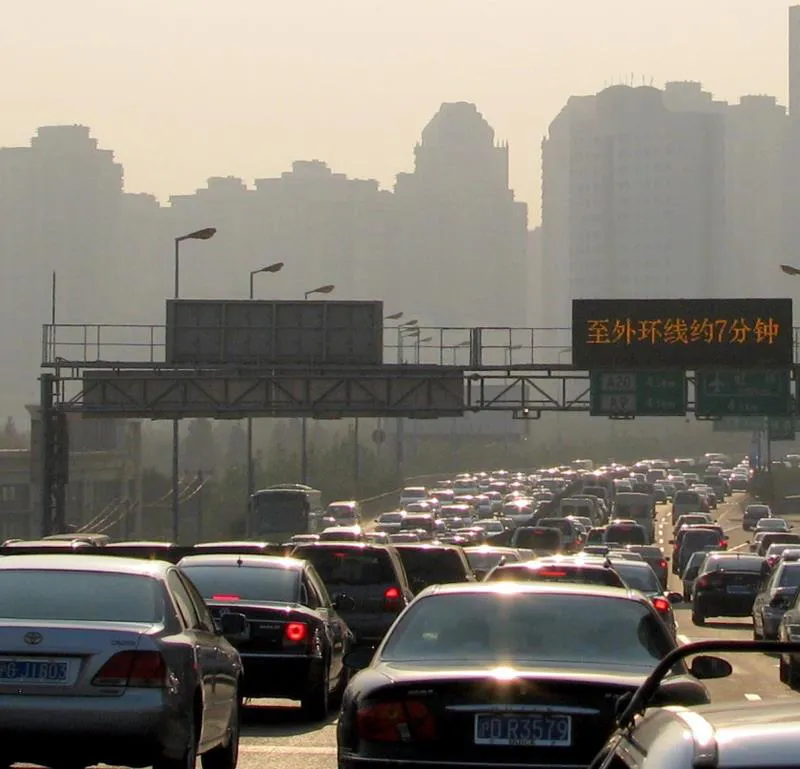
The consequent growth in auto fleets, coupled with roadway capacity constraints, has led to severe congestion in most cities around the world. Fig. 1.3 shows the familiar image of being “stuck in traffic” and it is taking increasingly longer for urban residents to reach their destinations, especially in developing countries. This has had an adverse impact on the economic efficiency of cities making it much more difficult for people to access jobs and for goods to access markets.
Further, increases in “greenhouse gases” and other pollutants from the fuel used in urban transport threatens the health and well-being of the people and impacts the planet's sustainability. Since motor vehicles primarily use nonrenewable petroleum fuels, there are also increasing concerns about energy security. Oil prices have also tended to fluctuate widely, often triggered by unforeseen political developments. This, in turn, has threatened the energy security of countries—especially those who are heavily dependent on imports to meet their petroleum fuel needs. The rapid depletion of a nonrenewable fossil fuel at a rate that is faster than the rate at which it can be replaced by nature, threatens its very availability in the future.
Finally, the policy focus on meeting the demands of motorized traffic has marginalized the needs of nonmotorized vehicles, including walking, contributed to growing congestion and has also made road safety a major concern. Increasing incidence of road accident injuries and fatalities has become a matter of concern around the world.
Despite all of these negative impacts, motorization is not slowing down. For example, in 2015 there were almost 4.9 million motorbikes and scooters in Vietnam, Hanoi, with a population of 7.9 million [6], and growing at over 15% annually, i.e., almost doubling every five years. This growth is showing no signs of abating. To make matters worse, motorcycles are being replaced by cars with increasing household incomes. This is despite the city having one of the worst road safety records and poorest air quality in the world. Most other cities in developing countries face a similar situation (see Box 1.2). With many cities still growing rapidly, it is difficult to imagine what the future holds. Clearly, it is an unsustainable situation. Efforts at keeping the global temperature rise to within 2°C over preindustrial levels could go awry and air pollution could cause many more deaths in the future. The economic efficiency of cities will also be adversely impacted. The business as usual scenario is both untenable and undesirable in the long term.
Emergence of New Paradigms
New paradigms to deal with the problems of rapid motorization have emerged and are being planned and implemented in some parts of the world. For example, the traditional approach of increasing transport capacity, primarily roadway capacity, is giving way to efforts at reducing the demand for motorized travel in such a way that it better matches the supply. Similarly, ef...
Table of contents
- Cover image
- Title page
- Table of Contents
- Copyright
- About the Authors
- Foreword
- Preface
- Acknowledgements
- About the Book
- Chapter 1. The Setting
- Chapter 2. The Response: From Enhancing Supply to Managing Demand
- Chapter 3. The Objective: Looking Beyond Congestion
- Chapter 4. Public Transit: From Compulsion to Choice
- Chapter 5. Network Planning: From Segment to Whole Trip
- Chapter 6. Powering Motor Vehicles: From IC Engines to Electric Batteries
- Chapter 7. Financing: From Users Pay to Beneficiaries Pay
- Chapter 8. Vehicles: From Independent to Networked
- Chapter 9. Transport Planning and Decision Making in the Age of Social Media: From Exclusivity to Inclusivity
- Chapter 10. Impact of the ICT Age
- Chapter 11. Looking Ahead
- Index
Trusted by 375,005 students
Access to over 1.5 million titles for a fair monthly price.
Study more efficiently using our study tools.
Frequently asked questions
Yes, you can cancel anytime from the Subscription tab in your account settings on the Perlego website. Your subscription will stay active until the end of your current billing period. Learn how to cancel your subscription
No, books cannot be downloaded as external files, such as PDFs, for use outside of Perlego. However, you can download books within the Perlego app for offline reading on mobile or tablet. Learn how to download books offline
Perlego offers two plans: Essential and Complete
- Essential is ideal for learners and professionals who enjoy exploring a wide range of subjects. Access the Essential Library with 800,000+ trusted titles and best-sellers across business, personal growth, and the humanities. Includes unlimited reading time and Standard Read Aloud voice.
- Complete: Perfect for advanced learners and researchers needing full, unrestricted access. Unlock 1.5M+ books across hundreds of subjects, including academic and specialized titles. The Complete Plan also includes advanced features like Premium Read Aloud and Research Assistant.
We are an online textbook subscription service, where you can get access to an entire online library for less than the price of a single book per month. With over 1.5 million books across 990+ topics, we’ve got you covered! Learn about our mission
Look out for the read-aloud symbol on your next book to see if you can listen to it. The read-aloud tool reads text aloud for you, highlighting the text as it is being read. You can pause it, speed it up and slow it down. Learn more about Read Aloud
Yes! You can use the Perlego app on both iOS and Android devices to read anytime, anywhere — even offline. Perfect for commutes or when you’re on the go.
Please note we cannot support devices running on iOS 13 and Android 7 or earlier. Learn more about using the app
Please note we cannot support devices running on iOS 13 and Android 7 or earlier. Learn more about using the app
Yes, you can access Emerging Paradigms in Urban Mobility by Om Prakash Agarwal,Samuel Zimmerman,Ajay Kumar in PDF and/or ePUB format, as well as other popular books in Technology & Engineering & Transportation & Navigation. We have over 1.5 million books available in our catalogue for you to explore.