eBook - ePub
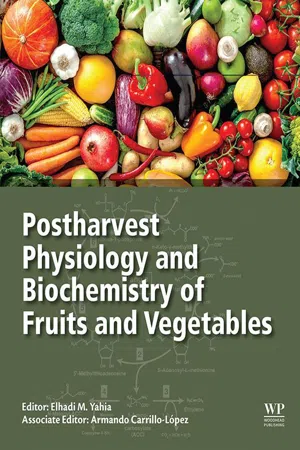
Postharvest Physiology and Biochemistry of Fruits and Vegetables
- 510 pages
- English
- ePUB (mobile friendly)
- Available on iOS & Android
eBook - ePub
Postharvest Physiology and Biochemistry of Fruits and Vegetables
About this book
Postharvest Physiology and Biochemistry of Fruits and Vegetables presents an updated, interrelated and sequenced view of the contribution of fruits and vegetables on human health, their aspects of plant metabolism, physical and chemical/compositional changes during the entire fruit development lifecycle, the physiological disorders and biochemical effects of modified/controlled atmospheres, and the biotechnology of horticultural crops. The book is written specifically for those interested in preharvest and postharvest crop science and the impact of physiological and biochemical changes on their roles as functional foods.
- Deals with the developmental aspects of the lifecycle in whole fruits
- Describes issues, such as the morphology and anatomy of fruits, beginning with the structural organization of the whole plant and explaining the fruit structure and its botanical classification
- Addresses biotechnological concepts that control firmness, quality and the nutritional value of fruits
Information
Subtopic
BotánicaChapter 1
Introduction
Elhadi M. Yahia, Faculty of Natural Sciences, Autonomous University of Queretaro, Queretaro, Mexico
Abstract
Horticultural commodities have great importance in human life. Many fruits, vegetables, herbs, and other horticultural commodities are of great importance for the human diet and health. Many horticultural commodities are also of great importance for several other uses. The great diversity of horticultural commodities in color, shape, size, form, taste, aroma, texture, etc., is the result of great diversity in anatomical, morphological, physiological and biochemical origins, characteristics, and requirements, and therefore, a great diversity in proper preharvest and postharvest handling needs and requirements. Fresh horticultural commodities are living organs, among the most perishable types of foods, and therefore, they suffer the most qualitative and quantitative losses and waste compared to all other food classes. It is very important that the characteristics of these important food commodities and the mechanisms that control their development, maturation, ripening, and senescence are understood for these commodities to be properly handled, their quality preserved, and their qualitative and quantitative losses and waste reduced. However, almost all books published on the topic in the last several years have not treated the subject in an integrated, orderly, and complete manner, and almost none of them are formatted as textbooks, but mostly as “reviews,” making it difficult for a wide spectrum of potential readers, especially students and technicians, to take full advantage of them.
Keywords
Postharvest; physiology; biochemistry; anatomy; morphology; horticultural commodities
1.1 Introduction
Fruits and vegetables are very significant to human nutrition, and are highly recommended for a healthy diet. More than 700 million metric tons of fruits are produced in the world each year. The greatest annual fruit harvest in the world occurs in Asia, followed by the Americas, Africa, Europe, and Oceania. China alone produces about 300 million metric tons of fruits annually. The most popular classes of fruits include bananas and apples, followed by grapes and oranges. About 1223 million metric tons of vegetables and melons were produced worldwide, mostly in Asia followed by Europe, the Americas, and Oceania. China is the leading producer, with a production volume of nearly 170 million metric tons, followed by India with approximately 40 million metric tons of fresh vegetables. Horticultural commodities contribute very significantly to the economy of many countries. For example, the total farm income from vegetables in the United States is $20,588,841,000, and the value of US product shipments of frozen vegetables is $9.1 billion.
Fresh fruits and vegetables and their processed products have become essential and important human dietary choices in recent years, primarily because of several epidemiological studies showing various health benefits associated with their consumption. The nutritional and food qualities of fruits and vegetables are a result of the accumulation of components derived from the intricate biochemical pathways. In an era where the consumption of fruits and vegetable is essential for human nutrition and health, postharvest science gets a new meaning.
However, about 30%–60% of total production of fruits and vegetables are lost and wasted, mostly due to improper postharvest handling. In some developing countries, losses and waste have been estimated at 50% in tomatoes, 49% in carrots, 62% in lettuce, 20%–80% in bananas, 50%–100% in papaya, 43% in avocados, 27% in grapes, etc. It is evident that these losses and waste are very high and significant in terms of nutrition in a world suffering from hunger, mostly due to poor utilization of efforts during production and management before and after harvest and, ultimately, enormous economic losses, especially for countries where agriculture is an important economic sector. Postharvest losses and waste are a huge challenge, because they are not only the result of losses and waste of nutrients in a world still suffering from severe hunger, but also the wasting of other very important resources such as land, water, energy, chemicals, and the environmental problems created by the wasted commodities. Many factors contribute to postharvest losses and waste, including biological, microbiological, and environmental. Proper postharvest handling and management are essential to preserve quality and to reduce losses and waste. Proper handling of perishable horticultural commodities requires the proper understanding of factors that lead to biological changes and mechanisms of maturation, ripening, and senescence.
Fruits and vegetables share several common structural and nutritional properties and characteristic differences due to differences in their biochemical composition. Fruits, in general, are attractive organs for vectors involved in seed dispersal, and thus have evolved features such as enhanced color, attractive flavor, and taste. Consequently, the developmental and biochemical processes within a fruit are programmed to achieve this goal.
Suitability for end use, including storage capability, shelf-life potential, and acceptability for processing either minimal or secondary processing, are very much determined by the physiological and biochemical characteristics of the commodity. Selection of a certain cultivar of any horticulture commodity for its suitability for any postharvest treatment normally requires a complete analysis of all the physiological and biochemical characteristics that define the suitability of the commodity for the desired use. For example, in selecting butterhead lettuce for fresh-cut use, it was established that cultivars having both lower respiration rates and lower sensitivity to high carbon dioxide (CO2) injury were the most suitable. Most often there is more than one physiological characteristic that determines the overall acceptability of a certain cultivar to a particular postharvest treatment. If all the characteristics required are identified when selecting new cultivars, then there is a greater chance that the specific cultivar will have a consistent acceptability for the specific postharvest treatment to be used over the long term. Horticulture commodity quality is determined by the physiological and biochemical characteristics of the commodity, and therefore, genetic transformation platforms may provide avenues to accelerate quality improvement for fresh storage and processing uses in the future, once the molecular mechanisms for quality are better understood.
Fresh horticultural commodities are living organs capable of continuing their life processes after detaching from the plant. They perform a series of metabolic pathways in order to obtain the required energy to preserve their life, and therefore, physiological and biochemical processes are carried out during their whole postharvest life. Being living organisms, fresh horticultural commodities respire and consequently generate heat. When respiring, they take up oxygen and give off CO2. After harvest, fruits and vegetables enter into different phases that lead to senescence and death. In the case of botanical fruits, they prepare their tissue for seed dispersal. Several changes take place in the tissue in its pathway to become attractive to the seed dispersers. Changes in cell wall composition and structure result in tissue softening. Changes in pigments result in color development (yellow/orange/red/purple) generally concomitantly with chlorophyll degradation and synthesis and development of other pigments such as carotenoids and flavonoids. Changes in sugar content are an important process in all fruits and vegetables, especially in starchy fruits where an increase in sugars is presented in spite of the sugar consumption by the respiratory process. Changes in flavor (taste and aroma) compounds are common during ripening and senescence. The ethylene volatile is a well-known plant hormone and it has been named the “ripening hormone” because of its immense importance in the physiological and biochemical processes, especially those that lead to ripening and senescence.
Knowledge of the biochemical and physiological profile of fresh horticultural commodities is a very important tool to assist in optimizing the use of postharvest technologies and proper commercial utilization of the commodity. The understanding of the biochemical and physiological bases of quality retention in fruits and vegetables provides good guidance for the maintenance of these commodities and for the proper use of postharvest methods and techniques. Examples of these are the sensitivity to chilling injury, mineral difficiency, heat, very low oxygen, very high CO2, among others. Therefore, it is important to define the characteristics of the horticulture commodity using existing information and then develop possible strategies to preserve quality and to enhance postharvest life, as defined by different criteria, such as sensory quality, nutritional quality, and functional quality. Postharvest management of fruits and vegetables requires a thorough knowledge of their nature, physiology, and responses to the surrounding environment, such as temperature and relative humidity (RH), composition of the atmosphere, and metabolic products such as ethylene, to which they are subjected to from harvest to consumption, since each product behaves differently depending on its nature and the management conditions. To apply an appropriate postharvest management to these products, it is necessary to understand the main biological aspects that favor their preservation. Lack of this knowledge is the major cause of quality deterioration, high consumer prices, and the heavy losses that occur during the commercialization and distribution of fruits and vegetables.
1.2 The Importance of Fruits and Vegetables in Human Nutrition and Health
The trade in fresh fruits and vegetables is increasing worldwide because of the importance of these products for the human diet and health. They provide variety and flavor to dishes and meet several essential nutritional requirements, such as ascorbic acid (vitamin C), in addition to other vitamins such as A, B6, thiamine, riboflavin, and folic acid, some of which humans cannot synthesize, and need to be obtained from the diet. Fruits and vegetables are important sources of carbohydrates and minerals. The dietary fiber provided by fruits and vegetables has been increasingly incorporated into the human diet in order to minimize some diseases related to modern lifestyle. Other important constituents include pigments such as carotenoids, flavonoids, and other polyphenols, and other phytonutrients. For this reason, there is a worldwide trend to increase the consumption of fruits and vegetables.
There is strong evidence that fruit and vegetable consumption can prevent a number of chronic noncommunicable diseases, including cardiovascular diseases (CVDs), diabetes, obesity, cancer, and respiratory conditions, mostly due to the very important phytochemicals they contain. Phytochemicals are bioactive nonnutrient plant compounds found in fruits, vegetables, grains, and other plant foods, and have been linked to reductions in the risk of major chronic diseases. They are almost ubiquitous in plant-derived foods and inherently have more subtle effects than nutrients. Phytochemicals can accumulate in relatively high amounts in plants and appear to have a myriad of supplemental roles in a plant’s life cycle. Although these secondary metabolites account for the bioactive chemicals responsible for medicinal actions in humans, they are actually produced to provide the plant itself with unique survival or adaptive strategies. Phytochemicals can provide protection against abiotic stresses such as UV-B irradiation, temperature extremes, low water potential, or mineral deficiency. One of the most versatile groups of phytochemicals, carotenoids, protect chloroplasts from photodegradation by absorbing high-energy quanta, while also scavenging free radicals and reactive oxygen species. Flavonols, another important group of phytochemicals, as well as providing protection against the damaging effects of UV-B, are also involved in promoting the growth of pollen tubes in the style to facilitate fertilization of the ovule. Other phytochemical groups such as lignans, terpenoids, and isoflavonoids also play important defense roles against pathogen and insect attack.
Consumers are increasingly becoming aware of the disease-preventive and health-restoring roles of fruits and vegetables, because of which they are classified by some as functional foods. Many quality components are also regarded as important functional food ingredients (nutraceuticals) that include soluble and insoluble fibers; color pigments such as chlorophylls, anthocyanins, and carotenoids; several polyphenolic components; and sulfur-containing components in crucifer and Allium vegetables. Fruits in general contain large amounts of fibrous materials such as cellulose and pectin. The breakdown of these large polymers into smaller water-soluble components during ripening leads to fruit softening. Anthocyanins are the major color components in several horticultural commodities such as grapes, strawberries, blueberries, apples, and plums. Carotenoids, such as β-carotene, luteion, β-cryptoxanthin, lycopene, among others, are the major color components in several horticultural commodities such as tomatoes, mangoes, and papayas, and these components provide health benefits to consumers through their antioxidant properties and ability to influence metabolic processes within the human body. Vegetables such as asparagus are rich in glutathione, another component in the antioxidant defense system. Lipid content is quite low in fruits and vegetables; however, very few fruits, such as avocado, nuts, and olives store large amounts of triacylglycerols (oils). The amounts of proteins are usually low in most fruits and vegetables.
The nutritional value of horticultural commodities is influenced by the very nature of the product whose composition may vary for genetic reasons, crop development conditions, maturity at harvest, and postharvest handling to which they are subjected to before being consumed.
Postharvest losses in nutritional quality, particularly vitamin C content, can be substantial and are enhanced by several internal as well as external factors, such as physical damage, extended storage duration, high temperatures, chilling injury of chilling-sensitive crops, low RH, among others.
Many aspects of the secondary metabolism after harvest of fruits and vegetables are still not fully understood. However, extensive efforts are underway in order to get an insight into the physiology and biochemistry of fruits and vegetables and the relation between their functional-nutraceutical properties and human health.
1.3 Fruit and Vegetable Development
Fruits and vegetables belong to various plant structures. Fruits are part of the female reproductive organs of plants that produce seeds, that is, the ovary is developed and mature. For their part, vegetables can consist of fruits, flowers, leaves, stems, buds, roots, and tubers. This great variety of structures and composition greatly influences their management during harvest, postharvest, and commercialization.
The developmental processes in fruits and vegetables are influenced by fertilization, and the hormonal changes induced in the ovary leading to gene expression and biochemical changes resulting in the characteristic fruit that may vary in ontogeny, form, structure, and quality. Fruits originate from different parts of the ovary. Pome fruits such as apple and pear develop from the thalamus of the flower. The ovary wall (mesocarp) in drupes, such as cherries, peaches, plums, and apricots, develops into the fruit enclosing a single seed. Berry fruits, such as tomato and grape, possess the seeds embedded in a jelly-like pectinaceous matrix, with the ovary wall developing into the flesh of the fruit. Citrus fruits belong to the class known as hesperidium, where the ovary wall develops as a protective structure surrounding the juice-filled locules that are the edible part of the fruit. The seeds in strawberry are located outside the fruit, and it is the receptacle of the ovary (central portion) that develops into the edible part. Most vegetables are leaves, petioles, or stems containing chlorophyll, or roots, tubers, or fruits that predominantly contain storage components such as starch. Examples of these include potato and eggplant (Solanaceae), gourds (Cucurbitaceae), several types of yams (Dioscoreaceae and Araceae), vegetables of leaf and flower origin (cabbage, broccoli, cauliflower—Cruciferae), and unripe fruits of leguminous plants such as peas and beans (Leguminosae).
Edible plants have been classified in many ways. Fruits and vegetables have been classified also in several ways using different criteria, such as botanical, agronomic, gastronomic, and according to how they are handled after harvest. The botanical definitions of fruit refers ...
Table of contents
- Cover image
- Title page
- Table of Contents
- Copyright
- List of Contributors
- Foreword
- Chapter 1. Introduction
- Chapter 2. Contribution of Fruits and Vegetables to Human Nutrition and Health
- Chapter 3. Photosynthesis
- Chapter 4. Respiratory Metabolism
- Chapter 5. Biology and Biochemistry of Ethylene
- Chapter 6. Morphology and Anatomy
- Chapter 7. Ripening and Senescence
- Chapter 8. Transpiration
- Chapter 9. Carbohydrates
- Chapter 10. Organic Acids
- Chapter 11. Pigments
- Chapter 12. Phenolic Compounds
- Chapter 13. Lipids
- Chapter 14. Texture
- Chapter 15. Protein
- Chapter 16. Enzymes
- Chapter 17. Vitamins
- Chapter 18. Flavors and Aromas
- Chapter 19. Physiological Responses to Stress
- Chapter 20. Physiological and Biochemical Effects of Controlled and Modified Atmospheres
- Chapter 21. Molecular Biology and Biotechnology of Horticultural Crops
- Index
Trusted by 375,005 students
Access to over 1.5 million titles for a fair monthly price.
Study more efficiently using our study tools.
Frequently asked questions
Yes, you can cancel anytime from the Subscription tab in your account settings on the Perlego website. Your subscription will stay active until the end of your current billing period. Learn how to cancel your subscription
No, books cannot be downloaded as external files, such as PDFs, for use outside of Perlego. However, you can download books within the Perlego app for offline reading on mobile or tablet. Learn how to download books offline
Perlego offers two plans: Essential and Complete
- Essential is ideal for learners and professionals who enjoy exploring a wide range of subjects. Access the Essential Library with 800,000+ trusted titles and best-sellers across business, personal growth, and the humanities. Includes unlimited reading time and Standard Read Aloud voice.
- Complete: Perfect for advanced learners and researchers needing full, unrestricted access. Unlock 1.5M+ books across hundreds of subjects, including academic and specialized titles. The Complete Plan also includes advanced features like Premium Read Aloud and Research Assistant.
We are an online textbook subscription service, where you can get access to an entire online library for less than the price of a single book per month. With over 1.5 million books across 990+ topics, we’ve got you covered! Learn about our mission
Look out for the read-aloud symbol on your next book to see if you can listen to it. The read-aloud tool reads text aloud for you, highlighting the text as it is being read. You can pause it, speed it up and slow it down. Learn more about Read Aloud
Yes! You can use the Perlego app on both iOS and Android devices to read anytime, anywhere — even offline. Perfect for commutes or when you’re on the go.
Please note we cannot support devices running on iOS 13 and Android 7 or earlier. Learn more about using the app
Please note we cannot support devices running on iOS 13 and Android 7 or earlier. Learn more about using the app
Yes, you can access Postharvest Physiology and Biochemistry of Fruits and Vegetables by Elhadi M. Yahia,Armando Carrillo-Lopez in PDF and/or ePUB format, as well as other popular books in Tecnología e ingeniería & Botánica. We have over 1.5 million books available in our catalogue for you to explore.