eBook - ePub
Characterization Techniques for Perovskite Solar Cell Materials
- 276 pages
- English
- ePUB (mobile friendly)
- Available on iOS & Android
eBook - ePub
Characterization Techniques for Perovskite Solar Cell Materials
About this book
Characterization Techniques for Perovskite Solar Cell Materials: Characterization of Recently Emerged Perovskite Solar Cell Materials to Provide an Understanding of the Fundamental Physics on the Nano Scale and Optimize the Operation of the Device Towards Stable and Low-Cost Photovoltaic Technology explores the characterization of nanocrystals of the perovskite film, related interfaces, and the overall impacts of these properties on device efficiency. Included is a collection of both main and research techniques for perovskite solar cells. For the first time, readers will have a complete reference of different characterization techniques, all housed in a work written by highly experienced experts.
- Explores various characterization techniques for perovskite solar cells and discusses both their strengths and weaknesses
- Discusses material synthesis and device fabrication of perovskite solar cells
- Includes a comparison throughout the work on how to distinguish one perovskite solar cell from another
Information
Chapter 1
Bandgap tuning and compositional exchange for lead halide perovskite materials
Somayeh Gholipour1,2 and Michael Saliba3,4, 1Department of Physics, Nanophysics Research Laboratory, University of Tehran, Tehran, Iran, 2Department of Physics, Faculty of Basic Sciences, University of Mazandaran, Babolsar, Iran, 3Technical University of Darmstadt, Department of Materials Science - Optoelectronics, Darmstadt, Germany, 4IEK-5 Photovoltaik, Forschungszentrum Jülich GmbH, Jülich, Germany
Abstract
Perovskite solar cells (PSCs) have rapidly emerged as a potential competitive photovoltaic technology reaching high power conversion efficiencies (PCEs) from single digits to a certified 23.7% in just a few years. At this stage, the key issues are the further improvement of the PCE and long-term device stability. In this chapter, we summarize the recent developments in the quest to phase stabilize the perovskite material. Since the organic cations are volatile and sensitive to moisture, heat, light and thus a long-term risk factor for phase stability, our focus is on incorporation of inorganic cations such as cesium and rubidium to enhance the photo-active black phases by means of modifications in optoelectronic properties of perovskites. The challenges associated with PSC industrialization include the role of cation/anion in phase stability, phase segregation of the halides, toxicity, organic/inorganic ion mixing and determination of the best tuned-band gap composition for tandem applications.
Keywords
Multi-cation perovskites; Tandem solar cell; Band gap engineering; Phase stability; Photovoltaic devices
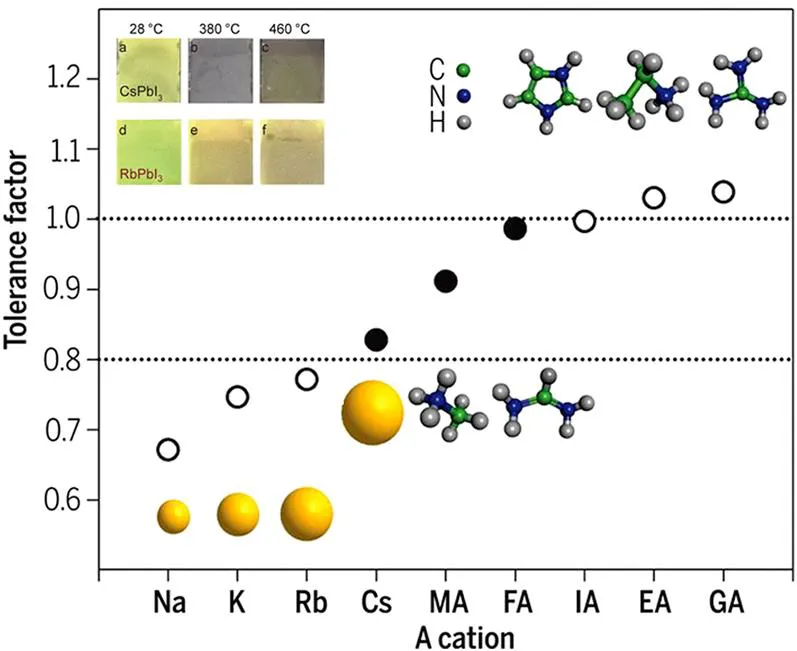
Goldschmidt tolerance factor determines the suitability of cation to be compatible with the 3D structure of ABX3 perovskite, which empirically was found to be between 0.8 and 1 for photoactive “black phase” perovskites.
1.1 Introduction
PSCs consisted of materials with ABX3 structures (see Fig. 1.1B), where A=cesium (Cs), methylammonium (MA), or formamidinium (FA); B=tin (Sn) or lead (Pb); X=chlorine (Cl), bromine (Br), or iodine (I). They have improved considerably in recent years starting with PCEs from 3.8% [1] in 2009 to 24.2% [2] in 2019. Engineering of material properties and specifically the bandgap of perovskite materials for solar cell applications was conducted recently by changing the material composition. The aim of the current chapter is to present the recent efforts and available techniques for such a compositional engineering, by considering the impacts and consequences on solar cell performance.

These perovskites can be processed by a myriad of techniques (including inexpensive solution processing). They have a tunable band gap from about 1.2 to 3.0 eV by interchanging the above mentioned cations [3,4], metals [5,6], or halides [7]. This is illustrated schematically in Fig. 1.1A, where colloidal CsPbX3 (X=Cl, Br, I) solutions under UV light have a photoluminescence (PL) peak (Fig. 1.1C) ranging from 1.77 (CsPbI3) to 3.06 eV (CsPbCl3). The intermediate band gaps can be reached by mixing the respective halides [8]. In addition, by using Sn/Pb metal mixtures, band gaps from 1.59 (MAPbI3) to 1.29 eV (MASnI3) become available. Interestingly, the mixed metals do not follow a linear Vegard trend [5,6,9,10] and the most red-shifted band gap is at 1.15 eV for an intermediary MASn0.8Pb0.2I3 [11]. Moreover, germanium is the second closest element to lead in the periodic table with oxidation state 2+, which has a lower cationic size, lower electronegativity and lower toxicity [12]. Bandgap tuning of germanium based perovskites is pursued by utilizing different monovalent cations [13], halides [14] and mixtures of halides and cations [15] leading to bandgaps of 1.3–3.7 eV. Non-cubic germanium perovskite compounds show nonlinear optical properties as reported in ref. [13] and [16]. As an alternative, Bi3+ has been the most investigated trivalent metal cation for lead exchange in halide perovskite solar cell applications so far. Antimony is a neighbor of Bi in the periodic table with oxidation state 3+ and a smaller cationic radius. In similarity to bismuth, the antimony cation tends to form layered perovskites with the formula A2Sb3X9. Thus, trivalent double perovskites including Cs2Bi3I9, MA2Bi3I9 and Cs3Sb2I9 lead to large band gap of 2.0 eV [17], 2.1 eV [17], 1.96 eV [18], respectively.
The large band gap range has made perovskites attractive for various applications outside of photovoltaics, ranging from lasing [19], light-emitting devices [20], sensing [21], photodetectors [22,23] as well as X-ray and particle-detection [24–27].
This also enables various options for photovoltaic applications. Some of the simplest and most accessible lead-based perovskites, e.g. MAPbI3 [28,29], can already achieve band gaps between 1.55 and 1.62 eV, which are nearly ideal for single-junction photovoltaic (PV) applications [30]. Even targeting directly the Shockley-Queisser optimum for single-junctions at 1.42 eV is an option by using a small amount of Sn in Sn/Pb metal mixtures [30]. Increasing the amount of Sn further results in band gaps of ≈ 1.2 eV which is close to silicon. Larger band gaps of 1.7 eV can also be achieved by using halide Br/I mixtures, enabling tandem solar cells with silicon. Even perovskite on perovskite tandem solar cells become accessible [31–36]. According to the Shockley-Queisser limit and the design of the single-junction solar cell, the maximum achievable efficiency is inherently limited to 31% due to thermalization and transmission losses [30]. Thus, a tandem design that consists of multiple absorber cells stacked in a horizontal fashion can be realized to absorb a larger portion of the solar spectrum and consequentially yield higher PCEs (see Chapter 12).
The same band gap can be achieved through different compositions by varying the ratios of the cations, metals, or anions. For example, increasing the Br content blue-shifts the band gap towards 1.7 eV, which is highly desired for perovskite/silicon tandems. However, this imposes new challenges: for example, using an equimolar amount of mixed halides (Br and I) may lead to phase segregation with distinct Br and I domains occurs in single cation MA-perovskites under full sun illumination as reported by Hoke et al. [37]. Such dephasing is problematic for long-term stable materials, since results in the formation of more iodine rich phases acting as recombination centers [38].
This effect can then be counteracted through perovskites with ...
Table of contents
- Cover image
- Title page
- Table of Contents
- Copyright
- List of contributors
- Preface
- Chapter 1. Bandgap tuning and compositional exchange for lead halide perovskite materials
- Chapter 2. X-ray diffraction and Raman spectroscopy for lead halide perovskites
- Chapter 3. Optical absorption and photoluminescence spectroscopy
- Chapter 4. Current-voltage analysis: lessons learned from hysteresis
- Chapter 5. Photoelectron spectroscopy investigations of halide perovskite materials used in solar cells
- Chapter 6. Time resolved photo-induced optical spectroscopy
- Chapter 7. Photovoltage/photocurrent transient techniques
- Chapter 8. Temperature effects in lead halide perovskites
- Chapter 9. Stability of materials and complete devices
- Chapter 10. Characterizing MAPbI3 with the aid of first principles calculations
- Chapter 11. Organic-inorganic metal halide perovskite tandem devices
- Chapter 12. Concluding remarks
- Index
Trusted by 375,005 students
Access to over 1.5 million titles for a fair monthly price.
Study more efficiently using our study tools.
Frequently asked questions
Yes, you can cancel anytime from the Subscription tab in your account settings on the Perlego website. Your subscription will stay active until the end of your current billing period. Learn how to cancel your subscription
No, books cannot be downloaded as external files, such as PDFs, for use outside of Perlego. However, you can download books within the Perlego app for offline reading on mobile or tablet. Learn how to download books offline
Perlego offers two plans: Essential and Complete
- Essential is ideal for learners and professionals who enjoy exploring a wide range of subjects. Access the Essential Library with 800,000+ trusted titles and best-sellers across business, personal growth, and the humanities. Includes unlimited reading time and Standard Read Aloud voice.
- Complete: Perfect for advanced learners and researchers needing full, unrestricted access. Unlock 1.5M+ books across hundreds of subjects, including academic and specialized titles. The Complete Plan also includes advanced features like Premium Read Aloud and Research Assistant.
We are an online textbook subscription service, where you can get access to an entire online library for less than the price of a single book per month. With over 1.5 million books across 990+ topics, we’ve got you covered! Learn about our mission
Look out for the read-aloud symbol on your next book to see if you can listen to it. The read-aloud tool reads text aloud for you, highlighting the text as it is being read. You can pause it, speed it up and slow it down. Learn more about Read Aloud
Yes! You can use the Perlego app on both iOS and Android devices to read anytime, anywhere — even offline. Perfect for commutes or when you’re on the go.
Please note we cannot support devices running on iOS 13 and Android 7 or earlier. Learn more about using the app
Please note we cannot support devices running on iOS 13 and Android 7 or earlier. Learn more about using the app
Yes, you can access Characterization Techniques for Perovskite Solar Cell Materials by Meysam Pazoki,Anders Hagfeldt,Tomas Edvinsson in PDF and/or ePUB format, as well as other popular books in Technology & Engineering & Materials Science. We have over 1.5 million books available in our catalogue for you to explore.