- 724 pages
- English
- ePUB (mobile friendly)
- Available on iOS & Android
eBook - ePub
About this book
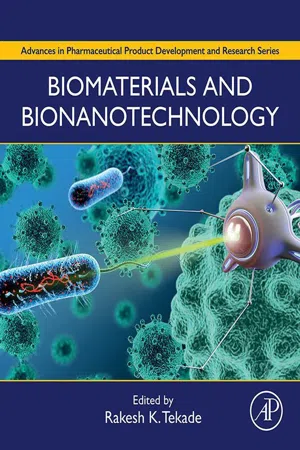
Biomaterials and Bionanotechnology examines the current state of the field within pharmaceutical sciences and concisely explains the history of biomaterials including key developments. Written by experts in the field, this volume within the Advances in Pharmaceutical Product Development and Research series deepens understanding of biomaterials and bionanotechnology within drug discovery and drug development. Each chapter delves into a particular aspect of this fast-moving field to cover the fundamental principles, advanced methodologies and technologies employed by pharmaceutical scientists, researchers and pharmaceutical industries to transform a drug candidate or new chemical entity into a final administrable dosage form, with particular focus on biomaterials and bionanomaterials. This book provides a comprehensive examination suitable for researchers working in the pharmaceutical, cosmetics, biotechnology, food and related industries as well as advanced students in these fields.
- Examines the most recent developments in biomaterials and nanomaterials for pharmaceutical sciences
- Covers important topics, such as the fundamentals of polymers science, transportation and bio interaction of properties in nanomaterials across biological systems, and nanotechnology in tissue engineering as they pertain specifically to pharmaceutical sciences
- Contains extensive references for further discovery on the role of biomaterials and nanomaterials in the drug discovery process
Information
Chapter 1
Design of Materials and Product Specifications
Divya Pandit1, Pran Kishore Deb2 and Renu Chadha1, 1University Institute of Pharmaceutical Sciences (UIPS), Panjab University, Chandigarh, India, 2Faculty of Pharmacy, Philadelphia University, Amman, Jordan
Abstract
A pharmaceutical industry is governed by specific regulatory bodies where the quality of any pharmaceutical product is given prime importance. Drug development process requires thorough planning to avoid failure to meet quality allied goals. Improper process designing leads to the quality deficit product, resulting in massive loss of company’s share in the market. Therefore, various guidelines have been implemented relevant to the design and development of the high-quality pharmaceutical product. Designing of specification in various aspects of drug development is considered as one of the most crucial steps for maintaining quality standard. In the present chapter, the basic objectives of designing the specification of drug substance and drug product have been explained while highlighting its importance and scope. Detail account of the guidelines has also been mentioned for better understanding to contextualize the chapter.
Keywords
Drug design; specifications; guideline; drug substances; drug product; drug quality
1.1 Introduction
It is the prerequisite responsibility of pharmaceutical companies to ensure that patients receive effective medicines of good quality. Manufacturers require assistance in the form of a comprehensive quality system model for implementation to meet their intended purpose and protect public health. This led to the establishment of various guidelines with a mandate to develop, establish and promote standards for the delivery of health care with respect to pharmaceuticals. However, these guidelines are a minimum requirement that is periodically reviewed and revised with the inception of new technological developments.
One of the control strategies for confirming the quality of the pharmaceutical product is to design raw material and finished product specification. During the International Conference of Drug Regulatory Authorities, officials from the United States, European Union (EU), and Japan felt a need to harmonize the requirements of pharmaceutical products, which led to the establishment of International Conference on Harmonization of Technical Requirements for the Registration of Pharmaceuticals for Human Use (ICH), with observers from WHO, Canada, and EFTA (Handoo et al., 2012). According to ICHQ6 (Quality guideline of International Conference on Harmonization of technical requirements for registration of pharmaceuticals for human use), specifications are the critical quality standard of tests in the form of numerical value or range to which a drug substance or drug product should conform (ICH, Q6A, 1999).
1.2 Objectives and Scope of Design of Materials and Product Specifications
A drug substance or its product needs to comply with the pharmacopoeial monograph. In case the monograph is not available then it should comply with the specifications mentioned in the NDA (new drug application). Regulatory authorities of some important pharmaceutical markets like the United States, EU, and Japan took an initiative to harmonize NDAs in the form of ICH guidelines to decrease the differences in technical requirements of various regulatory agencies for drug development. The ICH provided a platform for harmonization through feedback from both industry and regulatory representatives. ICHQ6A is one of the key ICH guidelines that is concerned with the specifications of new drug substances and drug products, while ICHQ6B deals with specification designing for biologicals (ICHQ6, 1999). The Food and Drug Administration (FDA) published a guidance pertaining to it with an objective to establish a single set of global specifications for new drug substances and their products (FDA, US, 2000).
The main objective of ICHQ6 is to identify the critical quality attributes that impact safety and efficacy of the drug substance or drug product and provide the reference to analytical procedures for their testing with acceptance criteria while maintaining the adequate accuracy and precision. Besides this, quality by design (QbD) approaches and clinical experience are the tools that are employed in establishing the specifications and nowadays this data is solicited by regulatory agencies like FDA. All the manufacturers need to propose and justify their acceptance criteria to regulatory authorities in the form of specifications for approval. This led to the thorough characterization of raw materials and final products by the manufacturers to ensure that they don’t put the patient at risk due to inadequate safety, quality, or efficacy of the pharmaceutical product. Hence, designing of specification became an indispensable step in pharmaceutical product development.
1.3 Pharmaceutical Product Specification
1.3.1 Concepts and the Need
The specification is a quality standard that determines the most appropriate means for reaching the stated objective of the manufacturer. Specifications cover general quality characteristics of the pharmaceuticals particularly related to pharmacotechnical aspects. Monographs or general chapters in pharmacopeia provide approved specifications. Some relevant information is also obtained by technical guidelines. For example, besides the ICHQ6 guideline, Q1, Q3, Q4, Q8, Q9, Q10 on stabilities, impurities, pharmacopeia, pharmaceutical development, quality risk management, and pharmaceutical quality system, respectively, are helpful in identifying the critical quality attributes and quantitative development of the acceptance criteria. An appropriate specification for each aspect of quality studied during the phase of development and during the validation of the manufacturing process should be determined as the applicant has to furnish appropriate analytical validation data in the marketing authorization application (MAA). The width of the upper and lower specification limits affect the shelf-life of the product. The tighter the specification limits, the higher are the chances of batch rejection, whereas the broader the specifications, the higher the incidences of acceptance of poor quality of the pharmaceutical product (Riley et al., 2013).
The regulatory authorities recognize that only a limited amount of data may be available at the time of filing. Therefore, the revised acceptance criteria can be proposed later when adequate data is available. Hence, the industry has an opportunity to loosen or tighten their specification based on the data with justification for each procedure and related acceptance criterion (FDA, US, 2000). The quality of drug substances and drug products is judged by the specifications applied to them throughout development, therefore, designing of specifications need to be done cautiously with appropriate justification.
1.3.2 The Rationale for Designing Specifications
Specifications are one of the essential...
Table of contents
- Cover image
- Title page
- Table of Contents
- Copyright
- Dedication
- List of Contributors
- About the Editor
- Chapter 1. Design of Materials and Product Specifications
- Chapter 2. Engineered Mesenchymal Stem Cells as Nanocarriers for Cancer Therapy and Diagnosis
- Chapter 3. Guiding Factors and Surface Modification Strategies for Biomaterials in Pharmaceutical Product Development
- Chapter 4. Biomaterials for Sustained and Controlled Delivery of Small Drug Molecules
- Chapter 5. Biotechnology-Based Pharmaceutical Products
- Chapter 6. Approaches to the Development of Implantable Therapeutic Systems
- Chapter 7. Nanotechnology in Tissue Engineering
- Chapter 8. Novel Therapeutic Approaches for the Treatment of Leishmaniasis
- Chapter 9. Up-to-Date Implications of Nanomaterials in Dental Science
- Chapter 10. Current Research Perspectives of Orthopedic Implant Materials
- Chapter 11. Biomaterials and Nanoparticles for Hyperthermia Therapy
- Chapter 12. Hyaluronic Acid as an Emerging Technology Platform for Silencing RNA Delivery
- Chapter 13. Thiolated-Chitosan: A Novel Mucoadhesive Polymer for Better-Targeted Drug Delivery
- Chapter 14. Recent Advances and Challenges in Microneedle-Mediated Transdermal Protein and Peptide Drug Delivery
- Chapter 15. Synthesis, Characterization, and Applications of Metal Nanoparticles
- Chapter 16. Functionalized Carbon Nanotubes for Protein, Peptide, and Gene Delivery
- Chapter 17. Surface Modifications of Biomaterials and Their Implication on Biocompatibility
- Index
Trusted by 375,005 students
Access to over 1.5 million titles for a fair monthly price.
Study more efficiently using our study tools.
Frequently asked questions
Yes, you can cancel anytime from the Subscription tab in your account settings on the Perlego website. Your subscription will stay active until the end of your current billing period. Learn how to cancel your subscription
No, books cannot be downloaded as external files, such as PDFs, for use outside of Perlego. However, you can download books within the Perlego app for offline reading on mobile or tablet. Learn how to download books offline
Perlego offers two plans: Essential and Complete
- Essential is ideal for learners and professionals who enjoy exploring a wide range of subjects. Access the Essential Library with 800,000+ trusted titles and best-sellers across business, personal growth, and the humanities. Includes unlimited reading time and Standard Read Aloud voice.
- Complete: Perfect for advanced learners and researchers needing full, unrestricted access. Unlock 1.5M+ books across hundreds of subjects, including academic and specialized titles. The Complete Plan also includes advanced features like Premium Read Aloud and Research Assistant.
We are an online textbook subscription service, where you can get access to an entire online library for less than the price of a single book per month. With over 1.5 million books across 990+ topics, we’ve got you covered! Learn about our mission
Look out for the read-aloud symbol on your next book to see if you can listen to it. The read-aloud tool reads text aloud for you, highlighting the text as it is being read. You can pause it, speed it up and slow it down. Learn more about Read Aloud
Yes! You can use the Perlego app on both iOS and Android devices to read anytime, anywhere — even offline. Perfect for commutes or when you’re on the go.
Please note we cannot support devices running on iOS 13 and Android 7 or earlier. Learn more about using the app
Please note we cannot support devices running on iOS 13 and Android 7 or earlier. Learn more about using the app
Yes, you can access Biomaterials and Bionanotechnology by in PDF and/or ePUB format, as well as other popular books in Medicina & Industria farmaceutica, biotecnologica e sanitaria. We have over 1.5 million books available in our catalogue for you to explore.