eBook - ePub
Transformation Optics-based Antennas
- 122 pages
- English
- ePUB (mobile friendly)
- Available on iOS & Android
eBook - ePub
Transformation Optics-based Antennas
About this book
Transformation Optics-based Antennas is organized into two chapters that follow an introduction that presents the basic principles of the transformation optics concept. Two types of transformation are presented, coordinate transformation and space transformation. Implementations using metamaterials are also discussed.
Chapter One focuses on coordinate transformation in the design of devices capable of modifying the electromagnetic appearance of a radiating source. Transformation of a directive radiation pattern into an isotropic one (and vice-versa) through space stretching and compression, respectively, and the possibility of creating multiple beams are also studied.
Chapter Two deals with devices designed using space transformation concepts. Quasi-conformal transformation optics (QCTO) are applied for the design of lenses, either to compensate for the phase shift created by the conformation of an array of sources or to steer a beam to an off-normal direction.
- Focuses firstly on the theoretical tools that define transformation optics
- Address the origin of these concepts by analyzing Fermat's principle
- Details the basic approaches and methods needed to design practical applications of transformation optics concepts
Tools to learn more effectively

Saving Books

Keyword Search

Annotating Text

Listen to it instead
Information
1
Transformation Optics Concept: Definition and Tools
Abstract:
The exciting field of metamaterials has attracted the interest of researchers from all across the world over the past few years. With roots in the foundations of optics and electromagnetics, researchers are exploring the underlying physics of metamaterials. Electromagnetic metamaterials are artificially structured materials composed of periodic arrays of sub-wavelength resonating structures, scatterers or apertures, whose electric or magnetic response provides the ability to engineer dielectric or magnetic properties that do not exist in naturally occurring materials. The dielectric or magnetic properties can be tailored by changing the geometrical parameters of the constituent structure of the metamaterial.
Keywords
Coordinate transformation; Electric resonators; Magnetic resonators; Metamaterials; Quasi-conformal transformation optics (QCTO); Space transformation; Transformation Optics
1.1 State of the art on metamaterials
The exciting field of metamaterials has attracted the interest of researchers from all across the world over the past few years. With roots in the foundations of optics and electromagnetics, researchers are exploring the underlying physics of metamaterials. Electromagnetic metamaterials are artificially structured materials composed of periodic arrays of sub-wavelength resonating structures, scatterers or apertures, whose electric or magnetic response provides the ability to engineer dielectric or magnetic properties that do not exist in naturally occurring materials. The dielectric or magnetic properties can be tailored by changing the geometrical parameters of the constituent structure of the metamaterial.
Metamaterials has covered a wide variety of topics with a rich history of scientific exploration. A metamaterial is a microstructured material that is patterned to achieve a desired interaction with some wave-type phenomena, and is usually either acoustic or electromagnetic. The electromagnetic metamaterials studied and applied in this book mainly concern the engineering of unusual permittivity and permeability values such as negative or less than unity.
The recent surge in interest in metamaterials, however, has been fueled by experimental and theoretical demonstrations of physical phenomena, resulting from this patterning, which mimic materials that are not available in nature. Figure 1.1 shows the most well-known metamaterial implementation, the emblematical electromagnetic cloaking device [SCH 06a].
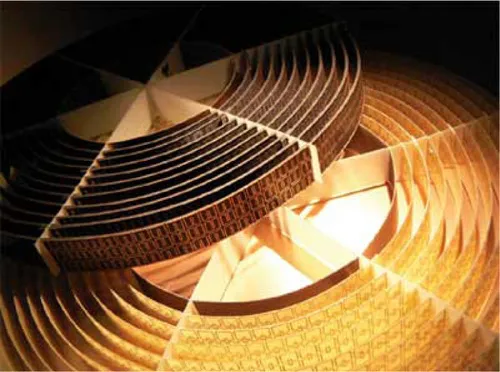
Table of contents
- Cover image
- Title page
- Table of Contents
- Copyright
- Preface
- Introduction
- 1: Transformation Optics Concept: Definition and Tools
- 2: Coordinate Transformation Concept: Transformation of Electromagnetic Sources
- 3: Space Transformation Concept: Controlling the Path of Electromagnetic Waves
- Conclusion
- Bibliography
- Index
Frequently asked questions
Yes, you can cancel anytime from the Subscription tab in your account settings on the Perlego website. Your subscription will stay active until the end of your current billing period. Learn how to cancel your subscription
No, books cannot be downloaded as external files, such as PDFs, for use outside of Perlego. However, you can download books within the Perlego app for offline reading on mobile or tablet. Learn how to download books offline
Perlego offers two plans: Essential and Complete
- Essential is ideal for learners and professionals who enjoy exploring a wide range of subjects. Access the Essential Library with 800,000+ trusted titles and best-sellers across business, personal growth, and the humanities. Includes unlimited reading time and Standard Read Aloud voice.
- Complete: Perfect for advanced learners and researchers needing full, unrestricted access. Unlock 1.4M+ books across hundreds of subjects, including academic and specialized titles. The Complete Plan also includes advanced features like Premium Read Aloud and Research Assistant.
We are an online textbook subscription service, where you can get access to an entire online library for less than the price of a single book per month. With over 1 million books across 990+ topics, we’ve got you covered! Learn about our mission
Look out for the read-aloud symbol on your next book to see if you can listen to it. The read-aloud tool reads text aloud for you, highlighting the text as it is being read. You can pause it, speed it up and slow it down. Learn more about Read Aloud
Yes! You can use the Perlego app on both iOS and Android devices to read anytime, anywhere — even offline. Perfect for commutes or when you’re on the go.
Please note we cannot support devices running on iOS 13 and Android 7 or earlier. Learn more about using the app
Please note we cannot support devices running on iOS 13 and Android 7 or earlier. Learn more about using the app
Yes, you can access Transformation Optics-based Antennas by Shah Nawaz Burokur,André de Lustrac,Jianjia Yi,Paul-Henri Tichit in PDF and/or ePUB format, as well as other popular books in Technology & Engineering & Civil Engineering. We have over one million books available in our catalogue for you to explore.