eBook - ePub
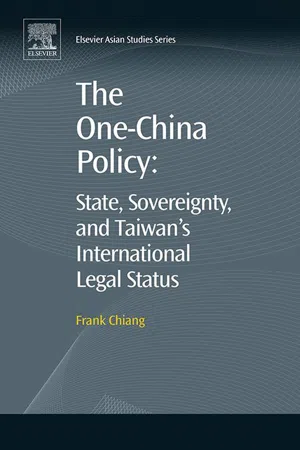
The One-China Policy: State, Sovereignty, and Taiwan's International Legal Status
- 388 pages
- English
- ePUB (mobile friendly)
- Available on iOS & Android
eBook - ePub
The One-China Policy: State, Sovereignty, and Taiwan's International Legal Status
About this book
The One-China Policy: State, Sovereignty, and Taiwan's International Legal Status examines the issue from the perspective of international law, also suggesting a peaceful solution. The book presents two related parts, with the first detailing the concept of the State, the theory of sovereignty, and their relations with international law. The second part of the work analyzes the political status of the Republic of China in Taiwan and the legal status of the island of Taiwan in international law. Written by a leading international expert in international law, this book provides approaches and answers to the question of Taiwan and the One-China policy.
- Responds to a key international issue of our time
- Takes a legal perspective on Taiwan and the One-China policy
- Considers the definition of a nation State from first principles, also offering new definitions
- Applies international law on territory to draw conclusions on Taiwan and its relation to the People's Republic of China
- Systematically critiques the role of the UN and other global actors in relation to Taiwan
Information
Part I
State, Sovereignty, and Territory
Outline
Chapter 1
The State
Abstract
This chapter provides a brief introduction to the concept of the State in terms of being a territorial political institution, as well as the various kinds of State including kingdoms, feudal states, and the birth of the “modern State.” The differences between a civil society and a State and how society developed into States are described briefly. This chapter also contains a short review on the feudal state in Europe and its development into modern State before a brief discussion on the fundamental characteristics of the modern State.
Keywords
State; civil society; society; kingdom; feudal state; territoriality; sovereignty; vassals
Part I examines the concept of the State and the theory of sovereignty, and then the territory of the modern State. This chapter examines the concept of the State and the various kinds of States.
The word “State” with a capital “S” as used in this work, except in cases of a quotation, applies broadly to a territorial political institution of any form commonly so described today. It includes kingdoms, the feudal States, and the modern States. As the State is a territorial political institution, when the term “political institution” is used for the State in this work, it means territorial political institution unless the context indicates otherwise.
1 The State and Society
State and society are two separate concepts, though the two are closely related. In discussing the evolution of humankind and the origin of the State, some writers equate the “State” with “civil society.”2
But the State and civil society are different both in concept and in the process of their formation. Although the State exists only in a civil society,3 not all civil societies are States.
It took a long time for human beings to form a society. The term “society” has been defined as “a community of people living in a particular country or region and having shared customs, laws and organizations.”4 The definition indicates that people formed a society in the place or region where they settled. This definition, however, describes a civil society, not a primitive one.
Human beings began with a savage society. Writers spoke of a “savage society,”5 referring to a primitive society as “when mankind derived their whole subsistence from the fruits…hunting, fishing, and their flocks…they had no dwelling place nor settled habitations…. Such was the ancient manner of living [until] agriculture was introduced.”6 The primitive society began as a familial group, where parents cared for their young. This later expanded to extended family groups, called “clans,” living in close proximity. This society eventually evolved to a civil society with a government and a functional political system. It took a long journey for a primitive society to develop into a civil society. The process was a gradual and slow one.
The process of establishing a State is different. From the beginning, the process for establishing a king and a kingdom, the earliest kind of the State, has been drastic. It is common that in a group of people, a strong person eventually emerges as the leader. The leader in an early society might initially have acquired his position by consent of the people or, sometimes, by brute force. At a certain point of time, the leader became their ruler—either by declaring himself their king (I am the king), or by accepting an acclamation of the people (Long live the king)—establishing a king, and a kingdom. Once a kingdom is established, a State is established. The State is an intangible political institution that has a life of its own. The State continues to exist, even though the king changes, until the State is extinguished, usually in a violent way.
2 Various Kinds of States
A The Medieval Feudal State
From ancient kingdoms, other kinds of States, mainly the feudal State and the modern State, developed. A brief review of the nature of the feudal State will help the reader understand the nature of the modern State.
In the 9th century, Europe began to fall into feudalism. Feudalism was a type of political order where a ruler only had the power to rule his vassals immediate below him, as opposed to all of the subjects within his territory. When the territorial magnates in the East Frankish Kingdom (what is known today as Germany) elected Arnulf, the Duke of Kaernten (Carinthia), as the King of Germany and Italy in 887,7 feudalism began in the Kingdom. The Kingdom consisted of what is today Germany and northern Italy. Later, after Frederick I was crowned emperor of what would become the Holy Roman Empire, he created the rank of Prince for his chief vassals in 1155.8 Similarly, in France, feudalism began when Hugh Capet was elected King of France in 987.9 And in England, it began in 1066 when the (French) Duke William of Normandy conquered England and established the English Kingdom.10 From then on, feudalism spread over Western Europe.
In the feudal system, the kingdom was built on the king’s control of his vassals. The king no longer directly controlled all the people within his kingdom. Outside of his own domain, the king ruled his kingdom through his feudal vassals. In exchange for large parcels of land, called fiefdoms, the feudal vassals provided labor and military services to the king and made regular payments, as dues and taxes, to him. The common people, consisting mainly of peasants and workers, were subject to the rule of their feudal lords, not the rule of the king. The king ruled over and collected taxes from his feudal vassals, who in turn collected taxes from their subjects.11
To a feudal king and feudal lords, the lands (territories) in the king’s domain and feudal lords’ dominions were their personal properties—their estates—respectively. The rulers had ownership interests or title to the lands. Much like real property, territories could be transferred or acquired through the marriage of rulers. Developments in Western Europe provide an illustration. The Duke of Bavaria, Maximilian (later Holy Roman Emperor), married Mary of Burgundy (1477) and, through her, acquired Burgundy and the Low Countries, including the Austrian Netherlands (modern Belgium). In this way, Mary’s territories went to the Duke of Bavaria as a dowry,12 similar to the way common people would gain ownership interests in land by marriage. Likewise, the Hohenstaufen King Frederick I (Barbarossa) acquired the province of Burgundy by marriage.13
B The Modern State
The modern State is a product of Western civilization.14 “The modern State” is a generic term. It does not refer to any particular State.15 There is no State that is the modern State. It is a collective name given to describe the States transformed from medieval feudalism that share some common characteristics.16
The transformation of the feudal State into the modern State did not begin in every State at the same time.17 It was a process that spread over time from one state to another. Although many historians regard France as the State where the modern State first developed in the 15th century, territorial political institutions with common characteristics of the modern State (e.g., the sovereign power) appeared in northern Italy as early as the 11th century. During this time, the Principalities of northern Italy,...
Table of contents
- Cover image
- Title page
- Table of Contents
- Copyright
- Foreword
- Preface
- Afterword
- Acknowledgment
- Introduction
- Part I: State, Sovereignty, and Territory
- Part II: China and The Republic of China
- Part III: Sovereignty Over Taiwan
- Part IV: US Control Over Taiwan
- Conclusion
- Bibliography
- Index
Trusted by 375,005 students
Access to over 1.5 million titles for a fair monthly price.
Study more efficiently using our study tools.
Frequently asked questions
Yes, you can cancel anytime from the Subscription tab in your account settings on the Perlego website. Your subscription will stay active until the end of your current billing period. Learn how to cancel your subscription
No, books cannot be downloaded as external files, such as PDFs, for use outside of Perlego. However, you can download books within the Perlego app for offline reading on mobile or tablet. Learn how to download books offline
Perlego offers two plans: Essential and Complete
- Essential is ideal for learners and professionals who enjoy exploring a wide range of subjects. Access the Essential Library with 800,000+ trusted titles and best-sellers across business, personal growth, and the humanities. Includes unlimited reading time and Standard Read Aloud voice.
- Complete: Perfect for advanced learners and researchers needing full, unrestricted access. Unlock 1.5M+ books across hundreds of subjects, including academic and specialized titles. The Complete Plan also includes advanced features like Premium Read Aloud and Research Assistant.
We are an online textbook subscription service, where you can get access to an entire online library for less than the price of a single book per month. With over 1.5 million books across 990+ topics, we’ve got you covered! Learn about our mission
Look out for the read-aloud symbol on your next book to see if you can listen to it. The read-aloud tool reads text aloud for you, highlighting the text as it is being read. You can pause it, speed it up and slow it down. Learn more about Read Aloud
Yes! You can use the Perlego app on both iOS and Android devices to read anytime, anywhere — even offline. Perfect for commutes or when you’re on the go.
Please note we cannot support devices running on iOS 13 and Android 7 or earlier. Learn more about using the app
Please note we cannot support devices running on iOS 13 and Android 7 or earlier. Learn more about using the app
Yes, you can access The One-China Policy: State, Sovereignty, and Taiwan's International Legal Status by Frank Chiang in PDF and/or ePUB format, as well as other popular books in Law & Financial Law. We have over 1.5 million books available in our catalogue for you to explore.