- 516 pages
- English
- ePUB (mobile friendly)
- Available on iOS & Android
eBook - ePub
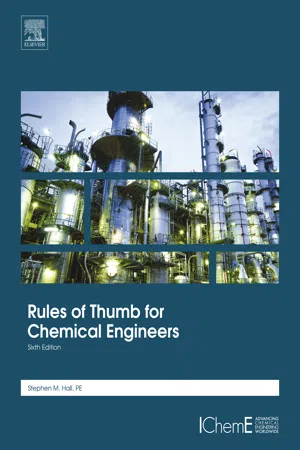
Rules of Thumb for Chemical Engineers
About this book
Rules of Thumb for Chemical Engineers, Sixth Edition, is the most complete guide for chemical and process engineers who need reliable and authoritative solutions to on-the-job problems. The text is comprehensively revised and updated with new data and formulas. The book helps solve process design problems quickly, accurately and safely, with hundreds of common sense techniques, shortcuts and calculations. Its concise sections detail the steps needed to answer critical design questions and challenges. The book discusses physical properties for proprietary materials, pharmaceutical and biopharmaceutical sector heuristics, process design, closed-loop heat transfer systems, heat exchangers, packed columns and structured packings.
This book will help you: save time you no longer have to spend on theory or derivations; improve accuracy by exploiting well tested and accepted methods culled from industry experts; and save money by reducing reliance on consultants. The book brings together solutions, information and work-arounds from engineers in the process industry.
- Includes new chapters on biotechnology and filtration
- Incorporates additional tables with typical values and new calculations
- Features supporting data for selecting and specifying heat transfer equipment
Information
Chapter 1
Safety
Abstract
After providing an overview of the US Occupational Safety and Health Association (OSHA) Process Safety Management (PSM) mandate, this chapter discusses the qualitative and quantitative methods for conducting Process Hazard Analysis (PHA). General safety design practices are listed. Emergency venting systems, through relief valves or rupture disks, are discussed along with the design equations following the American Petroleum Institute (API), OSHA, and the National Fire Protection Association (NFPA) standards. Equations are given for estimating the flash point of binary mixtures. Deflagration prevention and control are discussed. A key concept—prevention of backflow—is presented. Equipment purging schemes are defined along with calculations. Electrical area classifications are discussed. Design recommendations to prevent or control dust explosion hazards are provided.
Keywords
Process safety management; Process hazard analysis; Emergency venting; Flash point; Deflagration; Equipment purging; Dust explosion
Introduction
A prerequisite for every process design is that the safety of people, the environment, and equipment is assured. Although it may not be possible or practicable to absolutely prevent every incident, by using appropriate assessment and design tools, engineers do strive to strike a consistent balance between safety, technology, and cost.
This chapter gives an overview of the most comprehensive of the US safety standards, OSHA's Process Safety Management (PSM). The chapter then gives specifics that pertain to a range of safety-related issues and calculations. The two underlying principles are the following:
1. Information and Data. Engineers must have a thorough understanding of the chemistry, process, equipment, controls, operations, maintenance practices, and other factors that contribute to a safe plant. Understanding goes beyond the facts, criteria, equations, and algorithms that are presented throughout this book. Good engineers synthesize those individual unit operation concepts into coherent plant-wide designs. The combination of this informed high-level view and the details for each process step and unit operation form the body of knowledge for the hazards analyses, which are the second principle.
2. Process hazards analysis (PHA). Variously called a risk assessment, PHA, FMEA, HazOp, and many other terms, the PHA is intended to identify what could go wrong and determine the potential health impacts (both acute and chronic), environmental degradations, and business interruptions that could result. In addition to “what,” the PHA can address “who,” “why,” “when,” and “how” questions and provide guidance for whether or not mitigating features should be added to the plant design or operating instructions.
Many chapters in this book include a “Safety Considerations” section. These are intended to provide pointers and are not comprehensive. Incorporate them into the information and data that form the basis for a plant that is designed with safety being in the forefront.
Process Safety Management (PSM)
Compliance with OSHA's PSM [1] regulation is mandatory for every process facility that meets one of these tests:
• Quantities of specific listed highly hazardous chemicals are greater than the quantities listed in the regulation. Examples: 110 kg (250 lb) methyl isocyanate, 225 kg (500 lb) nitric acid (94.5% by weight or greater), 680 kg (1500 lb) chlorine gas, or 6800 kg (15,000 lb) methyl chloride.
• More than 4500 kg (10,000 lb) of flammable liquids or gases are present in one location, except for hydrocarbon fuels used solely for onsite consumption as a fuel, and flammable liquids stored in atmospheric tanks or transferred at a temperature below their normal boiling point (without benefit of chilling or refrigeration).
Certain facilities are exempt including retail facilities, oil or gas drilling and servicing facilities, and normally unoccupied remote facilities.
It is a 14-point performance-oriented system summarized in Table 1.1. While clearly emphasizing safety, PSM also makes good business sense because compliance reduces the frequency and severity of accidents. The elements composing PSM range widely and may have far-reaching implications.
Table 1.1
The 14 Elements of OSHA's Process Safety Management Regulation [1]
| Element | Description |
| Employee participation | Employers must consult with their employees and their representatives regarding the employer's efforts in the development and implementation of the PSM program elements and hazard assessments. Employers must also train and educate their employees and to inform affected employees of the findings from incident investigations required by the PSM program |
| Process safety information | Complete and accurate written information concerni... |
Table of contents
- Cover image
- Title page
- Table of Contents
- Copyright
- Preface
- Chapter 1: Safety
- Chapter 2: Process Evaluation
- Chapter 3: Process Modeling
- Chapter 4: Fluid Flow
- Chapter 5: Vessels
- Chapter 6: Blending and Agitation
- Chapter 7: Pumps
- Chapter 8: Fans, Blowers, and Compressors
- Chapter 9: Vacuum Systems
- Chapter 10: Pneumatic Conveying
- Chapter 11: Filtration
- Chapter 12: Heat Exchangers
- Chapter 13: Closed-Loop Heat Transfer Systems
- Chapter 14: Fractionators
- Chapter 15: Absorbers
- Chapter 16: Controls
- Chapter 17: Biopharmaceutical Systems
- Chapter 18: Bioprocessing
- Chapter 19: Energy Conservation
- Chapter 20: Drivers
- Chapter 21: Boilers
- Chapter 22: Cooling Towers
- Chapter 23: Refrigeration
- Chapter 24: Reliability
- Chapter 25: Metallurgy
- Chapter 26: Troubleshooting
- Chapter 27: Startup
- Chapter 28: Conversion Factors and Constants
- Chapter 29: Properties
- Appendix A: Resources
- Appendix B: Tank Cleaning
- Index
Trusted by 375,005 students
Access to over 1.5 million titles for a fair monthly price.
Study more efficiently using our study tools.
Frequently asked questions
Yes, you can cancel anytime from the Subscription tab in your account settings on the Perlego website. Your subscription will stay active until the end of your current billing period. Learn how to cancel your subscription
No, books cannot be downloaded as external files, such as PDFs, for use outside of Perlego. However, you can download books within the Perlego app for offline reading on mobile or tablet. Learn how to download books offline
Perlego offers two plans: Essential and Complete
- Essential is ideal for learners and professionals who enjoy exploring a wide range of subjects. Access the Essential Library with 800,000+ trusted titles and best-sellers across business, personal growth, and the humanities. Includes unlimited reading time and Standard Read Aloud voice.
- Complete: Perfect for advanced learners and researchers needing full, unrestricted access. Unlock 1.5M+ books across hundreds of subjects, including academic and specialized titles. The Complete Plan also includes advanced features like Premium Read Aloud and Research Assistant.
We are an online textbook subscription service, where you can get access to an entire online library for less than the price of a single book per month. With over 1.5 million books across 990+ topics, we’ve got you covered! Learn about our mission
Look out for the read-aloud symbol on your next book to see if you can listen to it. The read-aloud tool reads text aloud for you, highlighting the text as it is being read. You can pause it, speed it up and slow it down. Learn more about Read Aloud
Yes! You can use the Perlego app on both iOS and Android devices to read anytime, anywhere — even offline. Perfect for commutes or when you’re on the go.
Please note we cannot support devices running on iOS 13 and Android 7 or earlier. Learn more about using the app
Please note we cannot support devices running on iOS 13 and Android 7 or earlier. Learn more about using the app
Yes, you can access Rules of Thumb for Chemical Engineers by Stephen Hall in PDF and/or ePUB format, as well as other popular books in Tecnologia e ingegneria & Ingegneria chimica e biochimica. We have over 1.5 million books available in our catalogue for you to explore.