- 630 pages
- English
- ePUB (mobile friendly)
- Available on iOS & Android
eBook - ePub
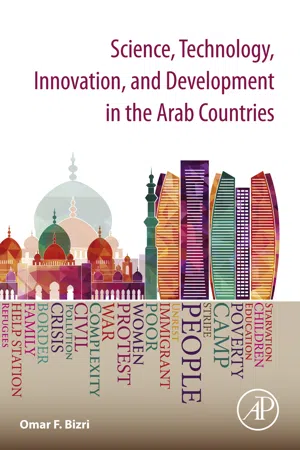
Science, Technology, Innovation, and Development in the Arab Countries
About this book
Science, Technology, Innovation, and Economic Growth in Arab Countries explores fresh approaches to STI policy formulation and implementation in the region, with applications to developing countries elsewhere. Developing useful contexts for studying Arab policies about science, technology, and innovation requires trustworthy data and judgment. Omar Bizri brings together both in this book.
Data from sources such as the World Bank, UNESCO, the International Telecommunication Union, Nature, Science and recent surveys and policy formulation initiatives anchor this study among national initiatives that focus on essential needs, including safe water and food production, renewable energy utilization, and job and enterprise creation. For those eager to understand the challenges of STI capacity building, this book explores the many connections between technological change and economic growth.
- Presents and analyzes data about past, current and proposed efforts aimed at STI capacity building in Arab countries
- Emphasizes demand-driven policies for promoting rapid infrastructure and endogenous STI capacity building, as well as job creation
- Explores ways to enhance STI capacity building efforts through community-based and national initiatives
- Includes data from sources such as the World Bank, UNESCO, the International Telecommunication Union, Nature, Science and recent surveys
Trusted by 375,005 students
Access to over 1.5 million titles for a fair monthly price.
Study more efficiently using our study tools.
Information
Chapter 1
Science, Technology, and Innovation
Paths for Alternative Futures
Abstract
Tumultuous conditions that the Arab world finds itself in nowadays are largely due to failures on many fronts, linked both directly and indirectly, to the manner with which knowledge, in general, and that embodied in science, technology, and innovation (STI) inputs, in particular, is accessed and implemented for inclusive and sustainable development.
Both past and more recent historical events might be invoked in explaining the state of Arab STI systems today. However, for a better future for the region and the world at large, a multitude of challenges require major shifts in policies as well as practical measures designed to enhance the Arab countries’ STI capabilities, with greater attention to STI inputs needed by local and rural communities, while safeguarding the environment.
In their quest for building STI capabilities, the Arab countries generally took paths dominated by central government authorities. While governments’ contributions should continue and even be enhanced, future contributions by a host of additional actors must also be encouraged, within well-designed policy frameworks, and with dynamic initiatives at their core.
In addition to contributions by the private sector, much larger roles are to be performed by local authorities as well as nongovernmental organizations, trade and industry federations, and professional associations. Additionally, improved schemes must be designed to benefit from the Arab countries’ growing diaspora, many of whose members are effective actors in a variety of STI domains.
Keywords
Armed conflict; Capacity building; Educational systems; Gross domestic product; Human resources; Inclusive and sustainable development; Information and communication technologies; Knowledge; Knowledge economies; National science, technology, and innovation system; Political turmoil; R & D activity; Science, technology, and innovation in the Arab countries; Science, technology, and innovation institutions
1.1. Introduction
Political turmoil and armed conflict have engulfed many parts of the Arab region for several years now, claiming hundreds of thousands of lives, destroying capital assets worth hundreds of billions and turning millions of its inhabitants into refugees. The human and economic costs of the conflict are still on the rise with no end yet in sight.
Analysis of the immediate causes of the conflict tends to blame a wide range of factors. Some even invoke complex conspiracies by outside powers, eager to loot the region’s wealth and spread their hegemony. However, although plots and conspiracies may have been the bread and butter of human history, what is glaringly obvious is a total lack of immunity possessed by large segments of Arab societies against them, whether imaginary or real. Devoid of such immunity—normally engendered by good governance, solid educational systems, plentiful employment opportunities, leading to uniform distribution of incomes and wealth—even worse fates are possible.
In effect, disasters that unfolded in many Arab countries are firmly rooted in persistent failure to acquire, adapt, and implement knowledge for inclusive and sustainable socioeconomic development. On the other hand, acquiring, adapting, and implementing such knowledge would have to rest squarely on the above pillars; namely good governance, quality education as well as transparent economic and social transactions.1 In order to escape this chicken-and-egg conundrum, it is essential to encourage evolutionary processes in politics, economics as well as in scientific and technological knowledge that subvert vicious cycles, installing more benign ones in their place. For example, governance, both good and bad, requires that modern telecommunication capabilities are acquired and disseminated. Once available, such capabilities may be used to enhance the quality of education as well as access useful information on assembling and delivery of a variety of goods and services, driving a multitude of innovative enterprises while at the same time enhancing people’s abilities to share crucial everyday information and organize to counter bad governance.
It is also likely that events of the current decade might convince policy makers to adopt alternative courses, opening wider possibilities for access to and implementation of knowledge, particularly knowledge linked to science, technology, and innovation (STI) capabilities in a manner that benefits all segments of society.
The current race by several Arab countries to set up their own knowledge economies is at least partly in response to some such notions. However, given goodwill and best intentions all round, trajectories toward establishing truly functional knowledge economies and societies are complicated by the fact that rentier practices have taken a firm hold during decades of misrule, inherited feudal values, and distorted legal and regulatory frameworks, thus engendering corruption and cronyism and negatively impacting public–private collaboration. Additionally, crucial coordination between concerned national STI institutions, which are at any rate ill-equipped, inadequately funded, and often mismanaged, with the aim of tackling essential development problems is absent or at best incidental.
1.2. A Historical Perspective
Since their independence from colonial rule, toward the middle of the 20th century, development efforts in the Arab countries have mostly been directed toward institution and infrastructure building. Attempts were made as early as the 1950s to establish science councils. Scientific research centers came into being in many countries in the 1970s. Some of the countries even established ministries of state for technology, as well as ministries for telecommunications and technology. Higher commissions for scientific research were set up by several Arab countries under the auspices of the Council of Ministers. Many of these initiatives certainly did make their mark on the national STI landscape; however, for the most part, changes they were able to bring about were mostly cosmetic and palliative, rather than fundamental.
Reviews of scientific research and technological development activity undertaken in some of the worst hit Arab countries compared with other countries in the region and around the globe indicate meager progress over the past years for which statistics are available, even prior to the onset of hostilities they witnessed several years later. With regard to innovation and innovative activities undertaken for the benefit of enterprise and job creation, several reports issued by international bodies, notably, the World Economic Forum, also indicate that countries such as Syria, Iraq, Libya, and Yemen have, for a number of years, occupied a less than satisfactory position even in comparison with other developing countries.
This situation may not be entirely blamed on the lack of will—by concerned government institutions as well as the STI community—to develop and implement viable STI initiatives. Indeed, as the following chapters will indicate, several attempts were made at relevant institution building by all Arab countries, particularly during the latter three decades of the past century and toward the beginning of the present century. Thus, many Arab countries, including Egypt, Syria, Iraq, Lebanon, Jordan, Tunisia as well as Kuwait and Saudi Arabia, among the Arab Gulf countries, established research and development facilities in the 1970s. This led to research output, at least some of which eventually translated into significant gains for national development. An example of such developments is provided by the near self-sufficiency in agricultural produce achieved by Syria during much of the 1980s and 1990s. Success attained by this country owed a great deal to endogenous agricultural scientific research and technological development aided by international and regional research centers,2 as well as the creation of agricultural research stations by concerned government authorities. Nevertheless, several factors3 conspired to limit and redirect research and development efforts in this country toward less, even nonproductive domains. At any rate, national institutions involved in scientific, technological, and innovation activities suffered the same if not a higher degree of undue political intervention and corruption that many other institutions in the country had to cope with, thereby curtailing their independence and abilities to contribute to national development.
1.3. Toward a Better Future for Science, Technology, and Innovation in the Arab Countries
Capabilities in STI have assumed critical importance for all aspects of socioeconomic activity in the developed as well as developing countries. The Arab countries are no exception. As indicated later, particularly in Chapters 2 and 3, building knowledge economies aided by a host of advanced technologies appears to be a prime preoccupation for many in the Arab world. In this regard, and in order that future efforts lead to optimal outcomes, it is essential to consider the following points:
- • Was STI capacity building progressing satisfactorily prior to the onset of the current turmoil?
- • How might STI capacity building proceed in the shadow of rentier practices, attendant corruption and cronyism, widespread unemployment, and poverty?
- • What kind of innovation systems and policies are needed in the immediate and near futures?
- • Who else, beside governments, might facilitate STI capacity building?
Subsequent paragraphs in this chapter provide introductory comments while detailed consideration of the above questions is taken up in ensuing chapters.
1.3.1. STI Capacity Building Was Already Suffering Before the Current Turmoil
It is essential to note at the very outset that the roots to current problems in the region, with their heavy impact on STI capacity building, date back decades if not centuries earlier, imprinted by a series of historical events and deeply embedded in cultural systems that enshrine rentier practices. See Frame 1.1.
Even before the Arab uprisings, which resulted in stagnation on many fronts including innovation in many aspects of socioeconomic life, it was patently evident that innovative potential inherent in these countries and their populations was far from being fully realized. Thus, in comparison with several other developing countries around the wor...
Table of contents
- Cover image
- Title page
- Table of Contents
- Copyright
- Dedication
- List of Figures
- List of Tables
- List of Frames
- Preface
- Acknowledgments
- Abbreviations and Acronyms
- Chapter 1. Science, Technology, and Innovation: Paths for Alternative Futures
- Chapter 2. The Arab Countries’ Economies and Development Policies
- Chapter 3. Science, Technology, and Innovation Policies and Institutional Landscapes
- Chapter 4. Research Output by the Arab Countries
- Chapter 5. Innovation and Entrepreneurship in the Arab Countries
- Chapter 6. Arab Science, Technology, and Innovation Systems: Challenges, Policy Regimes, and Future Directions
- Index
Frequently asked questions
Yes, you can cancel anytime from the Subscription tab in your account settings on the Perlego website. Your subscription will stay active until the end of your current billing period. Learn how to cancel your subscription
No, books cannot be downloaded as external files, such as PDFs, for use outside of Perlego. However, you can download books within the Perlego app for offline reading on mobile or tablet. Learn how to download books offline
Perlego offers two plans: Essential and Complete
- Essential is ideal for learners and professionals who enjoy exploring a wide range of subjects. Access the Essential Library with 800,000+ trusted titles and best-sellers across business, personal growth, and the humanities. Includes unlimited reading time and Standard Read Aloud voice.
- Complete: Perfect for advanced learners and researchers needing full, unrestricted access. Unlock 1.5M+ books across hundreds of subjects, including academic and specialized titles. The Complete Plan also includes advanced features like Premium Read Aloud and Research Assistant.
We are an online textbook subscription service, where you can get access to an entire online library for less than the price of a single book per month. With over 1.5 million books across 990+ topics, we’ve got you covered! Learn about our mission
Look out for the read-aloud symbol on your next book to see if you can listen to it. The read-aloud tool reads text aloud for you, highlighting the text as it is being read. You can pause it, speed it up and slow it down. Learn more about Read Aloud
Yes! You can use the Perlego app on both iOS and Android devices to read anytime, anywhere — even offline. Perfect for commutes or when you’re on the go.
Please note we cannot support devices running on iOS 13 and Android 7 or earlier. Learn more about using the app
Please note we cannot support devices running on iOS 13 and Android 7 or earlier. Learn more about using the app
Yes, you can access Science, Technology, Innovation, and Development in the Arab Countries by Omar Bizri in PDF and/or ePUB format, as well as other popular books in Economics & Business Development. We have over 1.5 million books available in our catalogue for you to explore.