eBook - ePub
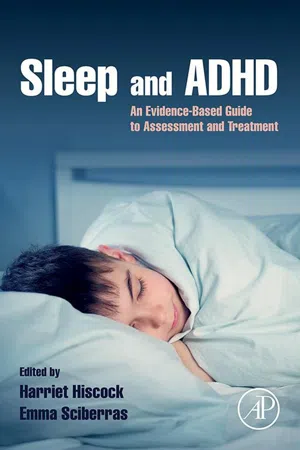
Sleep and ADHD
An Evidence-Based Guide to Assessment and Treatment
- 394 pages
- English
- ePUB (mobile friendly)
- Available on iOS & Android
eBook - ePub
About this book
Sleep and ADHD begins with an overview of sleep (normal sleep, sleep cues, developmental phases, etc.) and continues with the epidemiology of ADHD and sleep problems, including medical issues (e.g. sleep apnea), parasomnias, behavioral insomnias (i.e. limit setting, sleep onset association disorders, circadian rhythm disorders and anxiety-related insomnia). It then covers the etiology of sleep problems, including the role of sleep hygiene and habits, the developing child, and the role of stimulants and medications used in the management of ADHD sleep problems. As the first book of its kind, users will find this reference an invaluable addition to the literature on ADHD.
- Covers both the pharmacological and non-pharmacological management of sleep problems
- Addresses sleep issues in younger children, but also addresses adolescents and adults
- Discusses the impact of sleep problems on the family as well as the child with ADHD
- Reviews the evidence around the neurobiology of sleep and systems regulating sleep in ADHD
Information
Chapter 1
Attention Deficit Hyperactivity Disorder
An Overview
Daryl Efron1,2,3, 1Centre for Community Child Health, Murdoch Children’s Research Institute, Melbourne, VIC, Australia, 2Department of Paediatrics, University of Melbourne, Melbourne, VIC, Australia, 3General Medicine, The Royal Children’s Hospital, Melbourne, VIC, Australia
Abstract
Attention deficit hyperactivity disorder (ADHD) is the most common neurodevelopmental disorder. It is a polygenic disorder with multifactorial etiology, including genetic and environmental factors. Onset occurs in childhood, but symptoms usually persist across developmental stages into adult life, at least to some extent. A range of cognitive deficits are seen in ADHD, underpinning the substantial functional difficulties experienced by individuals with the condition. Management includes both pharmacological and nonpharmacological interventions. Comorbidities such as sleep problems are common and contribute to the impairments. These need to be identified and addressed alongside ADHD symptoms. ADHD is associated with an increased risk of negative long-term outcomes however, with support many patients thrive and have successful lives.
Keywords
Attention deficit hyperactivity disorder; comorbidities; genetics; psychostimulant medication
Attention deficit hyperactivity disorder (ADHD) is a neurodevelopmental disorder characterized by developmentally inappropriate levels of hyperactivity, impulsivity, and/or inattention. Onset occurs in childhood, but persistence into adolescence and adult life is common. Heterogeneity in symptom profile, comorbidity mix, genetic and environmental risk factors, neurocognitive deficits, and response to treatment is a notable feature of ADHD. Furthermore, the presentation and functional difficulties associated with ADHD evolve across developmental stages as demands change (Cherkasova, Sulla, Dalena, Pondé, & Hechtman, 2013). ADHD is associated with impairments in social, academic, and family functioning and poorer outcomes in childhood (Efron, Sciberras, & Anderson, 2014), adolescence and adulthood (Shaw et al., 2012).
ADHD is classified as a Neurodevelopmental Disorder in the Diagnostic and Statistical Manual of Mental Disorders-Fifth Edition (DSM-5) (American Psychiatric Association, 2013), alongside autism spectrum disorder (ASD), intellectual disability, learning disorders, and communication disorders. This represents an important conceptual shift from the DSM-IV (1994) where it was classified as a disruptive behavior disorder and is appropriate recognition of its strong neurobiological basis.
In the descriptive text, DSM-5 emphasizes the importance of gathering independent information “confirming substantial symptoms across settings” from informants “who have seen the individual in those settings,” that is, parents and teachers. DSM-5 also explicitly recognizes the fact that comorbidities are the rule rather than the exception in ADHD and need to be identified and addressed.
1.1 Historical Perspective
The disorder we currently call ADHD was first described in the medical literature over 200 years ago (Lange, Reichl, Lange, Tucha, & Tucha, 2010). In 1798, Scottish physician Sir Alexander Crighton published a work entitled “An inquiry into the nature and origin of mental derangement: comprehending a concise system of the physiology and pathology of the human mind and a history of the passions and their effects” in which he described individuals with either congenital or acquired mental restlessness, who were easily distracted by extraneous stimuli and had “an incapacity of attending with a necessary degree of constancy to any one object.” In the mid-19th century, German psychiatrist and author of popular illustrated children’s books Dr Heinrich Hoffman created two characters: Fidgety Phil, who drives his parents crazy with his inability to sit still at the dinner table, and Johnny Look-in-the-Air, who watches swallows and clouds as he walks and so falls into a river. These boys would be recognizable today as having the Combined and Inattentive presentations of ADHD, respectively. At the turn of the 20th century, the father of British pediatrics Sir George Still, in his Goulstonian Lectures to the Royal College of Physicians in London, described a series of 43 teenagers with “defective moral control.” They displayed symptoms such as “passionateness” (impulsivity), and “a quite abnormal capacity for sustained attention,” core symptoms of ADHD. Some of these children also demonstrated “spitefulness,” “lawlessness,” and “wanton mischievousness,” symptoms which today would suggest diagnoses of oppositional defiant disorder (ODD) or conduct disorder, which often co-occur with ADHD. The language used by Still betrays the Victorian period’s prevailing interpretation of aberrant behavior as symptomatic of character flaws and moral we...
Table of contents
- Cover image
- Title page
- Table of Contents
- Copyright
- List of Contributors
- Chapter 1. Attention Deficit Hyperactivity Disorder: An Overview
- Chapter 2. Overview of Sleep in Children
- Chapter 3. Epidemiology and Etiology of Behavioral Insomnias, Circadian Rhythm Disorders, and Parasomnias in ADHD
- Chapter 4. Epidemiology and Etiology of Medical Sleep Problems in ADHD
- Chapter 5. Healthy Sleep Practices (Sleep Hygiene) in Children With ADHD
- Chapter 6. ADHD Medications and Sleep
- Chapter 7. Child and Family Impacts of Sleep Problems in Children and Adolescents With ADHD
- Chapter 8. Assessing Sleep Problems in ADHD
- Chapter 9. Pharmacological and Nonpharmacological Treatment of Insomnias, Parasomnias, and Circadian Rhythm Disorders Associated With ADHD
- Chapter 10. Treatment of Medical (Sleep Breathing Disorders, Restless Legs Syndrome, Periodic Limb Movement Disorder, and Narcolepsy) Sleep Problems in ADHD
- Chapter 11. The Triple Threat of Sleep, Adolescence, and ADHD
- Chapter 12. Sleep in Adults With ADHD—Etiology, Impact, and Treatments
- Chapter 13. New Frontiers: Neurobiology of Sleep in ADHD
- Chapter 14. Future Research Directions in Attention Deficit Hyperactivity Disorder and Sleep
- Index
Trusted by 375,005 students
Access to over 1.5 million titles for a fair monthly price.
Study more efficiently using our study tools.
Frequently asked questions
Yes, you can cancel anytime from the Subscription tab in your account settings on the Perlego website. Your subscription will stay active until the end of your current billing period. Learn how to cancel your subscription
No, books cannot be downloaded as external files, such as PDFs, for use outside of Perlego. However, you can download books within the Perlego app for offline reading on mobile or tablet. Learn how to download books offline
Perlego offers two plans: Essential and Complete
- Essential is ideal for learners and professionals who enjoy exploring a wide range of subjects. Access the Essential Library with 800,000+ trusted titles and best-sellers across business, personal growth, and the humanities. Includes unlimited reading time and Standard Read Aloud voice.
- Complete: Perfect for advanced learners and researchers needing full, unrestricted access. Unlock 1.5M+ books across hundreds of subjects, including academic and specialized titles. The Complete Plan also includes advanced features like Premium Read Aloud and Research Assistant.
We are an online textbook subscription service, where you can get access to an entire online library for less than the price of a single book per month. With over 1.5 million books across 990+ topics, we’ve got you covered! Learn about our mission
Look out for the read-aloud symbol on your next book to see if you can listen to it. The read-aloud tool reads text aloud for you, highlighting the text as it is being read. You can pause it, speed it up and slow it down. Learn more about Read Aloud
Yes! You can use the Perlego app on both iOS and Android devices to read anytime, anywhere — even offline. Perfect for commutes or when you’re on the go.
Please note we cannot support devices running on iOS 13 and Android 7 or earlier. Learn more about using the app
Please note we cannot support devices running on iOS 13 and Android 7 or earlier. Learn more about using the app
Yes, you can access Sleep and ADHD by Harriet Hiscock,Emma Sciberras in PDF and/or ePUB format, as well as other popular books in Psychology & Clinical Psychology. We have over 1.5 million books available in our catalogue for you to explore.