eBook - ePub
Reactive Polymers: Fundamentals and Applications
A Concise Guide to Industrial Polymers
- 712 pages
- English
- ePUB (mobile friendly)
- Available on iOS & Android
eBook - ePub
Reactive Polymers: Fundamentals and Applications
A Concise Guide to Industrial Polymers
About this book
Reactive Polymers: Fundamentals and Applications: A Concise Guide to Industrial Polymers, Third Edition introduces engineers and scientists to a range of reactive polymers and then details their applications and performance benefits. Basic principles and industrial processes are described for each class of reactive resin (thermoset), as well as additives, the curing process, applications and uses. The initial chapters are devoted to individual resin types (e.g., epoxides, cyanacrylates), followed by more general chapters on topics such as reactive extrusion and dental applications. Injection molding of reactive polymers, radiation curing, thermosetting elastomers, and reactive extrusion equipment are covered as well.
The use of reactive polymers enables manufacturers to make chemical changes at a late stage in the production process, which, in turn, cause changes in performance and properties. Material selection and control of the reaction are essential to achieve optimal performance. Material new to this edition includes the most recent developments, applications and commercial products for each chemical class of thermosets, as well as sections on fabrication methods, reactive biopolymers, recycling of reactive polymers and case studies.
- Covers the basics and most recent developments, including reactive biopolymers, recycling of reactive polymers, nanocomposites and fluorosilicones
- Offers an indispensable guide for engineers and advanced students alike
- Provides extensive literature and patent review
- Reflects a thorough review of all literature published in this area since 2014
- Features revised and updated chapters to reflect the latest research in reactive polymers
Information
1
Unsaturated Polyester Resins
Abstract
In this chapter, we differentiate between unsaturated polyesters and unsaturated polyester resins that emerge from the condensation vessel. Little information about the discovery of unsaturated polyester resins is given. The monomers used for unsaturated polyesters are discussed including monomers for unsaturated polyesters and vinyl monomers. The specialties are discussed including monomers for waterborne unsaturated polyesters, low emission modifiers, epoxide-based unsaturated polyesters, etc. Their synthesis occurs by bulk or azeotropic condensation. Various special additives and reinforcing materials are used to enhance the process. Curing is achieved with a radical initiator and a promoter. The various properties mentioned are influenced by the choice of the component. Resins have a broad field of application. The resins for special purposes are also summarized. A mixture of unsaturated polyester with the vinyl polymer is referred to as an unsaturated polyester resin.
Keywords
Unsaturated polyesters; Unsaturated polyester resins; Monomers; Synthesis methods; Fields of use
Unsaturated polyester resins consist of two polymers, i.e., a short-chain polyester containing polymerizable double bonds and a vinyl monomer. The curing reaction consists of a copolymerization of the vinyl monomer with the double bonds of the polyester. In the course of curing, a three-dimensional network is formed. Unsaturated polyester resins belong to the group of so-called thermosets. There are several monographs and reviews on unsaturated polyesters and unsaturated polyester resins [1–7].
We will differentiate between unsaturated polyesters and unsaturated polyester resins. Unsaturated polyesters are the polyesters as they emerge from the condensation vessel. They are rarely sold as such, because they are brittle at room temperature and difficult to handle. Instead, whenever a polyester is freshly synthesized in a plant, it is mixed with the vinyl monomer in the molten state. Thus materials that are viscous at room temperature, with a styrene content of ca. 60% are sold. Such a mixture of an unsaturated polyester with the vinyl polymer is referred to here as an unsaturated polyester resin.
1.1 History
It was realized long ago that some natural oils as well as alkyd resins can be dried by certain additives and used as coatings. This drying results from a polymerization of the unsaturated moieties in the ester molecules. Next it was discovered that the addition of styrene would accelerate the drying. The invention of unsaturated polyester resins is ascribed to Carleton Ellis (1876–1941). The first patents with regard to polyester resins emerged in the 1930s [8–10]. Commercial production started in 1941 already reinforced with glass fibers for radar domes, also referred to as radomes.
1.2 Monomers
According to the composition of an unsaturated polyester resin, the monomers can be grouped into two main classes, i.e., components for the polyester and components for the vinyl monomer.
1.2.1 Monomers for an Unsaturated Polyester
Monomers used for unsaturated polyesters are shown in Table 1.1 and in Figures 1.1 and 1.2. Unsaturated diols are only rarely used.
Table 1.1
Monomers for Unsaturated Polyesters
| Saturated alcohols | Remarks |
| 1,2-Propylene glycol | Most common glycol |
| Ethylene glycol | Less compatible with styrene than Propylene glycol |
| Diethylene glycol | Good drying properties |
| Neopentyl glycol | Good hydrolysis resistance |
| Glycerol | Trifunctional alcohol, for branched polyesters. Danger of crosslinking during condensation |
| Tetrabromobisphenol A (TBBPA) | Flame retardant |
| Trimethylol propane | Trifunctional alcohol, cheaper than glycerol |
| Trimethylol propane mono allyl ether | Weather resistant for coatings [11,12] |
| Undecanol | Used as chain stopper |
| Saturated acids and anhydrides | Remarks |
| Phthalic anhydride | Most common anhydride |
| Isophthalic acid | Good hydrolysis resistance |
| Terephthalic acid | Superior hydrolysis resistance |
| HET acid | Flame retardant systems. In fact, even when addressed as HET acid, the HET anhydride is used |
| Tetrabromophthalic anhydride | Flame retardant systems |
| Adipic acid | Soft resins |
| Sebacic acid | Soft resins |
| o-Carboxy phthalanilic acid | [13] |
| Unsaturated acids and anhydrides | Remarks |
| Maleic anhydride | Most common |
| Fumaric acid | Copolymerizes better with styrene than maleic anhydride |
| Itaconic acid |
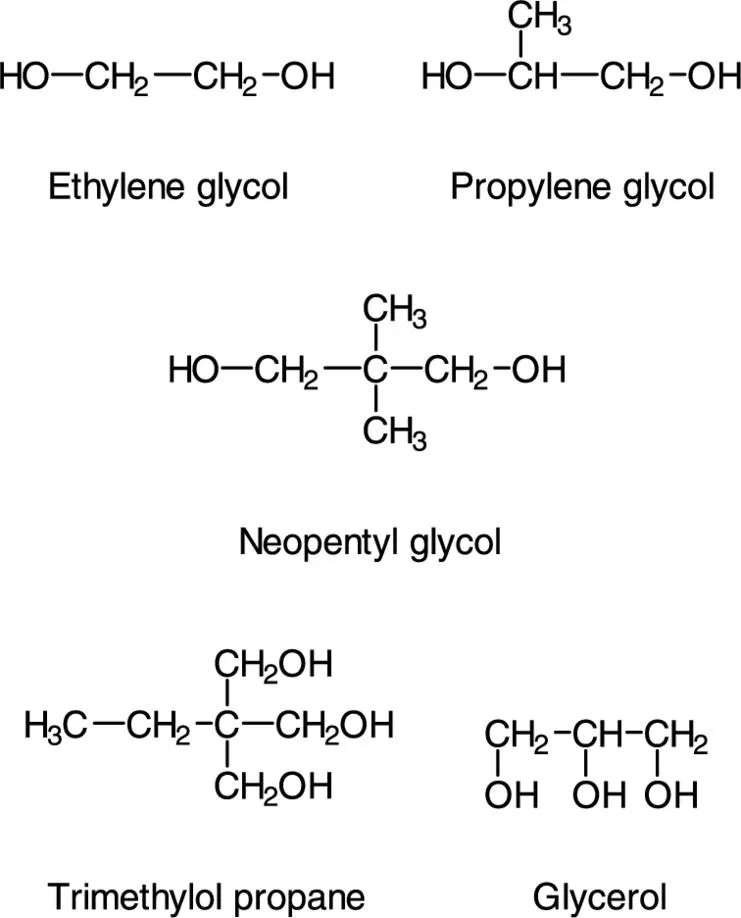
Figure 1.1 Diols and triols used for unsaturated polyester resins.
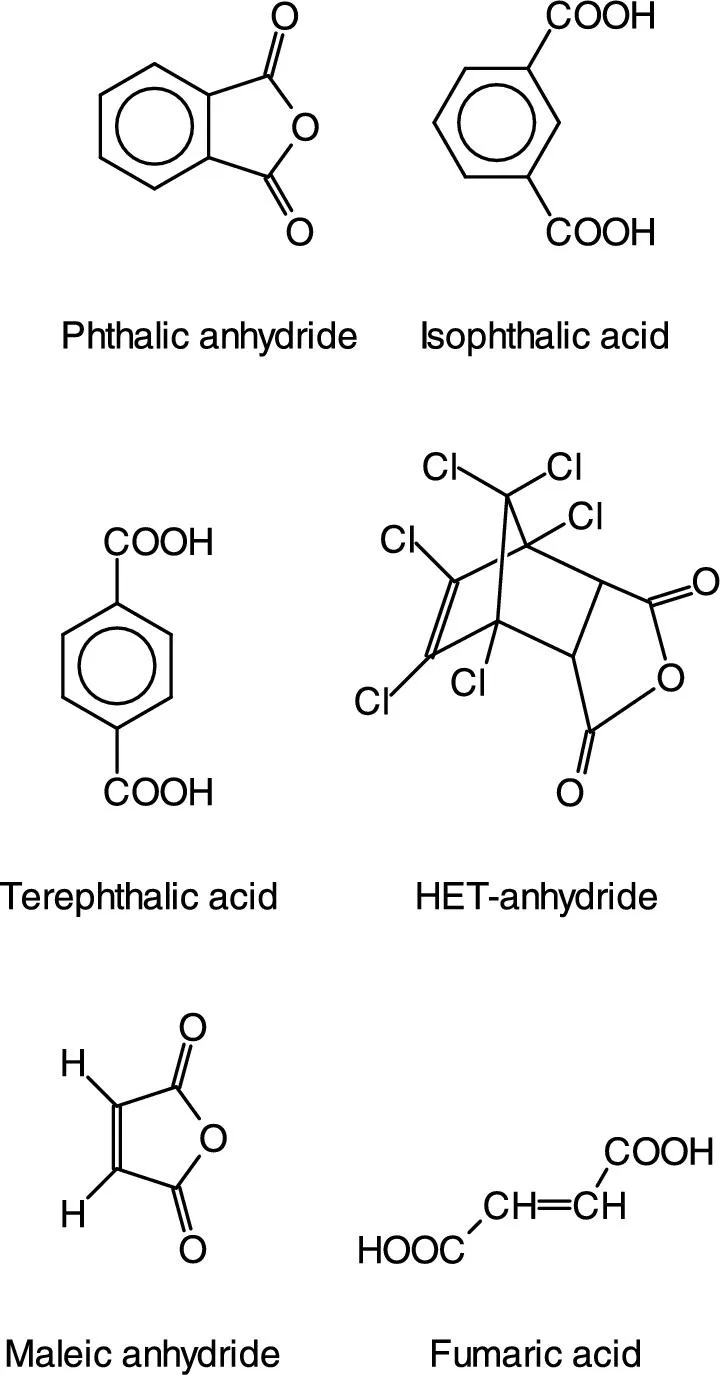
Figure 1.2 Acids and anhydrides used for unsaturated polyester resins.
1.2.1.1 Alcohol Components
The most common alcohol components are 1,2-propylene glycol and ethylene glycol (EG). Ether containing alcohols exhibit better air drying properties and are used in topcoats. Polyesters based on unsaturated diols can be prepared by the transesterification of diethyl adipate with unsaturated diols, e.g., cis-2-butene-1,4-diol, and 2-butyne-1,4-diol. The transesterification method is a suitable procedure for the preparation of unsaturated polyesters in comparison to the direct polycondensation [14]. cis-2-Butene-1,4-diol, the most available aliphatic unsaturated diol, has been used to produce some valuable polymers such as graftable unsaturated segmented poly(urethane)s and crosslinkable polyesters for medical purposes.
Chemically modified soybean oil is an inexpensive alternative candidate for unsaturated polyester (UP) compositions. In addition, when reinforced with natural fibers, these composites could yield comparable and adequate properties to common products. Acrylated epoxidized soybean oil or maleated acrylated epoxidized soybean oil can be used for the synthesis of a prepolymer that contains vinyl groups. These groups are then copolymerized with styrene, as common [15].
Isosorbide is referred to as a sugar diol because it is derived from D-glucose which ultimately is generated from starch [16]. Isosorbide can be included as a glycol into unsaturated polyesters using standard polyester synthetic techniques.
Formulations that are using an isosorbide-m...
Table of contents
- Cover image
- Title page
- Table of Contents
- Copyright
- Preface
- 1: Unsaturated Polyester Resins
- 2: Poly(urethane)s
- 3: Epoxy Resins
- 4: Phenol/Formaldehyde Resins
- 5: Urea/Formaldehyde Resins
- 6: Melamine Resins
- 7: Furan Resins
- 8: Silicones
- 9: Acrylic Resins
- 10: Cyanate Ester Resins
- 11: Bismaleimide Resins
- 12: Terpene Resins
- 13: Cyanoacrylates
- 14: Benzocyclobutene Resins
- 15: Reactive Extrusion
- 16: Compatibilization
- 17: Rheology Control
- 18: Grafting
- 19: Acrylic Dental Fillers
- 20: Toners
- Index
Trusted by 375,005 students
Access to over 1.5 million titles for a fair monthly price.
Study more efficiently using our study tools.
Frequently asked questions
Yes, you can cancel anytime from the Subscription tab in your account settings on the Perlego website. Your subscription will stay active until the end of your current billing period. Learn how to cancel your subscription
No, books cannot be downloaded as external files, such as PDFs, for use outside of Perlego. However, you can download books within the Perlego app for offline reading on mobile or tablet. Learn how to download books offline
Perlego offers two plans: Essential and Complete
- Essential is ideal for learners and professionals who enjoy exploring a wide range of subjects. Access the Essential Library with 800,000+ trusted titles and best-sellers across business, personal growth, and the humanities. Includes unlimited reading time and Standard Read Aloud voice.
- Complete: Perfect for advanced learners and researchers needing full, unrestricted access. Unlock 1.5M+ books across hundreds of subjects, including academic and specialized titles. The Complete Plan also includes advanced features like Premium Read Aloud and Research Assistant.
We are an online textbook subscription service, where you can get access to an entire online library for less than the price of a single book per month. With over 1.5 million books across 990+ topics, we’ve got you covered! Learn about our mission
Look out for the read-aloud symbol on your next book to see if you can listen to it. The read-aloud tool reads text aloud for you, highlighting the text as it is being read. You can pause it, speed it up and slow it down. Learn more about Read Aloud
Yes! You can use the Perlego app on both iOS and Android devices to read anytime, anywhere — even offline. Perfect for commutes or when you’re on the go.
Please note we cannot support devices running on iOS 13 and Android 7 or earlier. Learn more about using the app
Please note we cannot support devices running on iOS 13 and Android 7 or earlier. Learn more about using the app
Yes, you can access Reactive Polymers: Fundamentals and Applications by Johannes Karl Fink in PDF and/or ePUB format, as well as other popular books in Technology & Engineering & Materials Science. We have over 1.5 million books available in our catalogue for you to explore.