- 384 pages
- English
- ePUB (mobile friendly)
- Available on iOS & Android
eBook - ePub
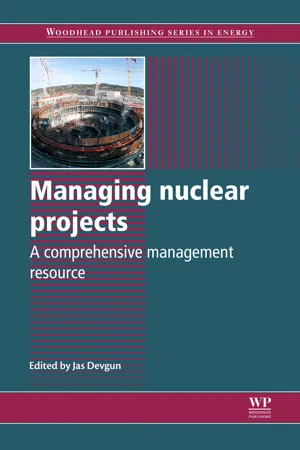
Managing Nuclear Projects
About this book
In addition to the nuclear power industry, the nuclear field has extensive projects and activities in the areas of research reactors, medical isotope production, decommissioning, and remediation of contaminated sites. Managing nuclear projects focuses on the management aspects of nuclear projects in a wide range of areas with emphasis on process, requirements, and lessons learned.Part one provides a general overview of the nuclear industry including basic principles for managing nuclear projects, nuclear safety culture, management of worker risk, training, and management of complex projects. Part two focuses on managing reactor projects with discussion on a variety of topics including management of research reactor projects, medical radioisotope production, power reactor modifications, power uprates, outage management, and management of nuclear-related R&D. Chapters in part three highlight the areas of radioactive waste and spent fuel management, reactor decommissioning, and remediation of radioactively contaminated sites. Finally, part four explores regulation, guidance and emergency management in the nuclear industry. Chapters discuss quality assurance and auditing programs, licensing procedures for nuclear installations, emergency preparedness, management of nuclear crises, and international nuclear cooperation.With its distinguished editor and contributors, Managing Nuclear Projects is a valuable resource for project managers, plant managers, engineers, regulators, training professionals, consultants, and academics.
- Examines the basic principles of managing nuclear projects focussing on processes and requirements
- Discusses the management of reactor projects
- Explores regulation, guidance and emergency management in the nuclear industry
Information
Part I
Basic principles
1
Basic principles for managing nuclear projects
J. Devgun, Senior Consultant, USA
Abstract:
This chapter focuses on the basic principles for managing nuclear projects in the commercial power industry. It discusses characteristics of the nuclear projects, key areas that a manager needs to know and basic steps for managing such projects. It also provides an overview of several relevant areas such as management of risk as well as lessons learned and future trends.
Key words
nuclear projects
nuclear accidents
radiation protection
nuclear safety culture
nuclear quality
construction technologies
1.1 Introduction
The nuclear industry is diverse and consists of many different fields. These include commercial nuclear power plants and electricity production, research reactors and nuclear R&D, nuclear instrumentation, nuclear medicine, defense applications, decommissioning of nuclear sites and remediation and cleanup of radioactive sites. Although some of the basic principles for managing nuclear projects are the same, special considerations will apply depending on the nature of the project, regulatory requirements in that area of application and the specific nature of the industry. The focus of this chapter is on the commercial nuclear power industry.
Nuclear energy currently provides about 13% of the world’s electricity. This share is likely to continue to grow as the energy demand worldwide continues to grow, even though, in the post-Fukushima era, nuclear expansion has slowed in many countries.
Energy demand continues to rise and in projections from the International Energy Agency (IEA) on the change in power generation from 2010 to 2035, the need for electricity in emerging economies drives a 70% increase in worldwide demand (IEA 2012). The nuclear share in the projections has been scaled back following the Fukushima accident and the IEA reduced the nuclear capacity projections in the World Energy Outlook (WEO) 2011, and then further reduced them in WEO 2012 from earlier projections in 2010. By 2035, the nuclear capacity is anticipated to rise to 580 GWe, approximately 55% more than the current capacity. The currently operating reactors (over 430 commercial power reactors in 31 countries) have a combined capacity of 372 GWe. The 104 reactors in the USA make it the largest fleet of commercial reactors in one country and provide about 20% of the electricity generation. Over 60 reactors are under construction in 13 countries, with major construction activity in China, South Korea, Russia and India.
Prior to the Fukushima Daiichi accident, the nuclear power industry had been in the early stages of a ‘renaissance’ and it had been estimated that anywhere from 60 to 130 new power reactors might be built worldwide over the next 20 years. The net effect of the Fukushima accident on the nuclear renaissance will not be known for some time, but it has slowed the momentum of the nuclear renaissance in the near term. However, the emerging economies, especially in Asia, are expected to continue with their nuclear expansion because of the limited fuel options for energy production and a substantial need for energy now and even greater need projected in the future.
Even though failures of some of the key site features at Fukushima can be attributed to events that in the past would have been considered as beyond the design basis, the industry as well as the regulatory authorities are analyzing what features, especially passive features, should be designed into the new reactor designs to minimize the potential for such failures. It is also recognized that since the design of the Fukushima BWR reactors where the first reactor was commissioned in 1971, many advanced safety features are already a part of the newer reactor designs.
Nuclear construction projects are large and complex projects requiring large-scale resources, technical expertise and experienced project management. Each of the operating reactors in the world have many projects ongoing at any time related to equipment replacement, system upgrades, modifications, regulatory-driven actions, power uprates or refueling. In addition, there are about 240 research reactors operating in 56 countries. Nuclear reactors are also used in ships and submarines. There are numerous projects in the nuclear-related facilities as well as in the reactor and facility decommissioning area. In the USA, in the Department of Energy (DOE) complex alone there are numerous large projects related to deactivation of nuclear facilities, decommissioning and site restoration. All across the nuclear industry there is specific emphasis on safety and management of risk.
1.2 Characteristics of nuclear projects
Nuclear projects are unique because of the presence of radioactivity and radioactive materials. Nuclear reactors use the atomic fission process and criticality to harness nuclear energy, and involve complex technologies to use this energy for electricity production. Some of the unique attributes of nuclear projects are discussed in Section 1.3.
The nuclear industry is highly regulated, and nuclear sites and projects are under constant scrutiny by regulators and the public. Public perception of nuclear risk and radiation risk creates more fear and concern and hence more public interest in anything nuclear. In addition, the presence of nuclear fuel also requires safeguards policies to be put in place.
Although commercial nuclear power has been around for over half a century, three major accidents (discussed in Section 1.2.1) have raised concerns and focused negative attention on the industry. Since the Chernobyl accident in 1986, specific attention has been directed towards the human performance aspects in the nuclear industry. The nuclear safety culture now at nuclear sites is very specific and rigorous. Nevertheless, the 2011 Fukushima accident showed that unanticipated natural events can occur and cause substantial damage to a facility with large-scale consequences. Major accidents have occurred in every industry with substantial consequences; however, the nuclear accidents have led to more long-lasting negative perceptions.
On a safety and performance basis, the industry has made very substantial progress over the past two decades to a point where the capacity factors for plants are much higher, refueling periods are shorter, significant events are fewer and worker safety incidents are minimized.
1.2.1 Impact of major commercial accidents on the industry
Three Mile Island
The accident at Three Mile Island Unit 2 (TMI-2) on 28 March 1979 started with the loss of main feedwater. Per published accounts the safety systems shut down the main turbine and actuated the emergency feedwater system. The emergency feedwater pumps failed to deliver water to the steam generators because two valves on emergency feedwater line were inadvertently left closed following maintenance. As the reactor coolant system (RCS) pressure and temperature rose, the pilot-operated pressure relief valve opened. However, the valve did not reset, remaining stuck in an open position during the plant transient, and the RCS pressure decreased to the point where the safety injection (SI) was automatically initiated. As those in the control room had no indication of the position (open or closed) of the relief valve, the operators assumed incorrectly (because of pressurizer level) that the core was covered with the coolant and they drastically reduced the replacement water flow. The steam void formed in the upper part of the reactor vessel led to uncovering of the fuel and partial meltdown of the core. At the time of the accident, the reactor had been in operational status for only 3 months, after being granted the operating license in 1978.
TMI-2 has been classified at Level 5 on the International Nuclear and Radiological Event Scale (INES). The accident was the worst accident in the commercial nuclear power industry in the USA, and led to reshaping of the industry through technical improvements in plant systems design and operator training as well as improvements in the regulatory oversight and emergency preparedness.
Chernobyl
The 26 April 1986 accident at Unit 4 of the Chernobyl plant (RBMK 1000 design, graphite-moderated) was the result of a beyond design basis test being conducted and a series of operator actions, including the disabling of automatic shutdown mechanisms, prior to the test. The operators prepared the reactor for the test on 25 April prior to a routine shutdown with the purpose of determining how long the turbines would spin and supply bridging power (until the emergency diesel generators were sequenced to start) to the main circulating pumps following loss of the main electrical power supply. Later investigations of the accident by the International Nuclear Safety Group (INSAG) of the International Atomic Energy Agency (IAEA) concluded ...
Table of contents
- Cover image
- Title page
- Table of Contents
- Copyright
- Dedication
- Contributor contact details
- Woodhead Publishing Series in Energy
- Preface
- Part I: Basic principles
- Part II: Managing reactor projects
- Part III: Managing radioactive waste, decommissioning and site remediation
- Part IV: Regulation, guidance and emergency management
- Index
Trusted by 375,005 students
Access to over 1.5 million titles for a fair monthly price.
Study more efficiently using our study tools.
Frequently asked questions
Yes, you can cancel anytime from the Subscription tab in your account settings on the Perlego website. Your subscription will stay active until the end of your current billing period. Learn how to cancel your subscription
No, books cannot be downloaded as external files, such as PDFs, for use outside of Perlego. However, you can download books within the Perlego app for offline reading on mobile or tablet. Learn how to download books offline
Perlego offers two plans: Essential and Complete
- Essential is ideal for learners and professionals who enjoy exploring a wide range of subjects. Access the Essential Library with 800,000+ trusted titles and best-sellers across business, personal growth, and the humanities. Includes unlimited reading time and Standard Read Aloud voice.
- Complete: Perfect for advanced learners and researchers needing full, unrestricted access. Unlock 1.5M+ books across hundreds of subjects, including academic and specialized titles. The Complete Plan also includes advanced features like Premium Read Aloud and Research Assistant.
We are an online textbook subscription service, where you can get access to an entire online library for less than the price of a single book per month. With over 1.5 million books across 990+ topics, we’ve got you covered! Learn about our mission
Look out for the read-aloud symbol on your next book to see if you can listen to it. The read-aloud tool reads text aloud for you, highlighting the text as it is being read. You can pause it, speed it up and slow it down. Learn more about Read Aloud
Yes! You can use the Perlego app on both iOS and Android devices to read anytime, anywhere — even offline. Perfect for commutes or when you’re on the go.
Please note we cannot support devices running on iOS 13 and Android 7 or earlier. Learn more about using the app
Please note we cannot support devices running on iOS 13 and Android 7 or earlier. Learn more about using the app
Yes, you can access Managing Nuclear Projects by Jas Devgun in PDF and/or ePUB format, as well as other popular books in Technology & Engineering & Mechanical Engineering. We have over 1.5 million books available in our catalogue for you to explore.