eBook - ePub
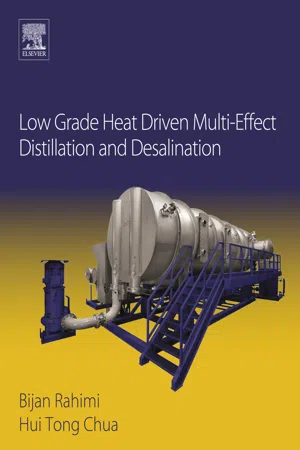
Low Grade Heat Driven Multi-Effect Distillation and Desalination
- 208 pages
- English
- ePUB (mobile friendly)
- Available on iOS & Android
eBook - ePub
Low Grade Heat Driven Multi-Effect Distillation and Desalination
About this book
Low Grade Heat Driven Multi-effect Distillation and Desalination describes the development of advanced multi-effect evaporation technologies that are driven by low grade sensible heat, including process waste heat in refineries, heat rejection from diesel generators or microturbines, and solar and geothermal energy. The technologies discussed can be applied to desalination in remote areas, purifying produced water in oil-and-gas industries, and to re-concentrate process liquor in refineries.
This book is ideal for researchers, engineering scientists, graduate students, and industrial practitioners working in the desalination, petrochemical, and mineral refining sectors, helping them further understand the technologies and opportunities that relate to their respective industries.
For researchers and graduate students, the core enabling ideas in the book will provide insights and open up new horizons in thermal engineering.
- Focuses on advanced, yet practical, distillation technologies using low-grade sensible heat
- Explains the new design paradigm that must accompany the development of technologies
- Contains key experimental data that serves to prove the core concepts that underpin the new technologies
- Covers extensive thermo-economic analyses of the technologies, the price point for adoption, capital cost comparison with existing technologies, operating costs, and net present values
Trusted by 375,005 students
Access to over 1.5 million titles for a fair monthly price.
Study more efficiently using our study tools.
Information
Chapter 1
Introduction to Desalination
Abstract
Desalination is the process of removing dissolved salts and minerals from saline water (such as seawater, brackish water, etc.). The main goal of the desalination process is to produce freshwater for the purpose of drinking, irrigation, or industrial usage. The other outcome of this process is brine (sometimes called concentrated feed or concentrate), which is mostly rejected to the environment in the case of seawater desalination application. In some industrial applications, such as mineral refineries, however, both the concentrate and freshwater production from the evaporation units are valuable and reusable in the process. In fact the concentrate can be more valuable than freshwater in those applications. This chapter briefly explains the history of desalination processes, the world's water shortage situation, and the importance of desalination processes to overcome this problem. The major types of desalination techniques and their pros and cons, the energy consumption, and the environmental impacts of desalination processes will also be explained in this chapter.
Keywords
Desalination; Desalination technologies; Energy consumption; Environmental impacts; Freshwater; History of desalination; Seawater
1.1. Introduction
Nearly 71% of the surface of the earth (510 × 106 km2) is covered by the oceans and the remaining 29% is covered by land [1]. There is certainly bountiful water available on earth, but only 3% is drinkable and 97% is saltwater [2]. Nearly 70% of this available freshwater is frozen in glaciers, while the remaining 30% is in underground hard-to-reach aquifers, of which approximately 0.25% flows into rivers and lakes for direct use [3]. Therefore, traditional sources of available freshwater such as underground aquifers and surface water constitute a limited quantity worldwide. Furthermore, depletion of these sources is increasing at an alarming rate [4].
Water scarcity is the mismatch of demand and availability of freshwater in a particular location. It has become a worldwide issue with the pollution of existing water supplies, increasing population and industry activity, uneven freshwater to population distributions, and changing rainfall patterns. This implies that many regions containing populated centers are becoming less capable of meeting the water supply requirements of the residing populations [3,5–7]. Water-stressed countries currently encompass one-third of the world's population and it is predicted to reach two-thirds by 2025 [8]. Aside from residential and industrial water shortage, agriculture is also being affected directly by water shortage. Farmers increasingly have to compete for water with urban residents and industries, thereby placing global food security at risk [9].
Methods of attenuating such water supply issues include wastewater treatment and reuse, desalination, as well as water conservation schemes. Some 80 countries face severe water shortage [10], while some countries such as Kuwait, the United Arab Emirates, and Saudi Arabia currently depend almost entirely on desalination for their supply of water [4].
As a result of these situations, seawater desalination has become an essential option to augment freshwater resources, especially in developing countries and many arid zones. As an example, in 2010 the Gulf Cooperation Council (GCC) countries (in the Middle East region) produce around 39% of the world's desalinated water production [11,12].
The desalination process is being increasingly adopted over traditional water supply methods because the cost per unit volume of water produced has come down for desalination while it has risen for traditional methods [4,7,13]. In 2011, approximately 150 countries worldwide used around 15,988 desalination plants (these include online, under construction, and contracted) to produce desalinated water [14]. The total global capacity of all online plants was 70.8 Mm3/day in 2011 [15]. This is a 10% increase compared to capacity in 2010. Also, 632 new plants were added from mid-2011 to August of 2012, thereby increasing the installed capacity to 74.8 Mm3/day [15]. As of June 30, 2015 the total number of desalination plants worldwide reached 18,426 with a total production rate exceeding 86.8 Mm3/day, which satisfied the need of around 300 million people around the world [16]. These data indicate the potential of the desalination market in both aspects of freshwater production rate and energy consumption.
1.2. A Brief History of Desalination
The word origin and history of desalination dates back to 1943, and as a verb, “desalt” was recorded in 1909 [17]. The concept of desalination is much older, however, with references to it being found in ancient writings [18]. Historically, salt has been held as a precious commodity. The first goal of desalination was not related to producing freshwater, but rather to extract and use the salt from salty water by means of natural evaporation [2].
It is difficult to pinpoint the first instance when humans desalinated salty water for freshwater, but Aristotle (384–322 BC) was one of the earliest recorded scientists who explained the desalination process. His understanding was based on his observations that when saltwater turns into vapor, the condensed vapor does not contain any salt [19]. At that time, the needs for producing freshwater for sailors was critical for long distance voyages. Ancient drawings depict sailors boiling seawater and suspending a large sponge from the mouth of a brass vessel to absorb what is evaporated [3]. Therefore, it is reasonable that the interest in desalination dates back as far as the 4th century BC.
Advanced technologies that mimic natural processes such as evaporation-condensation or osmosis to obtain freshwater from seawater, have been developed only in the modern decades. Basic desalination processes were used on naval ships from the 17th to 19th centuries. For example, in 1790, the US Secretary of State, Thomas Jefferson, received an offer to sell the government a seawater desalination scheme [2]. The first desalination units were eventually built for ships that were used to provide fresh boiler water, thereby removing the need to travel with cargo loads of water [18]. Years later, a British patent was granted in 1852 [20], and then in 1872 the first solar still was designed by a Swedish engineer, Carlos Wilson, and constructed in Chile [21]. In 1912, a 75 m3/day desalination plant was installed in Egypt [22]. The island of Curacao in the Netherlands Antilles was the first location to make a major ...
Table of contents
- Cover image
- Title page
- Table of Contents
- Copyright
- Dedication
- Biography
- Preface
- Chapter 1. Introduction to Desalination
- Chapter 2. Low Grade Sensible Heat-Driven Distillation
- Chapter 3. Boosted Multi-Effect Distillation Pilot Plant
- Chapter 4. Mathematical Simulation
- Chapter 5. Pumping Power Analysis
- Chapter 6. Waste Heat Performance Ratio
- Chapter 7. Thermo-Economic Analysis
- Chapter 8. Application of Novel Low Grade Heat-Driven Distillation to Seawater Desalination
- Chapter 9. Application of Novel Low Grade Heat-Driven Distillation in Alumina Refineries
- Appendix A. Seawater Enthalpy
- Appendix B. Boiling Point Elevation and Nonequilibrium Allowance
- Appendix C. Pressure Drop Across Plate Heat Exchangers
- Appendix D. Overall Heat Transfer Coefficient in Condenser and Falling Film Evaporators
- Appendix E. Plate Heat Exchanger Cost Estimation
- Appendix F. Plate Heat Exchanger Overall Heat Transfer Coefficient
- Appendix G. Excel Spreadsheet
- Nomenclature
- Index
Frequently asked questions
Yes, you can cancel anytime from the Subscription tab in your account settings on the Perlego website. Your subscription will stay active until the end of your current billing period. Learn how to cancel your subscription
No, books cannot be downloaded as external files, such as PDFs, for use outside of Perlego. However, you can download books within the Perlego app for offline reading on mobile or tablet. Learn how to download books offline
Perlego offers two plans: Essential and Complete
- Essential is ideal for learners and professionals who enjoy exploring a wide range of subjects. Access the Essential Library with 800,000+ trusted titles and best-sellers across business, personal growth, and the humanities. Includes unlimited reading time and Standard Read Aloud voice.
- Complete: Perfect for advanced learners and researchers needing full, unrestricted access. Unlock 1.5M+ books across hundreds of subjects, including academic and specialized titles. The Complete Plan also includes advanced features like Premium Read Aloud and Research Assistant.
We are an online textbook subscription service, where you can get access to an entire online library for less than the price of a single book per month. With over 1.5 million books across 990+ topics, we’ve got you covered! Learn about our mission
Look out for the read-aloud symbol on your next book to see if you can listen to it. The read-aloud tool reads text aloud for you, highlighting the text as it is being read. You can pause it, speed it up and slow it down. Learn more about Read Aloud
Yes! You can use the Perlego app on both iOS and Android devices to read anytime, anywhere — even offline. Perfect for commutes or when you’re on the go.
Please note we cannot support devices running on iOS 13 and Android 7 or earlier. Learn more about using the app
Please note we cannot support devices running on iOS 13 and Android 7 or earlier. Learn more about using the app
Yes, you can access Low Grade Heat Driven Multi-Effect Distillation and Desalination by Hui Tong Chua,Bijan Rahimi in PDF and/or ePUB format, as well as other popular books in Biological Sciences & Microbiology. We have over 1.5 million books available in our catalogue for you to explore.