eBook - ePub
Biological and Environmental Hazards, Risks, and Disasters
- 492 pages
- English
- ePUB (mobile friendly)
- Available on iOS & Android
eBook - ePub
Biological and Environmental Hazards, Risks, and Disasters
About this book
Biological and Environmental Hazards, Risks, and Disasters provides an integrated look at major impacts to the Earth's biosphere. Many of these are caused by diseases, algal blooms, insects, animals, species extinction, deforestation, land degradation, and comet and asteroid strikes that have important implications for humans.
This volume, from Elsevier's Hazards and Disasters Series, provides an in-depth view of threats, ranging from microscopic organisms to celestial objects. Perspectives from both natural and social sciences provide an in-depth understanding of potential impacts.
- Contributions from expert ecologists, environmental, biological, and agricultural scientists, and public health specialists selected by a world-renowned editorial board
- Presents the latest research on damages, causality, economic impacts, fatality rates, and preparedness and mitigation
- Contains tables, maps, diagrams, illustrations, and photographs of hazardous processes
Information
Chapter 1
Introduction to Biological and Environmental Hazards, Risks, and Disasters
Ramesh Sivanpillai Senior Research Scientist, Department of Botany | WyGISC, University of Wyoming, Laramie, WY, USA
The biotic components of Earth are connected by hierarchical, complex, and interconnected networks through which material and energy flow. Live cells are part of an organism, organisms are part of a population, populations are part of a community, communities are part of an ecosystem, ecosystems are part of a landscape, landscapes are part of a biome, and biomes are part of the entire biosphere. Ecologists study the components and processes at scales ranging from the physiology of small organisms to the carbon flow in the entire biosphere (Allen and Hoekstra, 1992). The structures and processes that are part of Earth's biosphere have evolved over several millions of years. When organisms are removed from their habitat or ecosystem, or introduced to a different ecosystem, alterations in the structure and processes occur, resulting in the disruption of stability of those ecosystems (Coztanza et al., 1992). Similarly, changes in abiotic components in ecosystems can alter the energy and material flows that occur within them. Any changes, minor or major, to the species composition or processes such as energy flow, pose risks and hazards to Earth's environment and its biotic components.
Accidental and intentional introduction of species to new ecosystems has resulted in adverse consequences. When modifications were made to the Welland Canal in the late 1800s and early 1900s to establish shipping connections between Lake Ontario and Lake Erie, sea lampreys (Petromyzon marinus) native to Atlantic Ocean entered the Great Lakes (Smith and Tibbles, 1980). This parasitic fish lacks a jaw, and sucks blood and other bodily fluids from host species (other fish) for its survival. Sea lamprey attacks do not kill their hosts in the Atlantic Ocean by virtue of millions of years of coevolution of host–parasite relationship, whereas the fish native to the Great Lakes did not have that evolutionary advantage. Sea lamprey populations exploded by the 1940s, and within the next two decades devastated native fish populations and the associated Great Lakes fishing industry (GLFC, http://www.glfc.org/sealamp/).
Similarly, Parthenium hysterophorus, a native plant of Northeast Mexico and endemic in America has spread to Africa, Australia, Asia, and Pacific Islands in the last 100 years. Known by various names, such as whitetop weed, ragweed, congress grass, and Santa Maria feverfew, Parthenium is classified as one of the world's seven most devastating and hazardous weeds (Patel, 2011). This weed is one of the most troublesome and noxious weeds in India. It has caused several health problems to humans and livestock (Kohli et al., 2006). Numerous examples of such biological invasions and their impacts have been reported from almost every continent.
Certain diseases that were once considered eradicated are reappearing in some parts of the world. The U.S. Centers for Disease Control and Prevention (CDC) lists several reemerging diseases including the deadly smallpox, yellow fever, and plague (CDC, 2015), and the prevalence of drug-resistant infections is listed as a major reason. The U.S. National Institutes of Health (NIH) has published a comprehensive list of reemerging diseases (NIH, 2012). With increased and faster global travel, diseases are spreading quicker and impacting greater numbers of people in multiple continents.
It is a formidable task to capture all hazards and risks associated with the myriad processes and components in their entirety in a single volume. Topics covered in this volume represent a few of the important risks and hazards that we face today. Earlier volumes published in this book series have captured the hazards, risks, and disasters associated with water, volcanoes, landslides, earthquakes, seas and oceans, snow and ice, and wildfires. This volume addresses several hazards, risks, and disasters that could be linked to other natural phenomena or human-made activities.
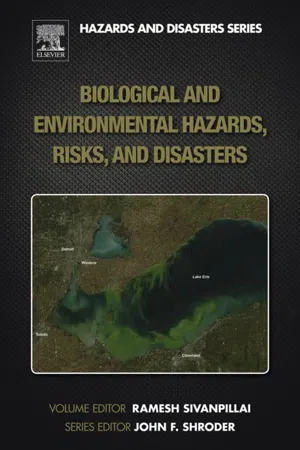
Chapters included in this volume deal with several important hazards and risks. The chapter on algal blooms (McGowan) identifies the sources of this major problem that has increased over the past 40 years, and the risks it poses humans and the environment. An overview of recent advances in the monitoring and detection of algal blooms in addition to forecasting and treating them is included.
The next five chapters deal with risks, hazards, and disasters associated with insects or the impact of changes at their population level. Grasshoppers pose hazards to agriculture, illustrated by Schell using examples from western North America. Locusts, when they form swarms consisting of millions of individuals, can wipe out crops and vegetation across large geographic areas. Their impact on agriculture and vegetation in Australia, Africa, and Western Asia along with the treatment measures adopted by various national and international agencies are described under three units (Lockwood, Adriaansen et al., and Cressman) in the following chapter. This is followed by chapters on the risks and potential disasters associated with declining bee population on food production (Carreck), the impact of surging bark beetle populations on North American forests (Hyde et al.), and risks associated with the release of natural enemies to tackle invasive weeds (Cuda).
Human–animal interactions have been either mutually beneficial or at times hazardous to humans. Cavin and Butler provide an overview of animal hazards including zoonotic diseases and techniques used for mitigating those hazards. Species extinction and their impact on biodiversity is described in the next essay (May).
Causes of environmental chronic diseases (Beyer) are examined next, along with responses to major disease outbreaks from different parts of the world. Insights are provided for intervening and preparing to reduce future burdens.
Land degradation and subsequent reduction in soil fertility poses a major risk to the entire human population. Following an overview (D'Odorico and Ravi), three units provide an in-depth analysis of the environmental risks associated with desertification (Oswald and Harris) and degradation of grassland (Wick et al.) and rangeland (Jay Angerer et al.) ecosystems.
Deforestation is a worldwide phenomenon driven by various causes in different parts. Following an overview (Houghton), three units highlight the causes and impact on deforestation in Southeast Asia (Turner and Snaddon), Nepal (Chaudhary), and Latin America (Boekhout van Solinge). Impacts of climate changes (Malanson) on species and ecosystems are described in the next chapter. Risks and threats posed by potential meteoroid and asteroid impacting the Earth are described in the final chapter (De Hon). Topics described in this book address several important biological and environmental risks and hazards that humanity faces today.
Chapter 2
Algal Blooms
Suzanne McGowan School of Geography, University Park, University of Nottingham, Nottingham, UK School of Geography, Malaysia Campus, University of Nottingham, Semenyih, Selangor Darul Ehsan, Malaysia
Abstract
Harmful algal blooms (HABs) in marine, brackish, and freshwater environments are caused by a broad range of microscopic algae and cyanobacteria. HABs are hazardous and sometimes fatal to human and animal populations, either through toxicity, or by creating ecological conditions, such as oxygen depletion, which can kill fish and other economically or ecologically important organisms. HAB hazards have increased globally over the past 40 years, because of eutrophication, translocation of exotic species via global shipping routes, climate-driven range expansions, and altered physical o...
Table of contents
- Cover image
- Title page
- Table of Contents
- Copyright
- Dedication
- Title and Description of the Cover Image
- Contributors
- Editorial Foreword
- Acknowledgments
- List of Reviewers
- Chapter 1. Introduction to Biological and Environmental Hazards, Risks, and Disasters
- Chapter 2. Algal Blooms
- Chapter 3. Large-Scale Grasshopper Infestations on North American Rangeland and Crops
- Chapter 4. Locusts: An Introduction
- Chapter 4.1. The Australian Plague Locust—Risk and Response
- Chapter 4.2. Desert Locust
- Chapter 4.3. Other Locusts
- Chapter 5. Decline of Bees and Other Pollinators
- Chapter 6. Bark Beetle-Induced Forest Mortality in the North American Rocky Mountains
- Chapter 7. Novel Approaches for Reversible Field Releases of Candidate Weed Biological Control Agents: Putting the Genie Back into the Bottle
- Chapter 8. Animal Hazards—Their Nature and Distribution
- Chapter 9. Loss of Biodiversity: Concerns and Threats
- Chapter 10. Chronic Environmental Diseases: Burdens, Causes, and Response
- Chapter 11. Land Degradation and Environmental Change
- Chapter 11.1. Desertification
- Chapter 11.2. Grassland Degradation
- Chapter 11.3. Land Degradation in Rangeland Ecosystems
- Chapter 12. Deforestation
- Chapter 12.1. Deforestation in Southeast Asia
- Chapter 12.2. Deforestation in Nepal: Causes, Consequences, and Responses
- Chapter 12.3. Deforestation in the Brazilian Amazon
- Chapter 13. Ecological Impacts of Climate Change
- Chapter 14. Meteor Impact Hazard
- Index
Trusted by 375,005 students
Access to over 1.5 million titles for a fair monthly price.
Study more efficiently using our study tools.
Frequently asked questions
Yes, you can cancel anytime from the Subscription tab in your account settings on the Perlego website. Your subscription will stay active until the end of your current billing period. Learn how to cancel your subscription
No, books cannot be downloaded as external files, such as PDFs, for use outside of Perlego. However, you can download books within the Perlego app for offline reading on mobile or tablet. Learn how to download books offline
Perlego offers two plans: Essential and Complete
- Essential is ideal for learners and professionals who enjoy exploring a wide range of subjects. Access the Essential Library with 800,000+ trusted titles and best-sellers across business, personal growth, and the humanities. Includes unlimited reading time and Standard Read Aloud voice.
- Complete: Perfect for advanced learners and researchers needing full, unrestricted access. Unlock 1.5M+ books across hundreds of subjects, including academic and specialized titles. The Complete Plan also includes advanced features like Premium Read Aloud and Research Assistant.
We are an online textbook subscription service, where you can get access to an entire online library for less than the price of a single book per month. With over 1.5 million books across 990+ topics, we’ve got you covered! Learn about our mission
Look out for the read-aloud symbol on your next book to see if you can listen to it. The read-aloud tool reads text aloud for you, highlighting the text as it is being read. You can pause it, speed it up and slow it down. Learn more about Read Aloud
Yes! You can use the Perlego app on both iOS and Android devices to read anytime, anywhere — even offline. Perfect for commutes or when you’re on the go.
Please note we cannot support devices running on iOS 13 and Android 7 or earlier. Learn more about using the app
Please note we cannot support devices running on iOS 13 and Android 7 or earlier. Learn more about using the app
Yes, you can access Biological and Environmental Hazards, Risks, and Disasters by Ramesh Sivanpillai, John F. Shroder in PDF and/or ePUB format, as well as other popular books in Physical Sciences & Geography. We have over 1.5 million books available in our catalogue for you to explore.