- 232 pages
- English
- ePUB (mobile friendly)
- Available on iOS & Android
eBook - ePub
About this book
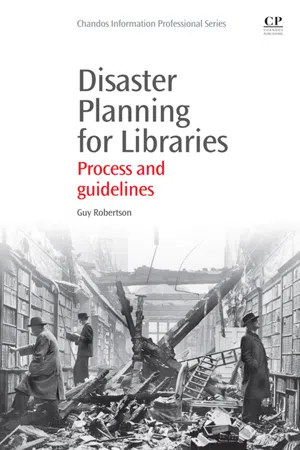
Libraries are constantly at risk. Every day, many libraries and their collections are damaged by fire, flooding, high winds, power outages, and criminal behaviour. Every library needs a plan to protect its staff, sites and collections, including yours. Disaster Planning for Libraries provides a practical guide to developing a comprehensive plan for any library. Twelve chapters cover essential areas of plan development; these include an overview of the risks faced by libraries, disaster preparedness and responding to disasters, resuming operations after a disaster and assessing damage, declaring disaster and managing a crisis, cleaning up and management after a disaster and normalizing relations, staff training, testing disaster plans, and the in-house planning champion.
- Provides a practical approach to developing a comprehensive plan for any library, big or small
- Supplements technical information with interviews and case studies
- Includes appendices covering pandemic management, moisture control, and library security
Information
Print ISBN
9781843347309
Subtopic
Global Development Studies1
Libraries and risk
Abstract
Risk is a constant feature of life. Librarians have often relied on others – including first responders, public health authorities and consultants – to help them prepare for and respond to risk. Many libraries lack effective disaster plans, which should cover the broad spectrum of risks: natural, technological, human-caused, proximity, security and enterprise. Human nature, exemplified by apathy, carelessness and inattention, can hinder planning efforts.
Keywords
risk
perils
risk management
risk profile
natural risks
technological risks
human-caused risks
security risks
proximity risks
enterprise risks
1.1. The prevalence of risk
Risk pervades life.
Everywhere, and at all times, you live under threat from numerous perils. Fortunately you have the time and opportunity to prepare for whatever might happen, and you possess the intelligence with which to mitigate risk. Working against you, however, is human nature, which includes apathy, stubbornness, irrationality and narrowness of perception: traits that hinder effective disaster planning in any organization.
Librarians are no more inclined than people in other professions to plan for and respond to disasters. Librarians are seldom trained in risk assessment and management, and in many cases have relied on others – police, firefighters, municipal planners, insurers, public health authorities and consultants – to prepare them for and occasionally save them from fire, flooding, severe weather, criminal activities and other negative events. But even when external bodies offer assistance and good advice, many librarians have not availed themselves of these things. There are numerous other tasks to complete. The adult services coordinator and her staff are busy weeding the fiction collection; the children’s librarians are struggling with the summer reading programme; the technical services department has what appears to be an insurmountable cataloguing backlog; the branch clerical staff is having difficulty handling an increase in borrowing and returns; and the head librarian is engaged full time in persuading the city council and library board not to cut the budget. There are few library employees who have time to devote to disaster planning. Moreover, many employees admit that they find planning and any training associated with it to be onerous and dull.
Thus it is no surprise that so many libraries lack effective disaster plans. In fact, library employees at all levels are often oblivious to the most conspicuous threats to their personal safety and operations. The reason is simple. Whereas daily routines involve the frequent repetition of activities, and ordinary problems and their solutions present themselves with dependable regularity, disasters are infrequent. Decades might pass between fires and floods; such disasters might never occur at most sites.
Because risk so infrequently turns into actual threats, you might take your safety and security for granted. The infrequency of emergencies and disasters can lull you into apathy. If deadly pandemics and fires and terrorist attacks are so unlikely and rare, why should you bother to take precautions against them? Are not the chances of such things happening slim? Why waste time, money and other resources to protect yourself from something that will probably never happen?
These are good questions. The answer is twofold. First, if risk never turns into actual threats, and you are never faced with an emergency or disaster, you may celebrate your good luck. At least you have demonstrated good sense and responsible custodianship by preparing for the worst, which is constantly possible. After all, you are unable to predict the future with absolute certainty, so you were prudent to acknowledge the possibility of nasty surprises.
But, second, if the risk of a fire turns into a real conflagration that engulfs your main branch, then you were equally sensible to have a plan to deal with the loss – temporary or permanent – of that branch building, the loss of the offices, collections, and other assets that it contained, and the displacement of the employees who occupied it. There might be those who criticize you for developing disaster plans, and who suggest that you are ‘alarmist’ or ‘Chicken Little’. You need patience and determination to deal with such criticism as a matter of course, and to proceed with the development of your plan. The first step in the planning process is to identify your library’s risk profile, that is, the spectrum of risks that prevail at your site or sites.
The following sections describe different kinds of risks that all planners must take into account.
1.2. Natural risks
‘California means earthquakes’, says a public librarian from Los Angeles. ‘Florida means hurricanes. Anywhere near the Mississippi River means floods. In America, nature is brutal.’
In fact, nature is no gentler anywhere else on earth. A large landmass such as the continental US has a long list of prevailing natural risks, but every square inch of the planet is exposed to a list similar in length, and always has been. There is no point in attempting to find a site that is unaffected by the forces of nature. Rather, it is best to identify whatever natural risks prevail, and to prepare for them accordingly. Among the most common are:
• Flooding and water ingress. Any library site near a river, lake, harbour or other natural body of water is at risk from flooding. Even a small local pond can break its banks and flood neighbouring sites. Water ingress – defined as seepage of water into a building – can also occur through an open window, a leaky roof, a clogged drain or a sewer back-up. Some regions have dealt with high levels of precipitation for millennia; others have only recently begun to see it owing to changing weather patterns. There is much anecdotal evidence to indicate that flooding and water ingress cause more damage to libraries than any other risk. ‘Water in the wrong place’ could also be the consequence of technological, proximity and security risks.
• Fire, smoke and fumes. Naturally occurring fires threaten any library situated near forests and other wooded areas. Any vegetation – including farmers’ crops, gardens in urban parks and tumbleweed – can burn and lead to damage. Smoke and fumes can pose a serious risk not only to employees but also to fragile IT equipment. Fire, smoke, fumes and explosions could also be consequences of technological, proximity and security risks.
• Severe weather. Any weather event that becomes extreme can be defined as severe. Winter storms, thunderstorms, high winds and heatwaves are common examples. Note that natural risks often overlap. Thunderstorms can involve lightning, which can cause fires. Winter storms can cause flooding and water ingress. High winds can damage roofs, and lead to water ingress. Heatwaves can result in fires. You must guard against secondary risks, which can cause more damage than the risks that give rise to them. All natural risks have secondary risks.
• Earthquakes. Among the most frightening natural phenomena, earthquakes can occur anywhere on earth, but are far more likely to strike regions identified as seismic zones. These include countries around the Pacific Rim, and particularly China, Japan, Indonesia, Canada, the US, Mexico and Chile. Mediterranean countries such as Italy, Greece and Turkey have a long history of devastating earthquakes. Seismologists cannot predict the occurrence of earthquakes with any accuracy. Library buildings and heavy furniture – including shelving systems – are particularly at risk from earthquakes.
• Tsunamis. These earthquake-generated sea waves move at high speed and can destroy coastal cities and their outlying communities. They can cause large numbers of fatalities and enormous property damage. Like earthquakes, tsunamis can wipe out not only a region’s libraries, but its entire information infrastructure, including archives and records centres, schools and post-secondary institutions, and information technology in public and private locations.
• Landslides and avalanches. Such natural phenomena occur most often in mountainous regions, although any natural slope – for example, a hillside in an urban park or along a suburban road – can be the site of a landslide or avalanche. Geotechnical engineers note the possibility of different kinds of landslides, including rockslides, landslips, mudslides and debris torrents. These could cut off libraries and their communities from neighbouring areas, and disrupt schedules and routines.
• Pests. Some insects and various other kinds of wildlife can become a pest in or around a library. The most common are silverfish, cockroaches and bedbugs; rodents such as rats and mice; and pigeons. These pests can infest and damage library materials. They are also signs of poor sanitation. Bedbugs can bite human beings, and rats can spread disease, but pests are rarely life-threatening unless they take the form of the poisonous snakes that congregated near the entrance of a school library in Kenya, or in the corners of a library parking lot in Arizona. Bears and mountain lions have been sighted near Western Canadian libraries. Cobras and scorpions have ‘made nuisances of themselves near libraries’, according to a rural school librarian in southern India.
Less common but still necessary to note for planning purposes in many libraries are:
• Pandemics. The last serious pandemic that caused high levels of f...
Table of contents
- Cover
- Title page
- Table of Contents
- Copyright
- Dedication
- Acknowledgments
- Preface
- A note on terminology
- How to use this book
- About the author
- 1: Libraries and risk
- 2: Preparedness
- 3: Disaster response
- 4: Operational resumption, continuity and recovery
- 5: Damage assessment
- 6: Disaster recognition, declaration procedures and crisis management
- 7: Strategic alliances
- 8: Post-disaster management of patrons
- 9: Normalization of operations
- 10: Orientation and training programmes
- 11: Basic tabletop exercises
- 12: Process and results
- Further reading
- Appendix One: Lancaster Gate Public Library Crisis Management Plan
- Appendix Two: Pandemic Management Program
- Appendix Three: Main Library and Branch Post-Disaster Security Plan
- Appendix Four: Lancaster Gate Public Library
- Appendix Five: Main Library and Branch Post-Disaster Staff Allocation Plan
- Appendix Six: Information Technology Disaster Recovery Plan
- Index
Trusted by 375,005 students
Access to over 1.5 million titles for a fair monthly price.
Study more efficiently using our study tools.
Frequently asked questions
Yes, you can cancel anytime from the Subscription tab in your account settings on the Perlego website. Your subscription will stay active until the end of your current billing period. Learn how to cancel your subscription
No, books cannot be downloaded as external files, such as PDFs, for use outside of Perlego. However, you can download books within the Perlego app for offline reading on mobile or tablet. Learn how to download books offline
Perlego offers two plans: Essential and Complete
- Essential is ideal for learners and professionals who enjoy exploring a wide range of subjects. Access the Essential Library with 800,000+ trusted titles and best-sellers across business, personal growth, and the humanities. Includes unlimited reading time and Standard Read Aloud voice.
- Complete: Perfect for advanced learners and researchers needing full, unrestricted access. Unlock 1.5M+ books across hundreds of subjects, including academic and specialized titles. The Complete Plan also includes advanced features like Premium Read Aloud and Research Assistant.
We are an online textbook subscription service, where you can get access to an entire online library for less than the price of a single book per month. With over 1.5 million books across 990+ topics, we’ve got you covered! Learn about our mission
Look out for the read-aloud symbol on your next book to see if you can listen to it. The read-aloud tool reads text aloud for you, highlighting the text as it is being read. You can pause it, speed it up and slow it down. Learn more about Read Aloud
Yes! You can use the Perlego app on both iOS and Android devices to read anytime, anywhere — even offline. Perfect for commutes or when you’re on the go.
Please note we cannot support devices running on iOS 13 and Android 7 or earlier. Learn more about using the app
Please note we cannot support devices running on iOS 13 and Android 7 or earlier. Learn more about using the app
Yes, you can access Disaster Planning for Libraries by Guy Robertson in PDF and/or ePUB format. We have over 1.5 million books available in our catalogue for you to explore.