- 384 pages
- English
- ePUB (mobile friendly)
- Available on iOS & Android
eBook - ePub
Military Textiles
About this book
Textiles for military uniforms face a complex set of challenges. They must provide protection, durability and comfort in a wide range of hostile environments. Military textiles reviews the range of recent research on how military clothing can best meet soldiers' needs.The first part of the book reviews general requirements of military textiles, including damage resistance, comfort, sweat management, cold-weather conditions and the integration of high-tech materials into uniforms. Part II concentrates on the protective role of military textiles, covering such areas as high-performance ballistic fibres, textiles for chemical and biological protection, camouflage materials and military fabrics for flame protection. The book also reviews the use of non-woven fabrics and new coatings for military applications.With its distinguished editor and international team of contributors, Military textiles is a valuable reference for those researching and manufacturing military textiles, as well as those interested in the wider area of textiles for protection.
- Reviews the range of recent research on how military clothing can best meet soldier's needs
- Examines damage resistance, sweat management and comfort
- Discusses the protective role of military textiles
Information
Part I
General requirements for military textiles
1
Future soldier requirements: Dealing with complexity
E. Sparks Cranfield University, UK
1.1 Introduction
Underpinning the development of military textiles and the use of these textiles in creating soldier clothing and equipment, are requirements providing performance measurements against which success is determined (Sommerville and Sawyer, 1997). Requirements form part of the discipline of systems engineering, which is concerned with the management of complexity, the behaviour that is exhibited when elements have a high number of inter-relationships or dependencies. But why are future soldier requirements complex, and what relationship do the requirements have to military textiles and the creation of soldier clothing and equipment? The latter question is the driver for future research as well as the creation of physical concept demonstrators. Collections of requirements form the basis of specifications for clothing and/or equipment and provide industry with a blueprint against which they design and test textiles; these in turn are manufactured into clothing and equipment which is again tested for suitability.
The question of complexity is demonstrated in Fig. 1.1, which diagrammatically represents the many facets that must be thought about when considering future soldier requirements. It is in no way complete, with the ability to add far greater fidelity using subsequent iterations. It does, however, serve the purpose of highlighting the inherent complexity of the activity, with dependencies between elements that may be outside our control, but may impact overall success (Stevens et al., 1998). Therefore, the title of ‘Future soldier requirements: Dealing with complexity’ recognises that many factors must be considered when making decisions about the best mix of clothing and equipment with which to supply the soldier, and that making these may require consideration of parameters that are outside our direct control because of the critical relationships that exist with other entities.
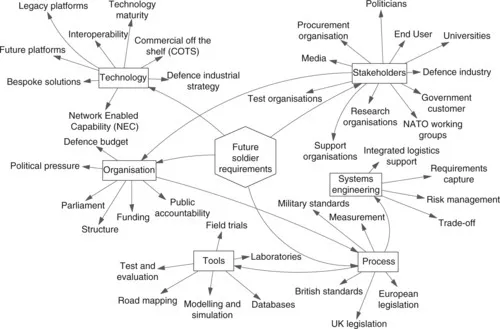
1.1 Future soldier requirements.
Figure 1.1 provides broad categories/areas of interest that will be revisited in later discussions to address future soldier requirements. They include stakeholders, process, organisation, technology and tools. All of these form components of systems engineering, which provides applied theory for dealing with systems from conception through to design and disposal, or from ‘cradle to grave’ (Forsberg and Mooz, 1992).
The adoption of this discipline within UK defence has come as a result of the Strategic Defence Review (HM Stationary Office, 1998), commissioned by Government to investigate time and cost overruns for management of defence procurement projects. This was also an opportunity to assess UK procurement processes and the types and quantities of military platforms required in the light of significant changes to the threats and theatres of operation post Cold War (Armstrong and Goldstein, 1990). The outcome was a realisation that greater flexibility and adaptability were required, moving from the traditional procurement of specific pieces of equipment to the term ‘capability’, bringing about effect to prosecute defence aims. Capability includes wider service-related issues, such as logistics, doctrine and manpower, as well as equipment. It represented a step change in business and a required process to support it, leading to the introduction of systems engineering (Controller and Auditor General, 2003). Optimisation of individual systems became no longer acceptable; the new age was about things working together towards a common aim, capitalising on synergy and underpinning the new manoeuvrist approach to warfare.
The following sections define the drivers for this change and then focus specifically on the soldier and the complexity associated with derivation of future requirements for clothing and equipment. Principles from the domain of systems thinking and systems engineering are utilised within the discussion but are not explicitly introduced on the grounds that they are sufficiently intuitive to provide benefit to the reader without necessitating specialist knowledge. In all instances, discussion is primarily focused from a UK perspective.
1.2 The current and future challenges faced by the soldier
The domain of defence is changing, partly as a consequence of the wider environment (finance, society and politics) but also due to shifting threats and changes in strategic level military doctrine. Uncertainty in the geographic location of the ‘front line’, and the nature of operations that we may be engaged in and with whom, present significant challenges, not only to the Armed Forces but also to the developers and researchers supporting equipment procurement. Buzz words for 21st century warfare include ‘integrated’, ‘high-tempo’, ‘combined’, ‘joint’, ‘multi-national’, ‘inter-agency’ and ‘full spectrum’. Effectiveness is expected to be increased with the ‘ability to move at short notice and with endurance, adapting through a seamless spectrum of conflict prevention, conflict and post-conflict activities’ (Director Infantry, 2000). Information superiority through Network Enabled Capability (NEC) will provide near real-time data from the sensor to shooter, supporting prosecution of high-level defence aims, protecting UK interests (Secretary of State for Defence, 2005). When distilled, these statements recognise a number of key factors that can be summarised as follows:
• We need our equipment to work more effectively together due to a greatly increased number of commitments at geographically dispersed locations.
• We are unlikely to deploy on large-scale operations on our own, meaning that our forces and their equipment must be capable of working with other nations.
• We need to exploit technological advancement rapidly with flexible, adaptable systems in order to counter agile adversaries with unorthodox doctrine.
• We need to ensure better value for money to counter years of time and cost overruns with equipment that has failed to meet stakeholder requirements.
This significant shift in future vision, and delivery of this vision, has come as a result of the Strategic Defence Review conducted in 1998, which offered an opportunity to look at the entire defence procurement situa...
Table of contents
- Cover image
- Title page
- Table of Contents
- Copyright page
- Contributor contact details
- Woodhead Publishing in Textiles
- Dedication
- Introduction
- Part I: General requirements for military textiles
- Part II: Protection
- Index
Trusted by 375,005 students
Access to over 1.5 million titles for a fair monthly price.
Study more efficiently using our study tools.
Frequently asked questions
Yes, you can cancel anytime from the Subscription tab in your account settings on the Perlego website. Your subscription will stay active until the end of your current billing period. Learn how to cancel your subscription
No, books cannot be downloaded as external files, such as PDFs, for use outside of Perlego. However, you can download books within the Perlego app for offline reading on mobile or tablet. Learn how to download books offline
Perlego offers two plans: Essential and Complete
- Essential is ideal for learners and professionals who enjoy exploring a wide range of subjects. Access the Essential Library with 800,000+ trusted titles and best-sellers across business, personal growth, and the humanities. Includes unlimited reading time and Standard Read Aloud voice.
- Complete: Perfect for advanced learners and researchers needing full, unrestricted access. Unlock 1.5M+ books across hundreds of subjects, including academic and specialized titles. The Complete Plan also includes advanced features like Premium Read Aloud and Research Assistant.
We are an online textbook subscription service, where you can get access to an entire online library for less than the price of a single book per month. With over 1.5 million books across 990+ topics, we’ve got you covered! Learn about our mission
Look out for the read-aloud symbol on your next book to see if you can listen to it. The read-aloud tool reads text aloud for you, highlighting the text as it is being read. You can pause it, speed it up and slow it down. Learn more about Read Aloud
Yes! You can use the Perlego app on both iOS and Android devices to read anytime, anywhere — even offline. Perfect for commutes or when you’re on the go.
Please note we cannot support devices running on iOS 13 and Android 7 or earlier. Learn more about using the app
Please note we cannot support devices running on iOS 13 and Android 7 or earlier. Learn more about using the app
Yes, you can access Military Textiles by E. Wilusz in PDF and/or ePUB format, as well as other popular books in Technology & Engineering & Materials Science. We have over 1.5 million books available in our catalogue for you to explore.