- 496 pages
- English
- ePUB (mobile friendly)
- Available on iOS & Android
eBook - ePub
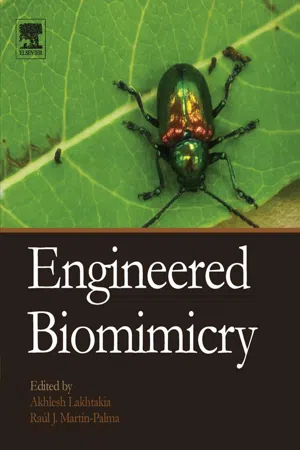
Engineered Biomimicry
About this book
Engineered Biomimicry covers a broad range of research topics in the emerging discipline of biomimicry. Biologically inspired science and technology, using the principles of math and physics, has led to the development of products as ubiquitous as Velcro™ (modeled after the spiny hooks on plant seeds and fruits). Readers will learn to take ideas and concepts like this from nature, implement them in research, and understand and explain diverse phenomena and their related functions. From bioinspired computing and medical products to biomimetic applications like artificial muscles, MEMS, textiles and vision sensors, Engineered Biomimicry explores a wide range of technologies informed by living natural systems.
Engineered Biomimicry helps physicists, engineers and material scientists seek solutions in nature to the most pressing technical problems of our times, while providing a solid understanding of the important role of biophysics. Some physical applications include adhesion superhydrophobicity and self-cleaning, structural coloration, photonic devices, biomaterials and composite materials, sensor systems, robotics and locomotion, and ultra-lightweight structures.
- Explores biomimicry, a fast-growing, cross-disciplinary field in which researchers study biological activities in nature to make critical advancements in science and engineering
- Introduces bioinspiration, biomimetics, and bioreplication, and provides biological background and practical applications for each
- Cutting-edge topics include bio-inspired robotics, microflyers, surface modification and more
Information
Chapter 1
Biomimetic Vision Sensors
Cameron H.G. Wright and Steven F. Barrett, Department of Electrical and Computer Engineering, University of Wyoming, Laramie, WY 82071, USA
Prospectus
This chapter is focused on vision sensors based on both mammalian and insect vision systems. Typically, the former uses a single large-aperture lens system and a large, high-resolution focal plane array; the latter uses many small-aperture lenses, each coupled to a small group of photodetectors. The strengths and weaknesses of each type of design are discussed, along with some guidelines for designing such sensors. A brief review of basic optical engineering, including simple diffraction theory and mathematical tools such as Fourier optics, is followed by a demonstration of how to match an optical system to some collection of photodetectors. Modeling and simulations performed with tools such as Zemax and MATLAB® are described for better understanding of both optical and neural aspects of biological vision systems and how they may be adapted to an artificial vision sensor. A biomimetic vision system based on the common housefly, Musca domestica, is discussed.
Keywords
Apposition; biomimetic; camera eye; compound eye; fly eye; hyperacuity; lateral inhibition; light adaptation; mammal eye; motion detection; multi-aperture; multiple aperture; neural superposition; optical flow; optical superposition; photoreceptor; retina; single aperture; vision sensor
1.1 Introduction
Biomimetic vision sensors are usually defined as imaging sensors that make practical use of what we have learned about animal vision systems. This approach should encompass more than just the study of animal eyes, because, along with the early neural layers, neural interconnects, and certain parts of the animal brain itself, eyes form a closely integrated vision system [1-3]. Thus, it is inadvisable to concentrate only on the eyes in trying to design a good biomimetic vision sensor; a systems approach is recommended [4].
This chapter concentrates on the two most frequently mimicked types of animal vision systems: ones that are based on a mammalian camera eye and ones that are based on an insect compound eye. The camera eye typically uses a single large-aperture lens or lens system with a relatively large, high-resolution focal plane array of photodetectors. This is similar to the eye of humans and other mammals and has long been mimicked for the basic design of both still and video cameras [1, 3, 5]. The compound eye instead uses many small-aperture lenses, each coupled to a small group of photodetectors. This is the type of eye found in insects in nature and has only recently been mimicked for use as alternative vision sensors [1, 3, 5]. However, knowledge of the optics and sensing in a camera eye is very helpful in understanding many aspects of the compound eye.
Using just two categories—camera eyes and compound eyes—can be somewhat oversimplified. Land and Nilsson describe at least 10 different ways in which animal eyes form a spatial image [1]. Different animals ended up with different eyes due to variations in the evolutionary pressures they faced, and it is believed that eyes independently evolved more than once [1]. Despite this history, the animal eyes we observe today have many similar characteristics. For example, a single facet of an apposition compound eye in an insect is quite similar to a very small version of the overall optical layout of the camera eye in a mammal.
Mammals evolved to have eyes that permit a high degree of spatial acuity in a compact organ, along with sufficient brain power to process all that spatial information. While mammals with foveated vision have a relatively narrow field of view for the highest degree of spatial acuity, they evolved ocular muscles to allow them to scan their surroundings, thereby expanding their effective field of view; however, this required additional complexity and brain function [1]. Insects evolved to have simple, modular eyes that could remain very small yet have a wide field of view and be able to detect even the tiniest movement in that field of view [1]. The insect brain is modest and cannot process large amounts of spatial information, but much preprocessing to extract features such as motion is achieved in the early neural layers before the visual signals reach the brain [1].
In general, the static spatial acuity of compound eyes found in nature is less than most camera eyes. Kirschfeld famously showed that a typical insect compound eye with spatial acuity equal to that of a human camera eye would need to be approximately 1 m in diameter, far too large for any insect [6]. Each type of eye has specific advantages and disadvantages. As previously mentioned, the camera eye and the compound eye are the two most common types of eye that designers have turned to when drawing upon nature to create useful vision sensors.
Before getting into the specifics of these two types of vision systems, we first need to discuss image formation and imaging parameters in general, using standard mathematical techniques to quantify how optics and photodetectors interact, and then show how that translates into a biomimetic design approach. Separate discussions of biomimetic adaptations of mammalian vision systems and insect vision systems are provided, along with strengths and weaknesses of each. The design, fabrication, and performance of a biomimetic vision system based on the common housefly, M. domestica, are presented.
1.2 Imaging, vision sensors, and eyes
We have found that one of the most common problems encountered in designing a biomimetic vision sensor is a misunderstanding of fundamental optics and image-sampling concepts. We therefore provide a brief overview here. This chapter is by no means an exhaustive reference for image formation, optical engineering, or animal eyes. In just a few pages, we cover information that spans many books. We include only enough detail here that we feel is important to most vision sensor designers and to provide context for the specific biomimetic vision sensor discussion that follows. For more detail, see [1-3, 5, 7-17]. We assume incoherent light in this discussion; coherent sources such as lasers require a slightly different treatment. Nontraditional imaging modalities such as light-field cameras are not discussed here.
1.2.1 Basic Optics and Sensors
1.2.1.1 Object and Image Distances
An image can be formed when light, reflected from an object or scene (at the object plane), is brought to focus on a surface (at the image plane). In a camera, the film or sensor array is located at the image plane to obtain the sharpest image. One way to create such an image is with a converging lens or system of lenses. A simplified diagram of this is shown in Figure 1.1, which identifies parameters that are helpful for making some basic calculations. One such basic calculation utilizes the Gaussian lens equation

which assumes the object is in focus at the image plane. Equation (1.1) is based on the simple optical arrangement depicted in Figure 1.1 containing a single thin lens of focal length f but can be used within reason for compound lens systems (set to the same focal length) where the op...
Table of contents
- Cover image
- Title page
- Table of Contents
- Copyright
- Dedication
- Contributors
- Foreword
- Preface
- The World’s Top Olympians
- Chapter 1. Biomimetic Vision Sensors
- Chapter 2. Noise Exploitation and Adaptation in Neuromorphic Sensors
- Chapter 3. Biomimetic Hard Materials
- Chapter 4. Biomimetic Robotics
- Chapter 5. Bioinspired and Biomimetic Microflyers
- Chapter 6. Muscular Biopolymers
- Chapter 7. Bioscaffolds: Fabrication and Performance
- Chapter 8. Surface Modification for Biocompatibility
- Chapter 9. Flight Control Using Biomimetic Optical Sensors
- Chapter 10. Biomimetic Textiles
- Chapter 11. Structural Colors
- Chapter 12. Biomimetic Antireflection Surfaces
- Chapter 13. Biomimetic Self-Organization and Self-Healing
- Chapter 14. Solution-Based Techniques for Biomimetics and Bioreplication
- Chapter 15. Vapor-Deposition Techniques
- Chapter 16. Atomic Layer Deposition for Biomimicry
- Chapter 17. Evolutionary Computation and Genetic Programming
- Index
Trusted by 375,005 students
Access to over 1.5 million titles for a fair monthly price.
Study more efficiently using our study tools.
Frequently asked questions
Yes, you can cancel anytime from the Subscription tab in your account settings on the Perlego website. Your subscription will stay active until the end of your current billing period. Learn how to cancel your subscription
No, books cannot be downloaded as external files, such as PDFs, for use outside of Perlego. However, you can download books within the Perlego app for offline reading on mobile or tablet. Learn how to download books offline
Perlego offers two plans: Essential and Complete
- Essential is ideal for learners and professionals who enjoy exploring a wide range of subjects. Access the Essential Library with 800,000+ trusted titles and best-sellers across business, personal growth, and the humanities. Includes unlimited reading time and Standard Read Aloud voice.
- Complete: Perfect for advanced learners and researchers needing full, unrestricted access. Unlock 1.5M+ books across hundreds of subjects, including academic and specialized titles. The Complete Plan also includes advanced features like Premium Read Aloud and Research Assistant.
We are an online textbook subscription service, where you can get access to an entire online library for less than the price of a single book per month. With over 1.5 million books across 990+ topics, we’ve got you covered! Learn about our mission
Look out for the read-aloud symbol on your next book to see if you can listen to it. The read-aloud tool reads text aloud for you, highlighting the text as it is being read. You can pause it, speed it up and slow it down. Learn more about Read Aloud
Yes! You can use the Perlego app on both iOS and Android devices to read anytime, anywhere — even offline. Perfect for commutes or when you’re on the go.
Please note we cannot support devices running on iOS 13 and Android 7 or earlier. Learn more about using the app
Please note we cannot support devices running on iOS 13 and Android 7 or earlier. Learn more about using the app
Yes, you can access Engineered Biomimicry by Akhlesh Lakhtakia,Raúl José Martín-Palma in PDF and/or ePUB format, as well as other popular books in Biological Sciences & Biochemistry. We have over 1.5 million books available in our catalogue for you to explore.