- 204 pages
- English
- ePUB (mobile friendly)
- Available on iOS & Android
eBook - ePub
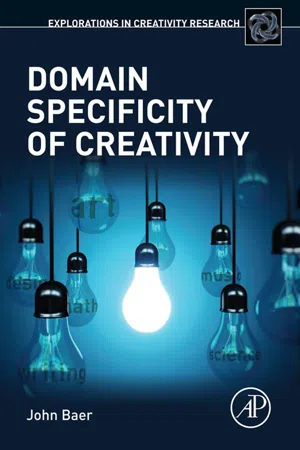
Domain Specificity of Creativity
About this book
Recent research findings have challenged the idea that creativity is domain-general. Domain Specificity of Creativity brings together the research information on domain specificity in creativity -- both the research that supports it and answers to research arguments that might seem to challenge it. The implications for domain specificity affect how we move forward with theories of creativity, testing for creativity, and teaching for creativity. The book outlines what these changes are and how creativity research and applications of that research will change in light of these new findings.
- Summarizes research regarding domain specificity in creativity
- Outlines implications of these findings for creativity theory, testing, and teaching
- Identifies unanswered questions and new research opportunities
Information
Topic
PsicologiaChapter 1
Domain Specificity: Introduction and Overview
Abstract
This chapter outlines the issue of the domain specificity/domain generality of creativity, comparing it to similar controversies in intelligence. It argues that although people generally think of creativity in a domain-general way, our intuitions, when guided by the right questions, actually suggest a much more domain-specific view. The goal of this chapter is not to convince the reader that domain specificity is the correct theory but simply to introduce the controversy, break down some seemingly commonsensical (but incorrect) biases in the ways we tend to think about creativity, and introduce the kinds of tools needed in creativity research to make reasonable judgments about domain specificity and generality.
Keywords
domain specificity
creativity
fluency
originality
flexibility
elaboration
Summary: This chapter outlines the issue of the domain specificity/domain generality of creativity, comparing it to similar controversies in intelligence. It argues that although people generally think of creativity in a domain-general way, our intuitions, when guided by the right questions, actually suggest a much more domain-specific view. The goal of this chapter is not to convince the reader that domain specificity is the correct theory but simply to introduce the controversy, break down some seemingly commonsensical (but incorrect) biases in the ways we tend to think about creativity, and introduce the kinds of tools needed in creativity research to make reasonable judgments about domain specificity and generality.
Can one use the same set skills, the same aptitudes, and the same abilities to do creative things in very different domains? Can one apply one’s creativity in writing poetry, playing the piano, or glazing pottery to cooking, chemistry, or chess in ways that will result in more interesting and delicious recipes, more original theories and experimental designs, or more innovative ways to checkmate one’s opponents? Is there a way of thinking or approaching problems that will lead to creative outcomes no matter the field in which one chooses to apply them? Is there a personality type that results in creativity in the arts, sciences, human relations, or anywhere else that creativity matters? These are the questions this book attempts to answer. Then, having answered those questions as far as current research can take us (which is rather far – the answers are surprisingly clear), later chapters explain what those answers mean for creativity research, creativity theory, creativity testing, and creativity training. The things one needs to know to be a competent poet, musician, florist, chef, chemist, or chess master are, of course, very different. No one would suggest that knowing what a haiku is will be of much use when cooking, designing chemistry experiments, or playing chess. But given reasonable levels of domain-specific knowledge in several domains, is there some broadly applicable way of conceptualizing or approaching problems, some general tendency to think in unusual or offbeat ways, some individual personality trait or quirk, or some comprehensive kind of thinking skill or thinking style that will generally lead to more creative outcomes no matter which of those domains one happens to be working in?
If one were asking similar questions about intelligence, the likely answer would be yes. Although there are some notable and even famous dissenters (such as Gardner, 1983), the consensus among those who study intelligence is that it is a domain-general set of abilities that are associated with performance across a very wide range of domains (Neisser et al., 1996). If someone shows intelligence in one area, it is likely that person will exhibit intelligence in the many other areas in which intelligence is thought to matter. As a result, people with more intelligence are likely to be better at chemistry, cooking, chess, writing poetry, composing music, and flower arranging than people with less intelligence (other things – such as domain-specific knowledge – being equal). Intelligence is fungible, like money: it can be used profitably in many very different kinds of endeavors. That doesn’t mean that intelligence (or g, as psychometricians often call it) can be used, or that it will be useful, everywhere — just as money can be useful in many different, but not all, situations. (As the Beatles and others observers have warned us, money can’t buy one love, among other things.)
A domain-general theory of intelligence therefore has limits; it argues that the skills that make up g can be widely useful in many diverse and seemingly unrelated contexts, but not all contexts. But even with this limitation, a domain-general view of intelligence is very broad and far-reaching, claiming almost (but not quite) universal applicability. In doing so it does not, however, insist that the skills that make up g are the only kinds of cognitive abilities that matter or deny the importance of many domain-specific cognitive abilities that operate primarily in a single domain. The sole claim of g is that there are many very significant domain-general cognitive abilities, not that g matters in every domain or that it is the only thing that matters in any domain (other than the “domain” of taking IQ tests).
Expertise, in contrast, works in an entirely different way. No one assumes that someone who is an expert in modern art will also know a great deal about Heian literature, auto mechanics, or dentistry. Expertise is domain-specific, and to my knowledge no one has ever seriously made a case for expertise being domain-general other than noting, perhaps, that people with higher intelligence are more likely to have multiple areas of expertise because they can acquire knowledge in most domains more easily. If one factors out intelligence and opportunity to learn, no domain generality is likely to be left when it comes to expertise. (I know of no studies that have attempted to test this claim directly, which is perhaps evidence just how obvious it seems to most psychologists.)
For many years psychologists assumed that creativity was, like intelligence, domain-general. If someone was creative in one area, then that person was more likely than chance to be creative in many other areas; all that would be needed was the acquisition of the necessary skills and knowledge in the new domains. Creative thinking skills could, like the cognitive skills that we call intelligence, be deployed in any field or endeavor. And understanding creativity did not require domain-by-domain investigations because if one understood creativity in one domain, the same general understanding would apply equally in other domains.
Under a domain-general conception of creativity, neither creativity testing nor creativity training needs to be concerned with domains. Consider the task facing those who wished to measure creativity — domain-general creativity, that is, which was the only kind of creativity in which most creativity test designers were interested. Domain-general creativity was, by definition, independent of domains, and so the wisest thing for creativity testers to do would be to make every possible effort to avoid any potentially contaminating effects of differences in domain-relevant skills or knowledge. For this reason, creativity test items have typically been designed to require as little domain knowledge as possible (such as listing possible uses for some common object with which every test taker would be expected to be familiar), because creative-thinking skills were believed to be universal and to exist independent of any specific content on which those skills might be applied.
Similarly, if creativity could be in some way increased through creativity training, it would be increased across the board (under a domain-general understanding of creativity), so the specific content of any creativity-training exercises designed to increase domain-general creativity was inconsequential. Whatever any increase in domain-general creative-thinking skills might produce in one domain it would also produce in most other domains, and brainstorming uses for a brick to increase one’s divergent-thinking skill (theorized to be a key creativity-relevant thinking skill) would therefore lead to more creativity when writing poems, solving puzzles, choreographing dances, designing experiments, or developing theories.1
All of these beliefs about the nature of creativity (and about how to test and train it) were grounded in the untested and generally unstated assumption that creativity is a domain-general entity that attaches to domains rather than something that forms part of the essential fabric of each separate domain (and cannot therefore be detached from its respective domain and applied wherever one might wish), as domain specificity theorists claim.
In the past quarter century the idea that creativity is domain general has been seriously challenged. To give a sense of the significance of this issue in the world of creativity research and theory, the Creativity Research Journal has published just one invited debate (in the form of a pair of Point-Counterpoint articles) in its history. The two articles that constituted that debate (Baer, 1998b; Plucker, 1998) addressed this crucial domain specificity/generality question, a hugely significant one for creativity research and theory. Even the author of the paper arguing for domain generality acknowledged that the tide had turned in favor of a domain-specific view:
Recent observers of the theoretical (Csikszentmihalyi, 1988) and empirical (Gardner, 1993; Runco, 1989; Sternberg & Lubart, 1995) creativity literature could reasonably assume that the debate is settled in favor of content specificity. In fact, Baer (1994a, 1994b, 1994c) provided convincing evidence that creativity is not only content specific but is also task specific within content areas. (Plucker, 1998, p. 179)
This change represented a nearly 180° turn from just a decade earlier (when domain generality was simply assumed, often implicitly), and as will be shown in Chapter 2, the evidence favoring a more domain-specific view has continued to accumulate.
The domain specificity/generality debate was also at the heart of the first debate ever sponsored by the American Psychological Association’s Division 10 (Psychology of Aesthetics, Creativity, and the Arts). The topic of that APA debate was the validity of divergent-thinking tests like the Torrance Tests of Creative Thinking, which are generally assumed to be domain-general assessments (even though Torrance himself found that his two versions of the test, verbal and figural, measured essentially orthogonal variables that were uncorrelated with each other; Cramond, Matthews-Morgan, Bandalos, & Zuo, 2005). Although the APA debate was nominally about the validity of the Torrance Tests, the underlying issue and the central question that animated the debate was the question of domain specificity (Baer, 2009; Kim, 2009; see also Baer, 2011b, 2011c; and Kim, 2011a, 2011b for a follow-up written version of the same debate that was solicited by the APA journal Psychology of Aesthetics, Creativity, and the Arts).
Domain specificity/generality is no longer an issue just for creativity specialists. It is the focus of one of the six chapters of Creativity 101 (Kaufman, 2009), a textbook that is widely used in undergraduate Introduction to Creativity courses, and it will be a featured topic in a forthcoming Oxford University Press Handbook of Educational Psychology (O’Donnell, in press), a volume addressed to the field of educational psychology more broadly. Sawyer’s Explaining Creativity is probably the most comprehensive creativity textbook on the market, and in the preface to the second edition of this text (2012) he noted that the issue of domain specificity had become one of the most controversial topics in the field. After discussing the issue in several chapters and weighing the various research findings, Sawyer concluded that “[t]he consensus among creativity researchers is that although there are domain-general creative strategies, creativity is primarily domain-specific” (p. 395). These examples are evidence of how broadly significant the issue of domain specificity has become for creativity theory, even among nonspecialists.
What difference does it make whether creativity is domain-general or domain-specific? How would this distinction play out in how people outside the field think about and understand what it means to be creative? What might be the educational implications? To answer these questions (which this chapter will preview and which will be developed more fully in later chapters), it is helpful first to address the intuitive understandings most people have about how creativity works. So think for a moment about your own creativity. How creative are you? If you were to give yourself a “creativity score” on a scale of 1–100, where would you place yourself?
The answer for most people is something on the order of, “Well, it depends.” There are many things on which it might depend, such as the time of day, one’s motivation, how much ethanol or other drugs one might have ingested, and the social and physical environment. But the big “it depends” issue is what one is asked to be creative in. Are you equally creative in everything you do, whether writing poetry, solving math equations, woodworking, dancing, solving interpersonal problems, designing science experiments, composing music, developing sports strategies, sculpting, gardening, teaching children how to do something, solving puzzles like the Rubik’s cube, or arranging complex schedules? Of course, one needs training to do many of those things, but is that the only thing that causes you to be less creative in some areas than others? Are there areas in which you have had some experience and yet find yourself far less creative than you are in other areas? Is one reason that you are more creative in some areas than others that it just seems easier for you to be creative in those areas?
It is not my goal to convince you that creativity is domain-specific based on your intuitions. How you and others might answer these questions is not the kind of evidence that counts in psychology: intuition...
Table of contents
- Cover
- Title page
- Table of Contents
- Copyright
- Foreword
- Chapter 1: Domain Specificity: Introduction and Overview
- Chapter 2: Research Evidence for Domain Specificity
- Chapter 3: Implications of Domain Specificity for Creativity Theory
- Chapter 4: Implications of Domain Specificity for Creativity Research
- Chapter 5: Implications of Domain Specificity for Creativity Assessment
- Chapter 6: Implications of Domain Specificity for Creativity Training
- Chapter 7: Finding Common Ground: The APT Model of Creativity and Metatheoretical Approaches to Understanding Creativity
- References
- Subject Index
Trusted by 375,005 students
Access to over 1.5 million titles for a fair monthly price.
Study more efficiently using our study tools.
Frequently asked questions
Yes, you can cancel anytime from the Subscription tab in your account settings on the Perlego website. Your subscription will stay active until the end of your current billing period. Learn how to cancel your subscription
No, books cannot be downloaded as external files, such as PDFs, for use outside of Perlego. However, you can download books within the Perlego app for offline reading on mobile or tablet. Learn how to download books offline
Perlego offers two plans: Essential and Complete
- Essential is ideal for learners and professionals who enjoy exploring a wide range of subjects. Access the Essential Library with 800,000+ trusted titles and best-sellers across business, personal growth, and the humanities. Includes unlimited reading time and Standard Read Aloud voice.
- Complete: Perfect for advanced learners and researchers needing full, unrestricted access. Unlock 1.5M+ books across hundreds of subjects, including academic and specialized titles. The Complete Plan also includes advanced features like Premium Read Aloud and Research Assistant.
We are an online textbook subscription service, where you can get access to an entire online library for less than the price of a single book per month. With over 1.5 million books across 990+ topics, we’ve got you covered! Learn about our mission
Look out for the read-aloud symbol on your next book to see if you can listen to it. The read-aloud tool reads text aloud for you, highlighting the text as it is being read. You can pause it, speed it up and slow it down. Learn more about Read Aloud
Yes! You can use the Perlego app on both iOS and Android devices to read anytime, anywhere — even offline. Perfect for commutes or when you’re on the go.
Please note we cannot support devices running on iOS 13 and Android 7 or earlier. Learn more about using the app
Please note we cannot support devices running on iOS 13 and Android 7 or earlier. Learn more about using the app
Yes, you can access Domain Specificity of Creativity by John Baer in PDF and/or ePUB format, as well as other popular books in Psicologia & Psicologia cognitiva e cognizione. We have over 1.5 million books available in our catalogue for you to explore.